150psi
Working Pressure
100k+
Fatigue Cycles
48°C
Max Temp
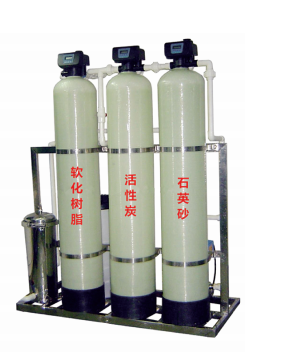
Water Softening Equipment
Working Principle
The primary working principle of water softening equipment is to utilize cation exchange softening. Raw water passes through a cation exchanger, which removes ions such as calcium, magnesium, and sodium from the water. The output water then consists essentially of water molecules, with no other ions, effectively preventing scale formation.
Purpose
When the feed water is from deep wells or has high hardness, the function of the water softening equipment is to reduce the calcium and magnesium ion content in the water. If a softener is absent or fails, calcium and magnesium salts can precipitate on the surface of the reverse osmosis (RO) membrane due to a sharp increase in concentration. This forms deposits that are difficult to dissolve in water, clogging the RO membrane pores, shortening the membrane’s service life, and increasing equipment maintenance costs.
Working Cycle
The operation of a softener typically consists of a cyclic sequence of several steps: backwash, brine draw (regeneration), slow rinse (displacement), and fast rinse. The processes for different water softening equipment are very similar, although some additional steps may be included based on actual process requirements or control needs. Any water softening equipment based on sodium ion exchange is developed from these five fundamental steps.
Automatic Softener Operation Sequence:
A. Service (In Operation)
Raw water, under a certain pressure (0.2-0.6 MPa) and flow rate, passes through the control valve chamber and enters the vessel (resin tank) containing ion-exchange resin. The Na⁺ contained in the resin exchanges with cations in the water (Ca²⁺, Mg²⁺, Fe²⁺…), reducing the Ca²⁺ and Mg²⁺ ion content in the effluent to meet specified requirements, thereby achieving water softening.
B. Backwash
After the resin is exhausted, backwashing is performed with water from the bottom up before regeneration. Backwashing serves two purposes: 1) loosening the resin bed compacted during operation, facilitating full contact between resin particles and the regenerant; 2) expelling suspended solids and broken resin accumulated on the resin surface with the backwash water, preventing the exchanger’s flow resistance from increasing excessively.
C. Brine Draw (Regeneration)
The regenerant brine solution, at a specific concentration and flow rate, flows through the exhausted resin bed, restoring its original exchange capacity.
D. Slow Rinse (Displacement)
After the regenerant is introduced, some unused brine remains in the exchanger. A slow rinse is performed with clean water at a flow rate less than or equal to the regenerant flow rate. This maximizes the utilization of the regenerant’s effectiveness and reduces the load on the fast rinse.
E. Fast Rinse
The purpose is to remove residual spent regenerant from the resin bed. Rinsing is typically performed at the normal service flow rate until the effluent quality meets standards.
F. Brine Tank Refill
Water is added to the brine tank to dissolve the amount of salt required for one regeneration cycle.
Send us your project requirements and our technical team will respond with detailed specifications, pricing, and lead times within 24 hours.