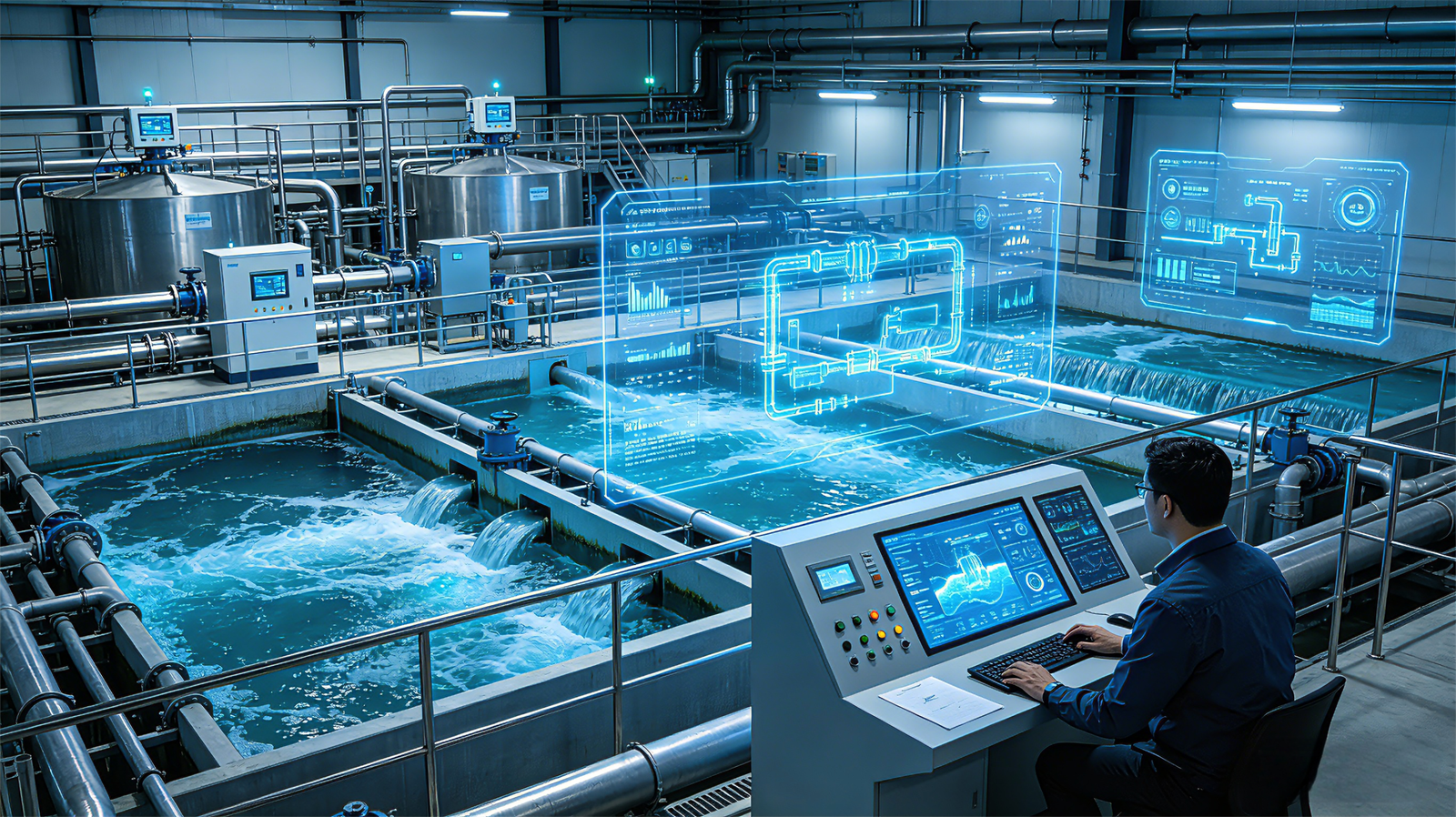
You may not know that every day, under the city where you live, hundreds of thousands of tons of sewage are undergoing an “intelligent rebirth”. In the past, sewage treatment plants relied on the experience of skilled workers, but now, a smart “AI brain” is taking over this complex task, making the treatment process more efficient, cost-effective and environmentally friendly.
Predict the future and prescribe the right medicine accurately.
Imagine if doctors could prepare your medicine a day before you fall ill. That would be great. AI does exactly this in sewage treatment.
By analyzing historical data and conducting real-time monitoring, AI can “sense” the subtle changes in sewage. For instance, it can learn that on Monday mornings, more laundry water is discharged from residential areas, causing changes in pollutants; and on rainy days, rainwater from factories mixes in, altering the water quality. Thus, before the changes occur, the system automatically adjusts the treatment plan.
In the pilot project in Beijing, this prediction system has reduced the use of chemical agents by nearly 20%, saving millions of yuan in costs each year. It is no longer a passive response but acts like an experienced “old traditional Chinese doctor”, taking the pulse in advance and prescribing accurately.
Be a “full-time doctor” to prevent problems before they occur.
Sudden equipment failure leading to excessive water discharge is a nightmare for treatment plants. In the past, this could only be remedied after the fact.
Nowadays, AI systems act like “physical exam doctors” on duty 24/7. Hundreds and thousands of sensors serve as its ears and eyes, constantly monitoring whether the equipment emits abnormal noises and checking if the instrument data shows any “unusual expressions”. It can detect early signs of equipment being in a “sub-health” state from seemingly normal data.
At a smart water plant in East China, the AI system once warned of a potential failure at a key pumping station three days in advance, preventing a complete plant shutdown and hefty fines. The system can even “diagnose” the type of failure, such as whether it is bearing wear or seal failure, and provide a list of maintenance suggestions, enabling ordinary workers to carry out professional repairs.
Be meticulous in calculation and squeeze benefits from energy consumption.
Treating sewage is a major electricity consumer, with electricity costs accounting for up to half of the total expenses. Among these, the process of aerating the water tanks (to allow microorganisms to “breathe”) is the most power-hungry.
AI is like a shrewd “energy-saving manager”. It analyzes the “breathing needs” (dissolved oxygen concentration) of microorganisms in the water in real time and dynamically adjusts the intensity of the blower to avoid the waste of “too much air”. In a famous water plant in Sweden, this system has reduced the plant’s energy consumption by 25% directly.
In China, after a factory with a daily processing capacity of 100,000 tons applied similar technology, it saved several million yuan in electricity fees annually and reduced carbon emissions equivalent to planting tens of thousands of trees.
From “individual combat” to “army group deployment”
The wisdom of the future is not limited to a single water plant. In some cutting-edge cities, AI is now orchestrating the entire “water network” of the city.
The system can grasp the drainage patterns of the entire city: during the morning rush hour, the sewage volume in residential areas is large; in the evening, the grease concentration in the restaurant street increases. Through intelligent analysis, it can direct the sewage to “intelligently flow” in the pipeline network, allowing the less burdened water treatment plants to handle more sewage and reducing the load on the plants in advance for the peak hours.
During the rainy season, the system can also predict the pressure that rainwater exerts on the pipe network, and coordinate in advance for each treatment plant to adjust its processes, maximizing the treatment capacity and reducing the risk of sewage overflow into rivers, thus protecting the urban water environment.
Challenges and the Future: Let Wisdom Reach Every Corner
Of course, the transformation is not achieved overnight. Many old plants have outdated equipment, making it difficult to collect high-quality data; there is a shortage of compound talents who are proficient in both water affairs and AI; meanwhile, managers also need to trust and learn to make decisions in collaboration with AI systems.
However, the trend is irreversible. As sensor costs decline and technology becomes more widespread, smart water management is moving from pilot projects to full-scale implementation. Future treatment plants will be more autonomous, quiet and efficient. They may be located right beside communities, like a green park, yet intelligently safeguarding the lifeblood of the city.
Conclusion
Ultimately, what AI brings to wastewater treatment plants is not just cold automation, but a profound “understanding”. It comprehends the joys and sorrows of microorganisms, the ever-changing nature of water flow, and the pulse of urban metabolism. By transforming human experience into inheritable, optimizable, and scalable algorithmic wisdom, we are not only purifying water but also reshaping a new way of living in harmony with nature – using fewer resources to create a cleaner cycle. This might be the warmest gift that technology offers to ecological civilization.