
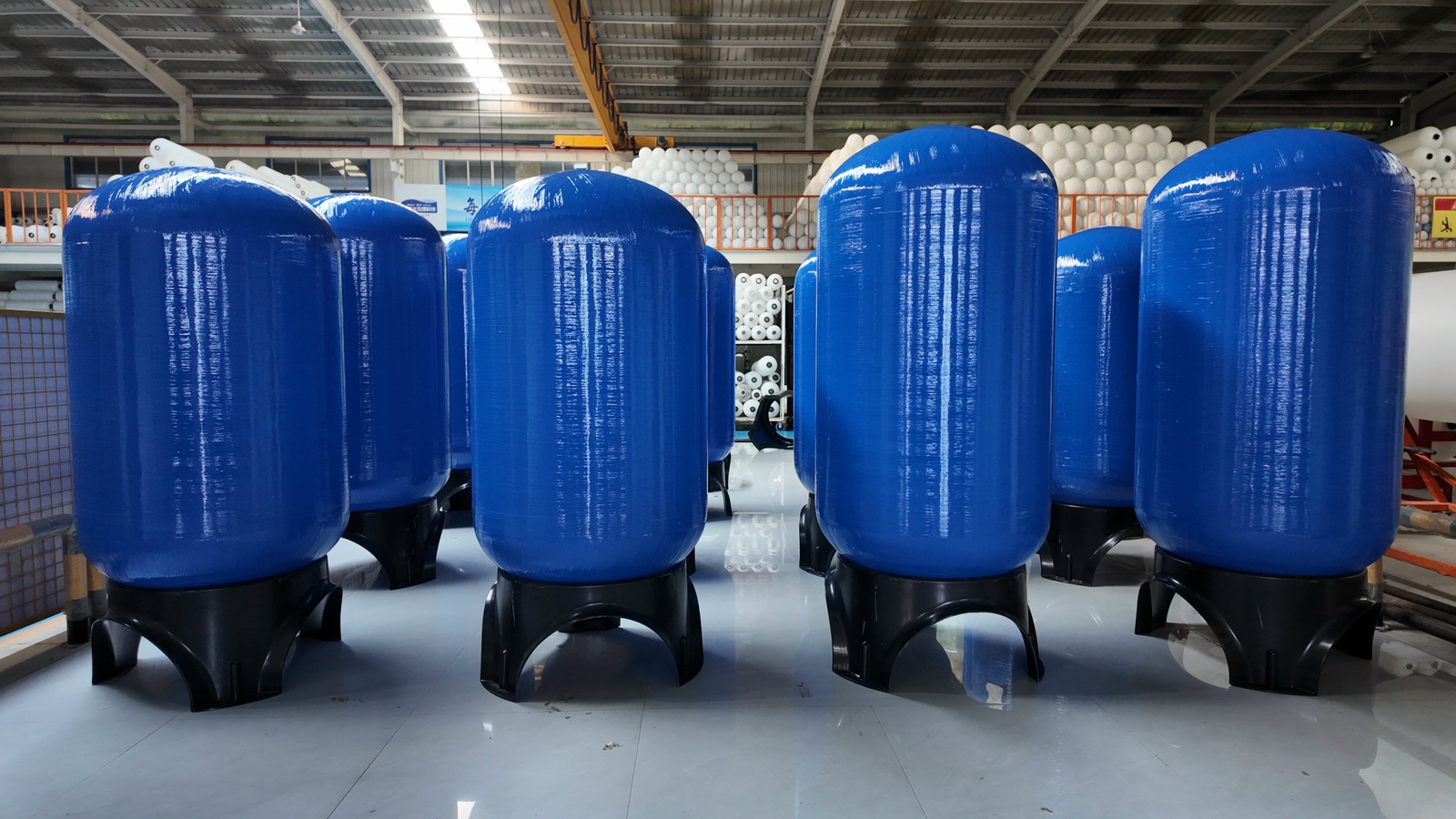
In the design of multi-media filters, the selection and combination of filter materials are the key factors determining their performance. By scientifically stratifying filter materials of different densities and particle sizes, a step-by-step interception from coarse filtration to fine filtration can be achieved, thereby significantly enhancing the pollutant-capturing capacity and filtration accuracy. Based on the filter material combination, they can be roughly classified into the following three mainstream configurations.
Standard double-layer configuration: Classic and efficient, widely applicable
Core combination: Anthracite + Quartz sand
This is the most widely used and technologically mature classic combination. The upper layer uses lightweight and coarse anthracite, which can effectively retain most suspended solids and larger particles; the lower layer is composed of denser and finer quartz sand, responsible for deep-level fine filtration to ensure that the effluent turbidity meets the standards. The advantage of this combination lies in its stable operation, economic cost, and convenient backwashing. It is a reliable choice for addressing routine turbidity removal and ordinary pre-treatment requirements.
High-precision three-layer configuration: Deep purification, protection of precision systems
Core composition: Anthracite + Quartz sand + Magnetite (or tourmaline, etc.)
Based on the double-layer structure, additional highly dense and finer magnetic iron ore and other filter materials are added to the bottom layer to form a three-level gradient filter bed of “coarse – medium – fine”. This structure further improves the filtration accuracy and pollutant interception capacity, and the effluent quality (such as the sludge density index SDI value) is better, which can effectively protect the subsequent precision membrane systems (such as reverse osmosis and ultrafiltration). Its characteristics are a longer filtration cycle and more stable effluent quality, and it is particularly suitable for the pre-protection of deep desalination or ultra-pure water preparation systems with strict requirements for influent water quality.
Integrated functional configuration: One machine for multiple purposes, suitable for specific water quality conditions.
Core combination: Integrating activated carbon, manganese sand, etc. on the basis of the filter layer
This type of configuration not only achieves physical filtration but also integrates specific chemical or biochemical treatment functions. For example:
• “Anthracite + Quartz Sand + Activated Carbon” combination: The activated carbon layer can effectively adsorb organic substances, residual chlorine, and off-flavors and odors in water, achieving a combined effect of filtration and adsorption.
• Use natural manganese sand or coated manganese sand: Through catalytic oxidation, it is specifically designed to remove iron and manganese ions from groundwater.
This type integrates the “filtration – purification” process, and is particularly suitable for scenarios where the raw water contains specific pollutants (such as organic micro-pollution, excessive iron and manganese). It can simplify the process flow, reduce investment and save space.
Conclusion
The efficiency of a multi-media filter is essentially a scientific manifestation of its filter material combination. The standard double-layer scheme is an economical and reliable general choice; the high-precision three-layer scheme provides a key barrier for high-end membrane systems; and the function-integrated scheme achieves efficient collaborative treatment for specific pollutants. In practical applications, based on the original water quality, treatment goals, and subsequent process requirements, scientifically selecting the filter material combination is the key to maximizing its efficiency and achieving optimal economic operation.