
What are the types of water treatment systems?
I see buyers lose time when they ask for a system type first. The wrong label creates wrong design, weak performance, and extra cost.
I group water treatment systems by application scale and treatment task. Common types include filtration, softening, RO, UF/NF, EDI, media filtration, and packaged plants. I choose the final type by raw water quality, outlet standard, flow rate, operating time, site limits, and maintenance ability.
I do not see “water treatment system type” as a simple product name. In my daily OEM/ODM discussions, I first look at the project. I ask what water comes in, what water must go out, and how the system will run. A commercial drinking water project, an industrial boiler feed water project, and a rural community water supply project may all use filters, membranes, pumps, tanks, and controls. They still need different system structures. If I only say “RO system,” I hide many important decisions. If you want to compare suppliers with less risk, I suggest that you read the system type from the task first, not from the product label.
Why do I start with application scale when I classify water treatment systems?
I often see one mistake at the first step. A buyer copies a household idea into an industrial project, and the result becomes unstable.
I classify water treatment systems first as commercial, industrial, municipal or community, and household. I use household systems only as context. For project procurement, I focus on scale, water standard, running hours, service access, and operating risk.
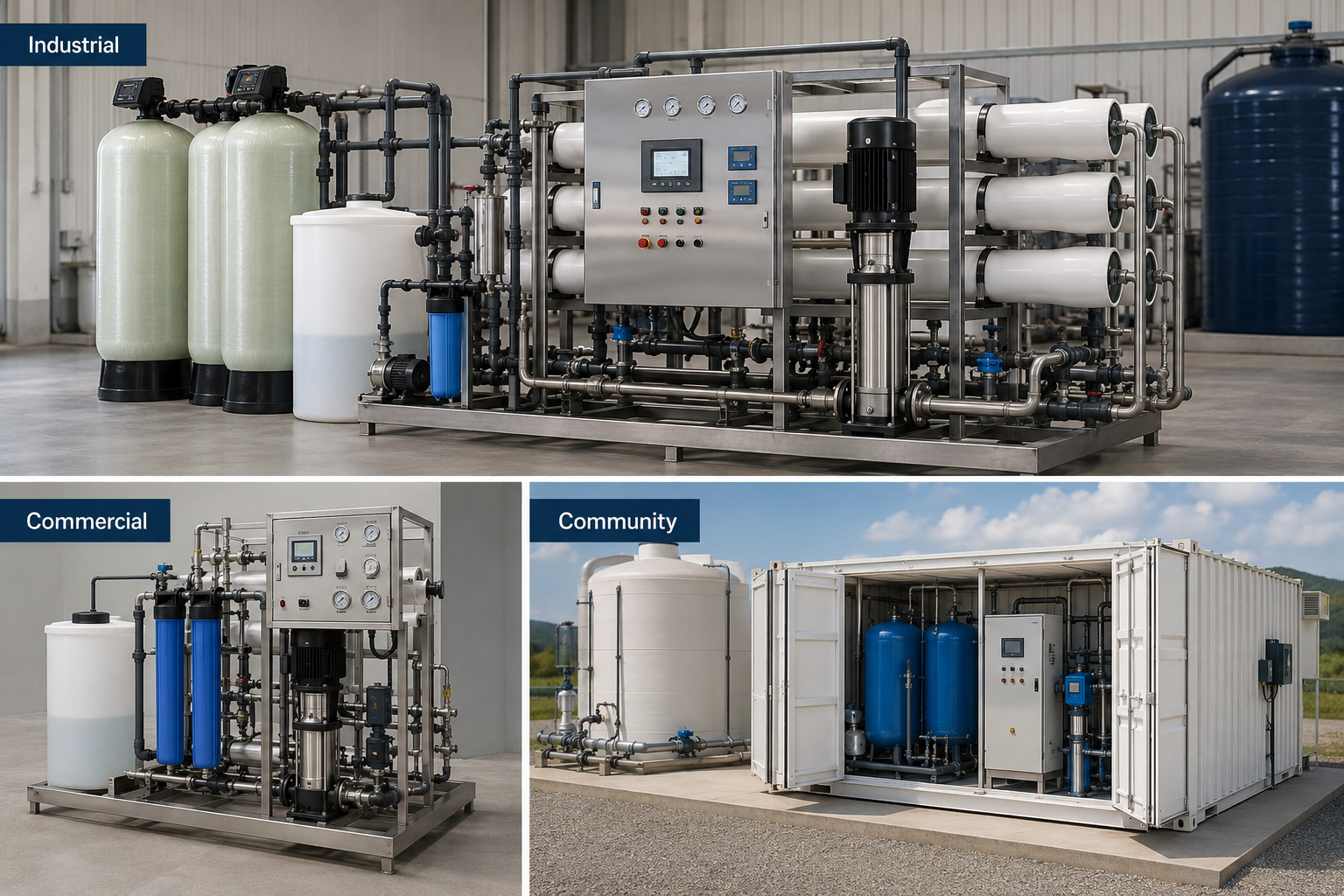
I start with application scale because scale changes almost every design choice. A small commercial system may serve a hotel, office building, school, or restaurant1. It may need safe drinking water, stable taste, and simple service. An industrial system may serve boiler feed water, process water, food production, electronics cleaning, or pharmaceutical support2. It may need much tighter control of hardness, salts, bacteria, or conductivity. A municipal or community system may serve many users. It may need strong reliability, easier operation, and clear spare parts planning3.
I also mention household systems because many people know them. But I do not use household thinking for project equipment. A household unit usually has low flow and simple service conditions. A project system needs planned flow, duty cycle, controls, pretreatment, cleaning space, and spare part supply.
| Scale I check | Typical use I see | Main design focus | Main procurement risk |
|---|---|---|---|
| Commercial | Hotel, school, office, restaurant | Stable flow, taste, simple maintenance | Undersized system or weak pretreatment |
| Industrial | Boiler, process, food, electronics | Target quality, continuous operation, process fit | Wrong membrane, wrong control, high downtime |
| Municipal or community | Rural supply, town plant, emergency supply | Reliability, operator skill, local water change | Hard maintenance and slow spare parts |
| Household | Home drinking water | Low flow and simple use | Not suitable as a project reference |
When I talk with procurement managers, I usually ask them not to send only a product name. I ask them to send the use case. I can then judge whether the system should be a compact skid, a larger integrated line, or a containerized plant. This step avoids many wrong quotations.
How do I classify systems by treatment task instead of product name?
I see confusion when buyers treat RO, UF, softeners, and filters as separate answers. Real systems usually combine them to solve one water task.
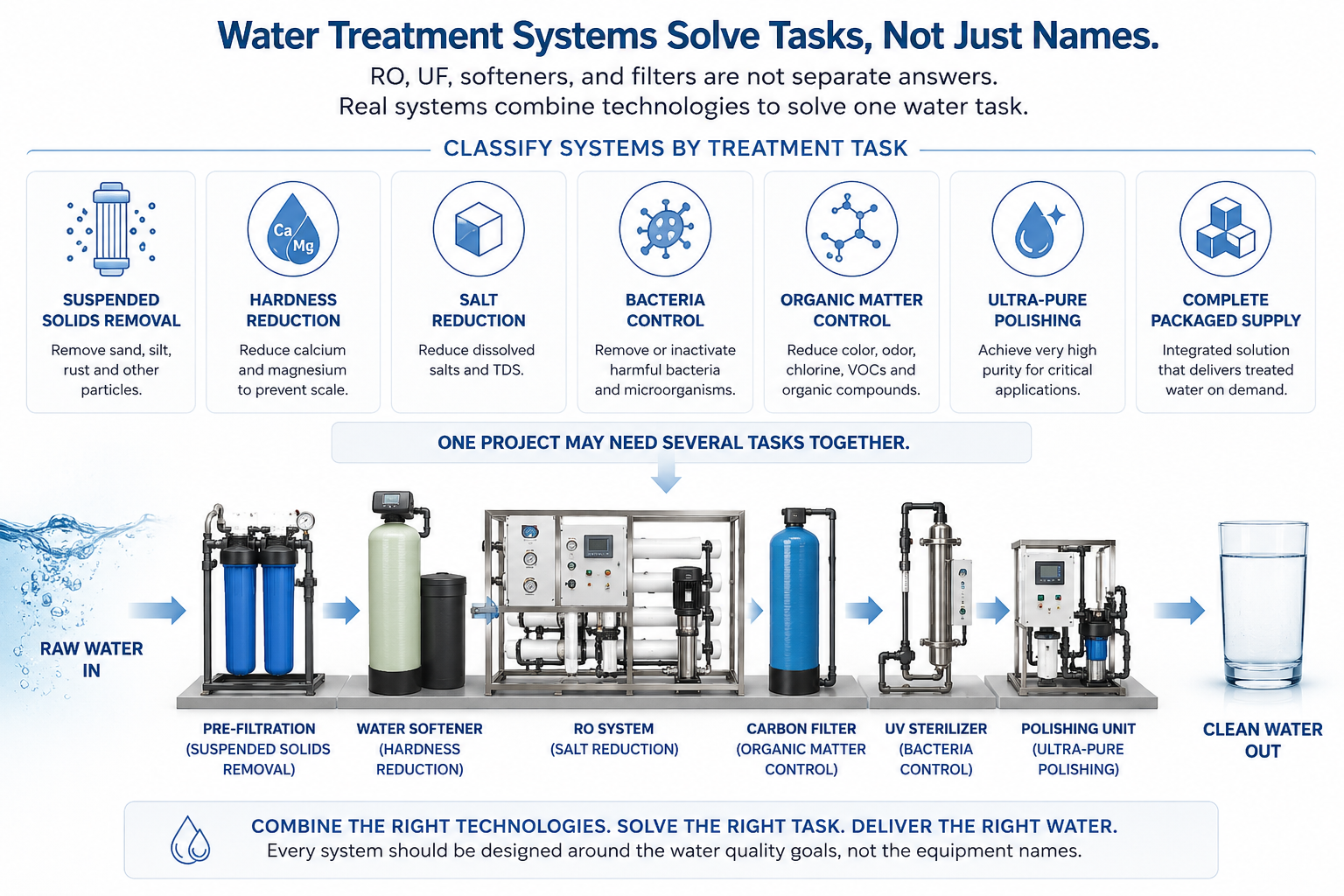
I classify system types by treatment task. These tasks include suspended solids removal, hardness reduction, salt reduction, bacteria control, organic matter control, ultra-pure polishing, and complete packaged supply. One project may need several tasks together.
I prefer task-based classification because water problems do not follow catalog names. Raw water may contain sand, rust, hardness, iron, manganese, organic matter, bacteria, or dissolved salts. One technology rarely handles all problems well. A media filter may remove suspended solids. A softener may reduce hardness. UF may act as a membrane barrier for fine particles and some microbes4. RO may reduce dissolved salts5. NF may sit between UF and RO in some separation needs6. EDI may polish RO permeate when very high purity is needed7. Activated carbon may help with odor, color, chlorine, or organic load8, based on the project need.
I do not tell a customer that one technology is always best. I ask what problem must be solved first. I then build a system chain. A simple system may include only filtration and disinfection. A demanding industrial system may include pretreatment, softening, RO, polishing, and controls.
| Task I identify | Common system part I may use | What I check before selection |
|---|---|---|
| Remove sand and suspended solids | Media filter, cartridge filter, UF | Particle load, turbidity trend, cleaning plan |
| Reduce hardness and scale risk | Softener, antiscalant dosing, pH control | Hardness, alkalinity, temperature, recovery plan |
| Reduce dissolved salts | RO, sometimes NF | TDS, target water use, reject handling |
| Improve fine particle barrier | UF | Feed water variation, backwash plan |
| Produce ultra-pure water | RO plus EDI and polishing | Required resistivity or process standard |
| Build a complete project plant | Skid, modular plant, containerized plant | Site area, power, operator skill, delivery plan |
This is why I ask buyers to avoid a one-word inquiry. “I need RO” is not enough. “I need process water for a boiler, from well water, with this flow, this running time, and this outlet requirement” is a useful inquiry.
What diagnostic questions do I ask before I suggest a system type?
I have seen project teams compare prices too early. They save one week on inquiry, then lose months with wrong data.
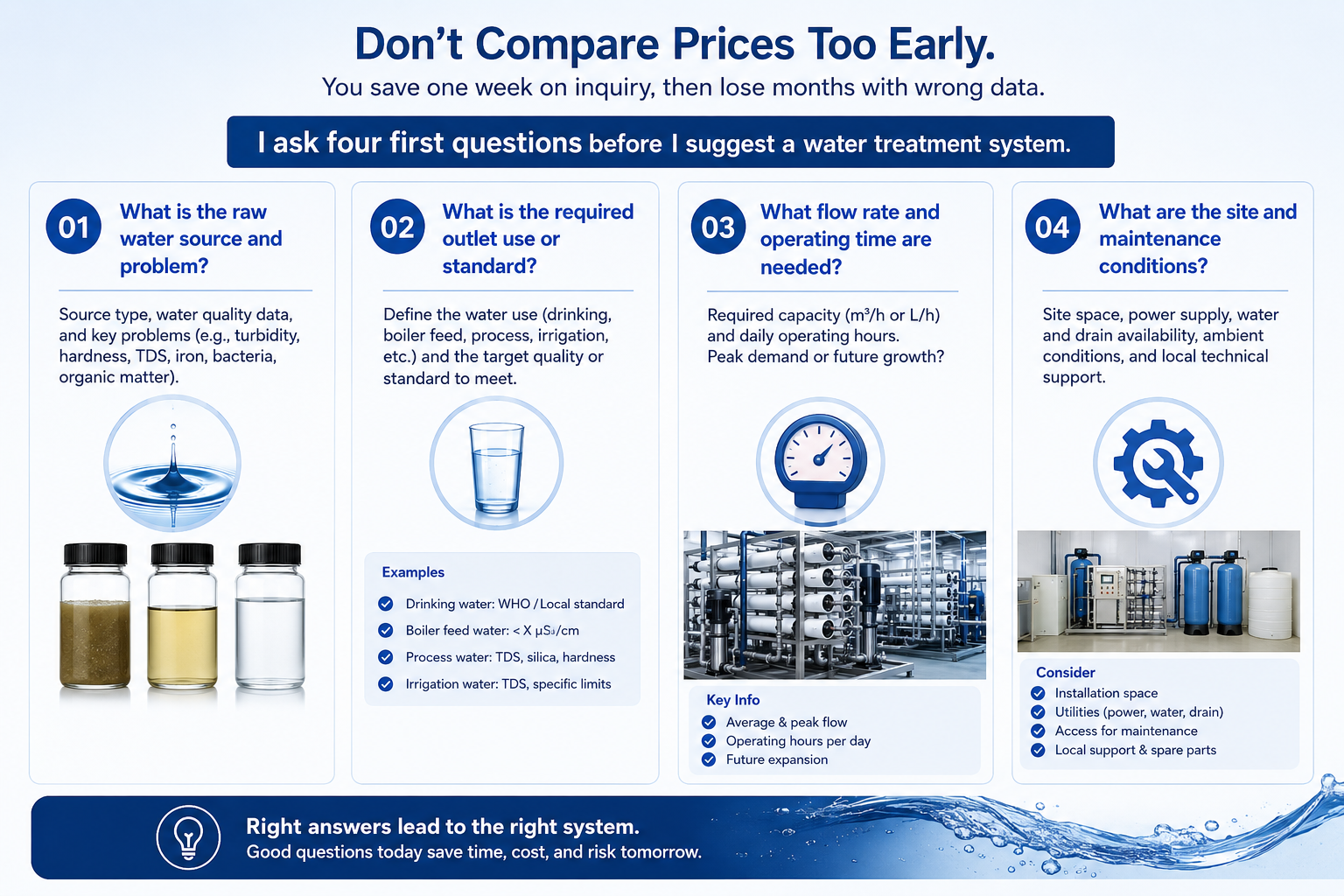
I ask four first questions before I suggest a water treatment system. I ask about the raw water source and problem, the required outlet use or standard, the needed flow and operating time, and the site and maintenance conditions.
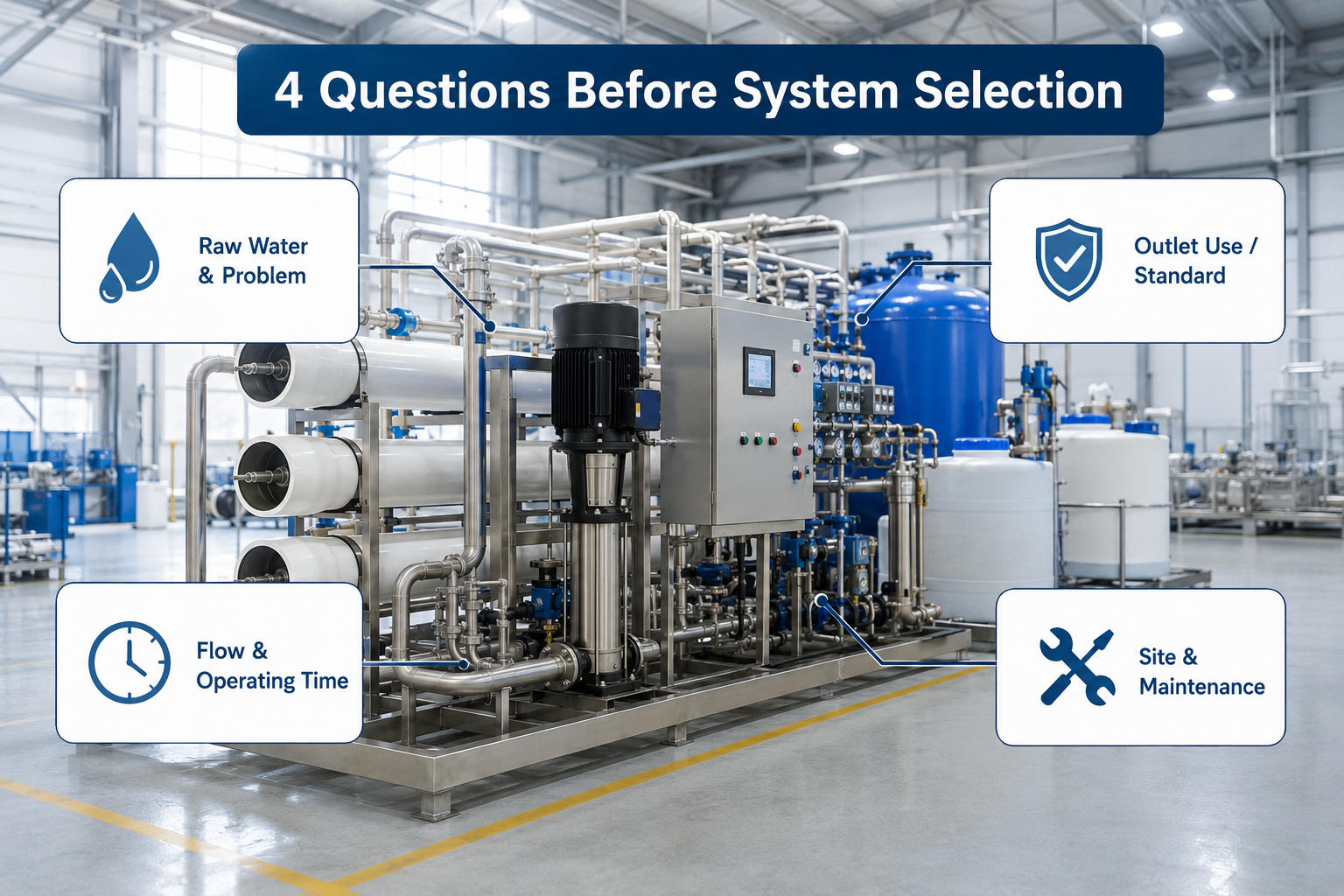
In supplier selection discussions, I usually slow the buyer down at the beginning. I know the buyer may want a fast quotation. I also know a fast but vague quotation can create risk. Raw water is the first point. River water, well water, tap water, seawater, industrial wastewater, and recycled water all bring different design issues. The second point is the target use. Drinking water, boiler feed water, bottled water, cooling makeup water, food processing water, and electronics rinse water are not the same.
The third point is flow. I ask for hourly flow, daily water volume, peak demand, and running hours. A system that runs a few hours per day is different from a system that runs continuously. The fourth point is the site. I ask about space, power, feed pressure, drainage, chemical storage, operator skill, and local service access. If a site cannot support complex maintenance, I should not design a system that needs frequent expert handling.
| Question I ask | Why I ask it | What can go wrong if I skip it |
|---|---|---|
| What is the raw water source? | I need to understand the inlet problem | Pretreatment may fail or membrane may foul fast |
| What is the outlet water use? | I need to match the target quality | The system may be too weak or too expensive |
| What flow and running time are needed? | I need to size pumps, vessels, and tanks | The system may not meet peak demand |
| What are the site limits? | I need to fit operation and service reality | Maintenance may become too hard |
| What standards must be met? | I need to match compliance needs | Documentation and acceptance may fail |
I have learned that these questions are not paperwork. They are risk control. When a buyer gives clear parameters, I can build a more reliable configuration and a more honest quotation.
How do common water treatment system combinations look in real projects?
I often receive a request for one machine. After we discuss the water source, the final solution becomes a treatment line.
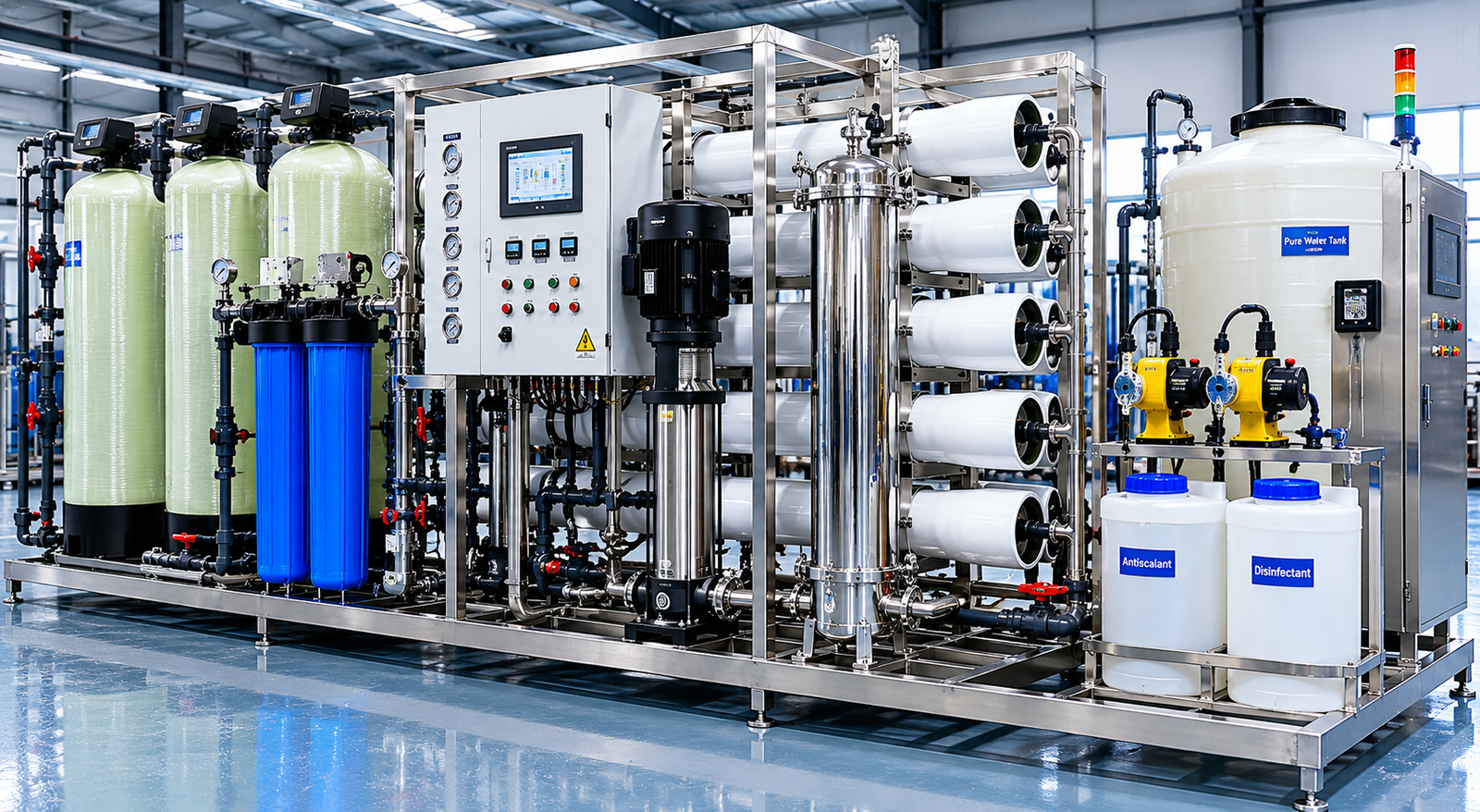
I often combine filtration, softening, UF, RO, NF, EDI, dosing, disinfection, tanks, and controls. The final system type depends on the project task, not only on the main membrane or filter name.
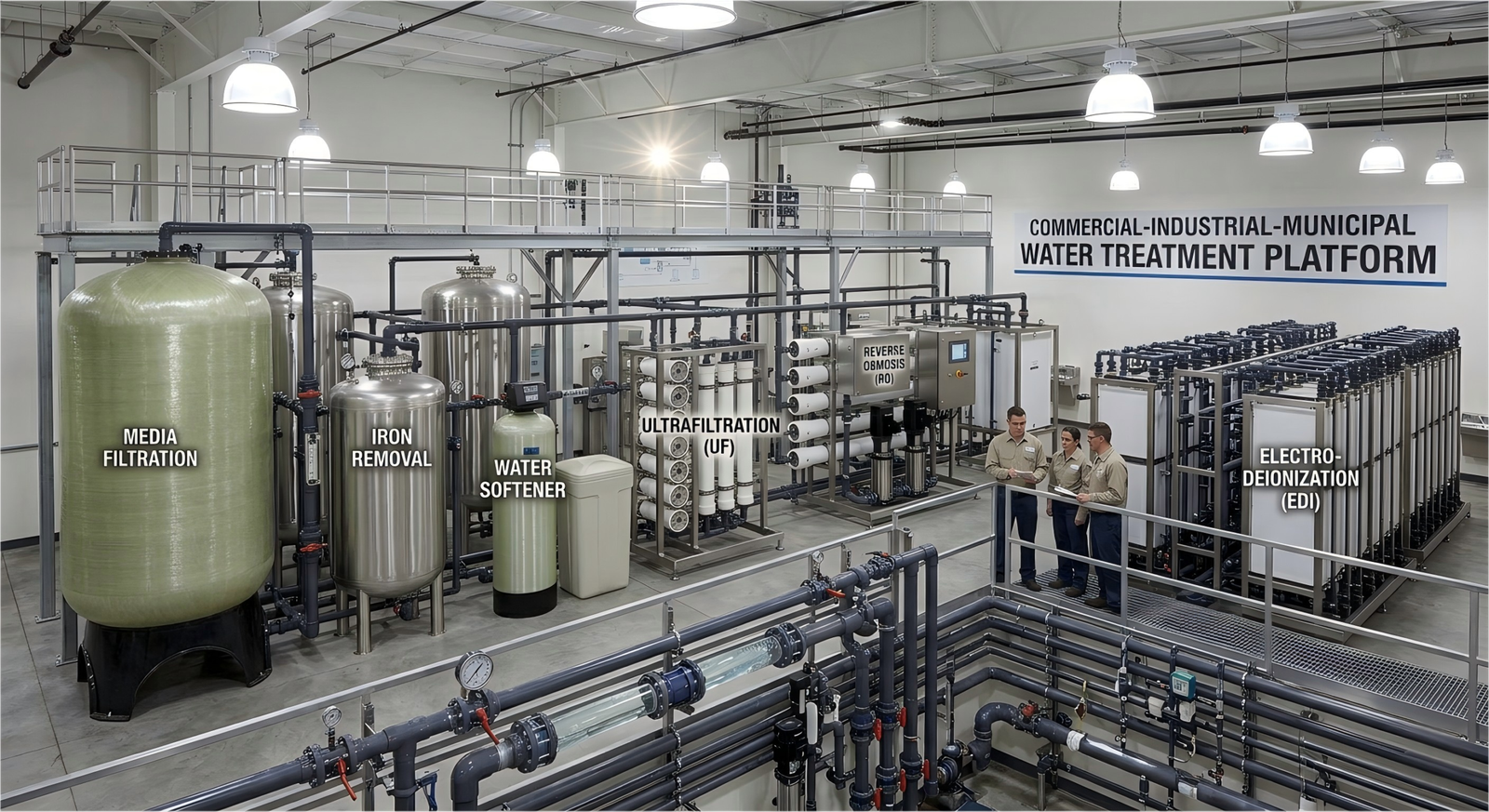
In real projects, I rarely see a single part working alone in a serious project. A commercial direct drinking water project may start with media filtration, carbon filtration, precision filtration, and RO. It may also include UV or another disinfection method, based on the local requirement. An industrial boiler feed project may need softening or antiscalant control before RO. It may also need degassing or polishing, based on the boiler requirement. A food and beverage project may care about stable taste, hygiene, cleanable structure, and material choice9. A community plant may need simpler operation, robust pretreatment, and easy spare parts.
I also see UF and NF used when full RO is not the right first answer. UF can support particle and microbial barrier tasks. NF can support partial separation needs in some food, beverage, or wastewater reuse cases. EDI normally appears after RO when the target is ultra-pure water for electronics, pharmaceutical, lab, or similar high-purity use.
| Project I see | Possible system combination | Why I may choose it |
|---|---|---|
| Commercial drinking water | Media filter + carbon filter + cartridge filter + RO + disinfection | I need stable taste and safe distribution support |
| Industrial boiler feed | Pretreatment + softening or scale control + RO + polishing if needed | I need to reduce scaling and protect boiler operation |
| Food or beverage process | Pretreatment + UF/NF/RO as needed + hygienic storage | I need process fit and stable product quality |
| Electronics or lab water | Pretreatment + RO + EDI + polishing | I need very low ions and stable high purity |
| Community water supply | Media filtration + membrane process or disinfection + storage | I need robust operation and easier maintenance |
| Wastewater reuse | Pretreatment + UF + RO/NF + dosing and controls | I need to manage variable water and reuse targets |
I see the “type” as the whole configuration. The main unit name is useful, but it is not the full answer. When I prepare an OEM or ODM system, I also think about frame layout, pipe material, electrical control, instrumentation, packaging, labels, manuals, and spare parts. These details affect the buyer after installation.
Why is asking only for an “RO system price” a procurement risk?
I understand why buyers ask for a quick price. I also know that a quick price without parameters can hide future cost.
I see “RO system price” as an incomplete request. RO price depends on feed water, target quality, flow, recovery plan, pretreatment, automation, materials, instruments, cleaning design, compliance documents, packaging, and after-sales support.
When a buyer asks only for an RO system price, I can give a rough range, but I cannot protect the project with that range. Two systems with the same flow can have different pretreatment, membranes, pumps, controls, frames, sensors, and pipe materials. One system may be built for light commercial use. Another may be built for continuous industrial duty. They may look similar in a photo, but they will not behave the same in the field.
I have seen low initial cost become high lifecycle cost. A weak pretreatment design can cause fast fouling10. A poor control setup can make operation unstable. Missing instruments can make troubleshooting slow. A layout that ignores maintenance space can make filter replacement difficult. A quotation that ignores local standards can create acceptance problems. This is why I prefer to review parameters before I recommend a type or price.
| Vague request I receive | Better request I prefer | Risk I reduce |
|---|---|---|
| I need RO price | I need RO for well water, this flow, this use, this standard | Wrong pretreatment and wrong membrane selection |
| I need industrial water system | I need process water for this equipment and running schedule | Undersized flow and unstable supply |
| I need drinking water plant | I need community water supply with this source and local rule | Compliance and maintenance problems |
| I need cheapest option | I need lowest total risk within this budget | High spare part cost and downtime |
| I need same as photo | I need this function with these site limits | Bad layout and hard installation |
A good quotation should show what is included and what is not included. I like to clarify feed water assumptions, outlet target, flow basis, operating schedule, pretreatment, control level, testing scope, documents, and spare parts. This makes supplier comparison fairer. It also helps procurement teams explain the decision to engineering and management.
How should I compare suppliers when I already know the system category?
I see many buyers compare suppliers by catalog pages. I think the better method is to compare the same duty, the same scope, and the same risk.
I compare suppliers by whether they understand the project duty, confirm the same scope, provide clear technical assumptions, support customization, control quality, and prepare documents, packaging, and spare parts for the real market.
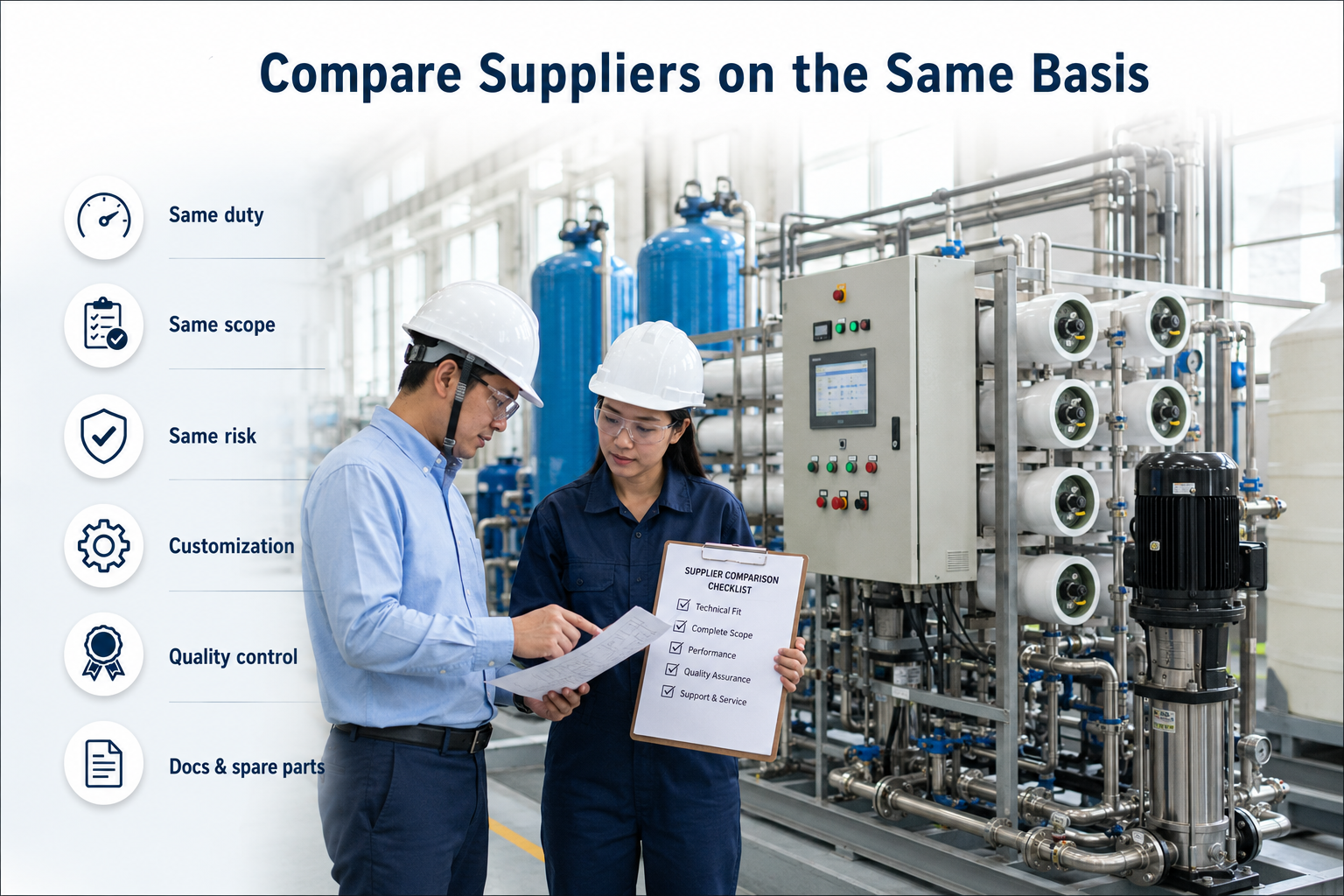
After I know the likely system category, I still do not stop at the name. I compare the solution scope. One supplier may include feed pumps, dosing, filters, membranes, controls, instruments, tanks, cleaning system, and documents. Another supplier may quote only the main skid. The second price may look lower, but the project cost may rise later.
I also compare how the supplier handles customization. For OEM/ODM projects, buyers may need a private label, a special frame size, a local voltage, a chosen valve brand, a different pipe material, a containerized design, or technical files in a required format. I also check whether the supplier asks serious questions. A supplier that never asks about raw water, flow, target quality, and site limits may be quoting a standard model without enough judgment.
| Supplier point I compare | What I look for | Why it matters |
|---|---|---|
| Technical review | The supplier checks raw water, target use, flow, and site | I need a system that fits the real duty |
| Scope clarity | The quotation lists included and excluded items | I need fair price comparison |
| Customization ability | The supplier can adjust layout, materials, controls, and branding | I need market fit and project fit |
| Quality control | The supplier tests key functions before shipment | I need lower installation risk |
| Documentation | The supplier provides drawings, manuals, certificates if needed | I need smoother acceptance and service |
| Spare parts support | The supplier plans consumables and replacement parts | I need lower after-sales pressure |
I speak as a manufacturer, so I focus on what can be built, tested, packed, shipped, and serviced. A good system type is not only correct on paper. It must also match the buyer’s procurement plan, installation schedule, local operator skill, and long-term maintenance model.
Conclusion
I choose water treatment system types by project task, raw water, outlet target, flow, site, and maintenance reality, not by a single product name.
"[PDF] Regulation 61-68, Water Classifications and Standards - EPA", https://www.epa.gov/system/files/documents/2024-01/sc-wqs-water-classifications.pdf. Regulatory and technical guidance documents from bodies such as the US EPA distinguish commercial water use from industrial use by end-use sector and volume, supporting the categorization of hotels, schools, and offices as commercial rather than industrial consumers. Evidence role: definition; source type: government. Supports: That commercial-scale water treatment systems are distinguished from industrial systems by their typical end-use settings and operational simplicity. Scope note: Such guidance typically addresses water consumption classification rather than treatment system design specifically; the mapping to system type is inferential. ↩
"(PDF) ASME Standar - Academia.edu", https://www.academia.edu/27508774/ASME_Standar. Standards bodies including ASME and ASTM publish water quality specifications for industrial applications—for example, ASME guidelines for boiler feedwater chemistry and ASTM standards for reagent-grade water used in electronics and pharmaceutical contexts—confirming that different industrial end uses impose distinct quality parameters. Evidence role: expert_consensus; source type: institution. Supports: That industrial applications such as boiler feed water, electronics manufacturing, and pharmaceutical production each impose specific and distinct water quality requirements. Scope note: Individual standards address specific applications; no single document covers all listed industrial uses simultaneously. ↩
"WHO releases guidelines and tools to enhance small water supplies", https://www.who.int/news/item/15-02-2024-who-releases-guidelines-and-tools-to-enhance-small-water-supplies. WHO and UNICEF guidance on rural and community water supply emphasizes system reliability, appropriate technology selection matched to local operator capacity, and supply chain planning for consumables and spare parts as critical factors in sustainable service delivery. Evidence role: expert_consensus; source type: institution. Supports: That community and municipal water supply systems are designed with emphasis on operational reliability, ease of operation by local staff, and availability of spare parts. Scope note: WHO/UNICEF guidance focuses primarily on low- and middle-income country contexts; requirements for municipal systems in high-income settings may differ in regulatory stringency and technical complexity. ↩
"Systematic Review of Microorganism Removal Performance by ...", https://pubmed.ncbi.nlm.nih.gov/40152626/. The World Health Organization's guidelines on drinking-water quality and associated technical documents describe ultrafiltration as a membrane process capable of removing particles, bacteria, and protozoa, though not reliably removing dissolved contaminants or viruses without additional treatment steps. Evidence role: mechanism; source type: institution. Supports: That ultrafiltration membranes remove fine suspended particles and provide a barrier against certain microorganisms including bacteria and protozoa. Scope note: Removal efficiency varies with membrane pore size, operating pressure, and feed water characteristics; the claim of 'some microbes' is accurate but imprecise without specifying organism size relative to membrane rating. ↩
"Reverse osmosis - Wikipedia", https://en.wikipedia.org/wiki/Reverse_osmosis. Reverse osmosis is described in technical literature as a pressure-driven membrane separation process in which a semipermeable membrane rejects dissolved ions and salts, producing a low-TDS permeate; typical commercial RO membranes achieve salt rejection rates of 95–99% depending on membrane type and operating conditions. Evidence role: mechanism; source type: encyclopedia. Supports: That reverse osmosis membranes reject dissolved salts and reduce total dissolved solids in the permeate stream. Scope note: Actual rejection rates depend on feed water composition, applied pressure, temperature, and membrane condition; the general claim is well supported but project-specific performance requires empirical testing. ↩
"Thin-film composite membrane - Wikipedia", https://en.wikipedia.org/wiki/Thin-film_composite_membrane. Nanofiltration is classified in membrane science literature as a pressure-driven process with a molecular weight cutoff typically between 200 and 1000 Da, rejecting divalent ions and larger organic molecules while passing monovalent ions more readily than RO, placing it functionally between UF and RO on the membrane separation spectrum. Evidence role: definition; source type: encyclopedia. Supports: That nanofiltration membranes occupy an intermediate position between ultrafiltration and reverse osmosis in terms of pore size and rejection characteristics. Scope note: The boundaries between membrane categories are not universally standardized; classification varies by manufacturer and regulatory context. ↩
"Electrodeionization (EDI) - ELGA LabWater", https://us.elgalabwater.com/electrodeionization-edi. Technical literature on electrodeionization describes the process as a continuous ion-exchange method that uses ion-exchange resins and membranes energized by an electric field to remove trace ions from RO permeate, achieving resistivity levels suitable for semiconductor, pharmaceutical, and laboratory applications. Evidence role: mechanism; source type: paper. Supports: That electrodeionization is employed downstream of reverse osmosis to further reduce ionic content and produce ultrapure water for demanding applications. Scope note: EDI performance is sensitive to feed water quality from the upstream RO stage; the claim is accurate as a general process description but does not specify achievable resistivity values. ↩
"Overview of Drinking Water Treatment Technologies | US EPA", https://www.epa.gov/sdwa/overview-drinking-water-treatment-technologies. The US EPA and WHO drinking water treatment guidance documents describe granular and powdered activated carbon as effective adsorbents for free chlorine, disinfection byproduct precursors, taste and odor compounds, and a range of organic micropollutants, with removal efficiency dependent on contact time, carbon type, and contaminant concentration. Evidence role: mechanism; source type: government. Supports: That activated carbon adsorbs chlorine, taste and odor compounds, and organic contaminants from water. Scope note: Activated carbon does not effectively remove dissolved inorganic salts, hardness, or heavy metals at typical drinking water concentrations; the claim is accurate for the specific contaminant categories listed. ↩
"Q7A Good Manufacturing Practice Guidance for Active ... - FDA", https://www.fda.gov/regulatory-information/search-fda-guidance-documents/q7a-good-manufacturing-practice-guidance-active-pharmaceutical-ingredients. Regulatory frameworks including FDA food safety regulations and EU Regulation (EC) No 852/2004 on food hygiene require that water used in food production be of potable quality, that equipment in contact with food or process water be constructed of food-grade materials, and that systems be designed to permit effective cleaning and disinfection. Evidence role: general_support; source type: government. Supports: That water used in food and beverage production is subject to regulatory requirements governing water quality, contact material safety, and system hygiene. Scope note: Specific requirements vary by product category, jurisdiction, and production process; the article's claim is directionally supported but the regulatory detail is more granular than the general statement implies. ↩
"Fouling in reverse osmosis membranes: monitoring, characterization ...", https://pmc.ncbi.nlm.nih.gov/articles/PMC10102236/. Research on RO membrane fouling identifies inadequate pretreatment—including insufficient removal of suspended solids, colloids, biological matter, and scalants—as a primary cause of accelerated flux decline and increased cleaning frequency, with studies documenting significant reductions in membrane lifespan under poor pretreatment conditions. Evidence role: mechanism; source type: paper. Supports: That insufficient pretreatment of feed water accelerates fouling of reverse osmosis membranes, reducing performance and increasing operating costs. Scope note: Fouling mechanisms and rates are highly site-specific; the general causal relationship is well established in literature, but quantitative impact depends on feed water composition and system design. ↩