

The size of the FRP tank affects flow stability, filtration performance, backwashing effectiveness, and installation costs.1 I often notice that buyers tend to choose based on diameter or capacity first, but this frequently leads to mismatches between the tank, valves, filter media layers, or available space on-site. The better solution is to size the tank around the full working condition.
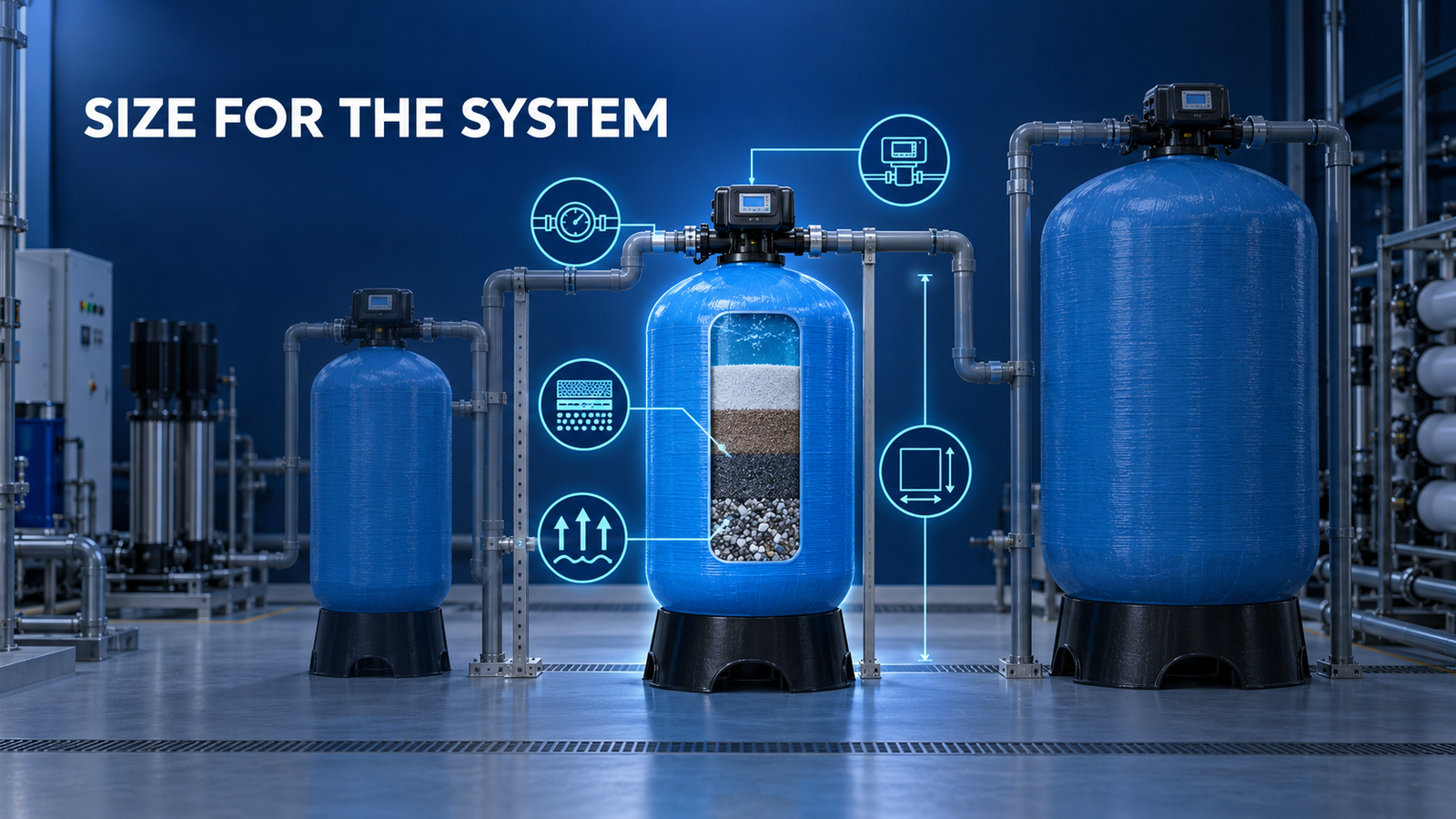
To choose the right FRP tank size, I first confirm the design flow rate, treatment application, media type, required bed depth, backwash capacity, working pressure, temperature, port type, valve compatibility, certification needs, and installation space. The correct size is not simply the largest tank; it is the tank that supports stable operation with acceptable procurement risk.2
When customers ask me to recommend a tank, I rarely answer with only one model number at first. I ask project questions. This helps me reduce wrong selection, rework, and performance complaints before the purchase order is placed.
Why Is FRP Tank Size More Than Diameter and Volume?
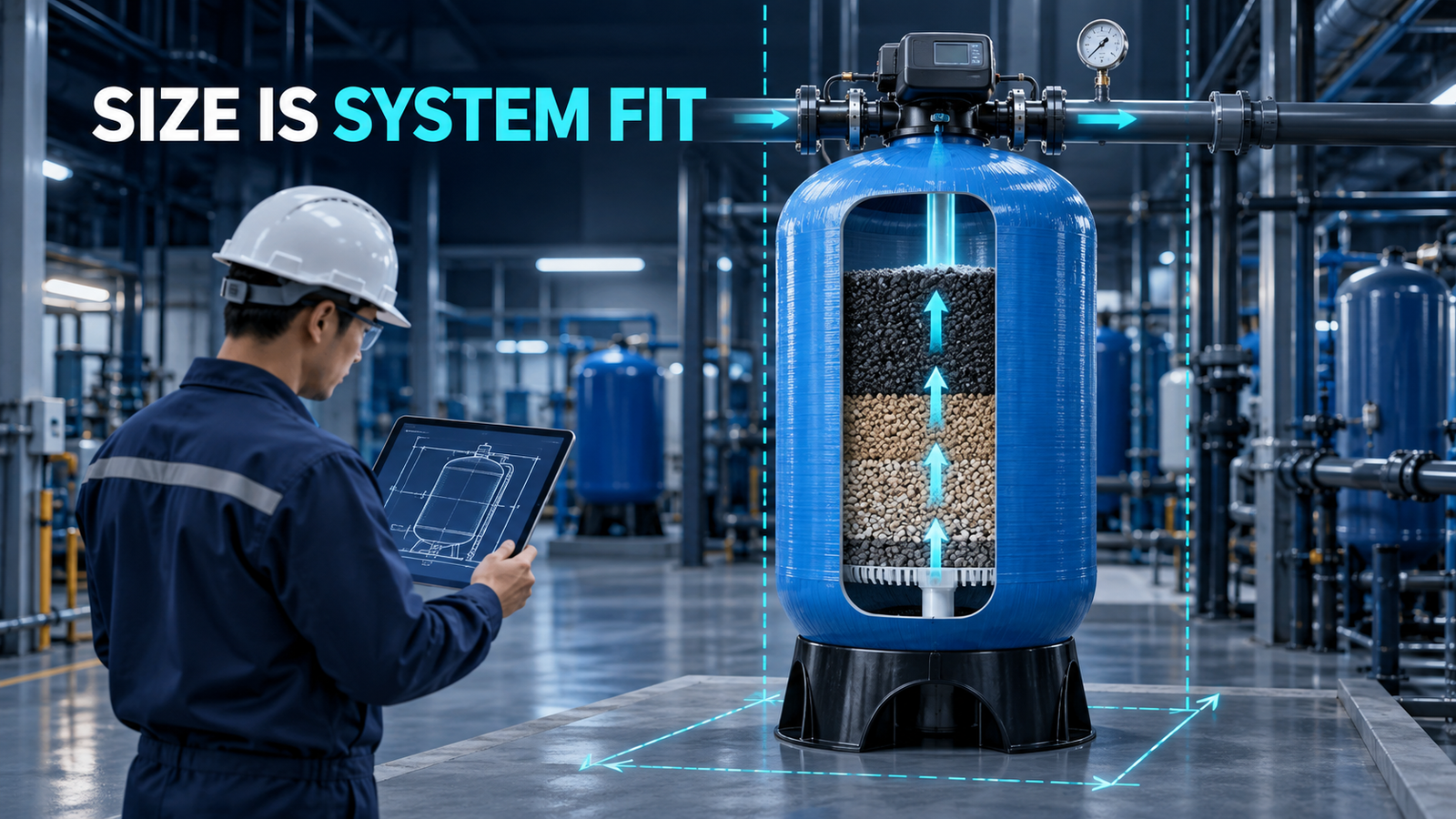
Choosing FRP tank size by diameter alone looks simple, but it can create hidden risk. A tank may hold enough media, yet still fail to backwash correctly or connect to the selected valve.3 That is why I treat size as a system-fit decision.
The right FRP tank size should match the treatment task, flow rate, media bed, backwash flow, pressure rating, interface, and installation limits. Diameter and volume are useful, but they are only part of the selection process.
What I Confirm First
When I receive an inquiry from a system integrator, I usually ask for:
- Design flow rate, such as normal flow and peak flow
- Application, such as softening, sand filtration, multimedia filtration, or activated carbon filtration
- Media type and loading volume
- Required bed depth and freeboard
- Backwash flow availability
- Working pressure and temperature
- Port size and valve type
- Installation height and floor space
- Market certification needs, such as CE, NSF, ISO documents, or local hygiene approval
A simple example helps. A buyer may ask for a large tank because the project has high flow. However, the site pump may not provide enough backwash flow. In that case, the larger tank can trap dirt, form channels, or shorten media life.
Key Sizing Factors
| Factor | Why It Matters |
|---|---|
| Flow rate | Controls service velocity and pressure drop |
| Application | Softening and filtration use different media rules |
| Media bed | Affects contact time and filtration quality |
| Backwash | Determines whether the bed can expand and clean |
| Interface | Must match valve, distributor, and piping |
| Space | Controls installation and maintenance access |
I manufacture FRP water treatment tanks, so I do not replace the role of a project design engineer. However, I can help buyers check whether the selected tank matches practical procurement and installation requirements.
How Does Flow Rate Affect FRP Tank Size?
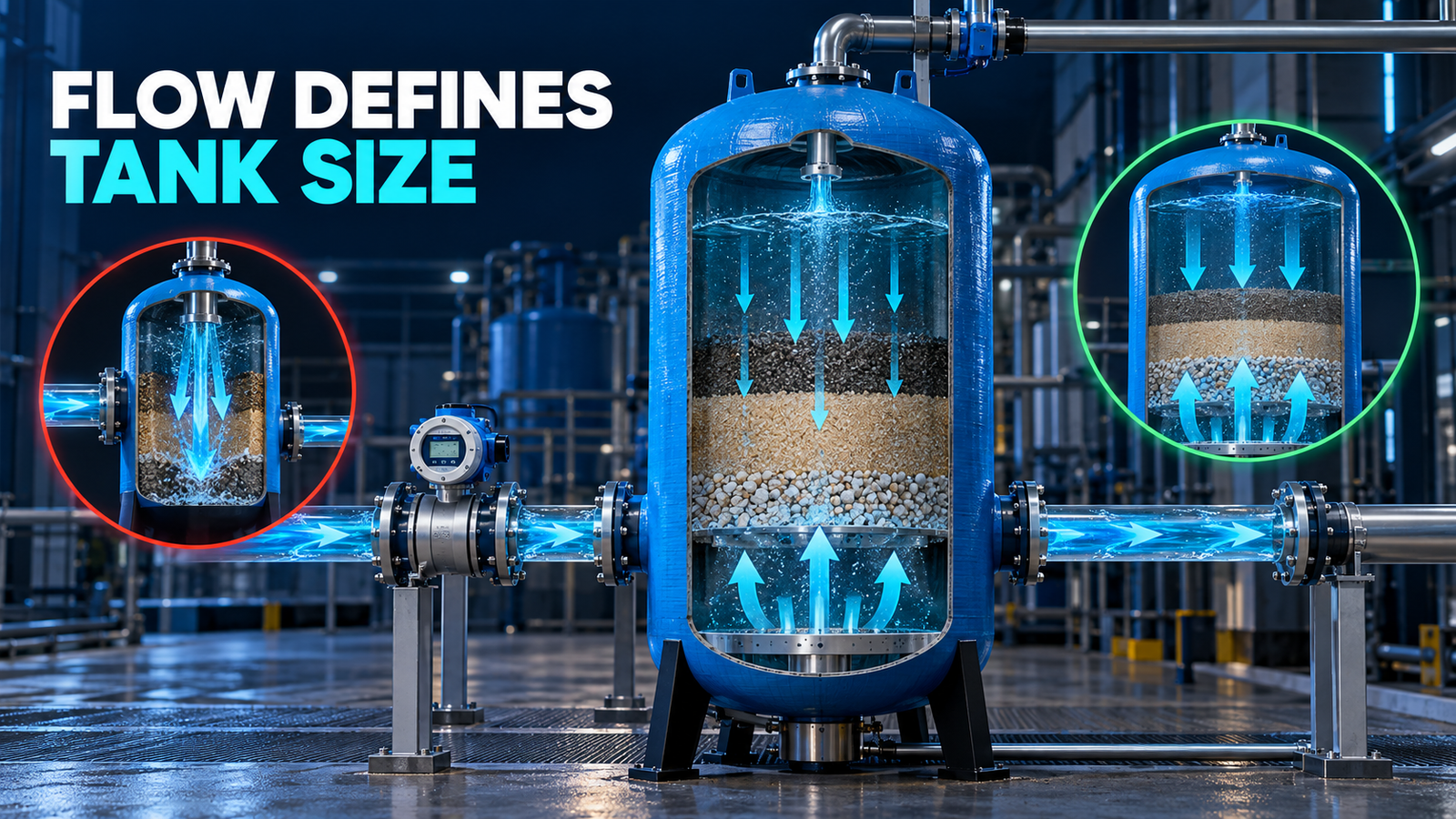
Flow rate is usually the first number I check because it directly affects treatment performance.4 If the tank is too small, water passes too quickly.5 If the tank is too large, the system may need more backwash water than the site can provide.6
FRP tank size should support the required service flow while keeping the media bed within a reasonable operating range. The buyer should verify flow velocity, pressure loss, and backwash demand according to the media supplier and project design.7
Normal Flow vs. Peak Flow
I always separate normal flow from peak flow. Normal flow tells me how the system works most of the time. Peak flow tells me whether the tank can handle short high-demand periods without unstable performance.
For example:
- A softener may need stable flow for ion exchange.
- A carbon filter may need enough contact time.8
- A sand or multimedia filter may need suitable surface loading.9
- A pretreatment system before RO may need reliable turbidity control.
If the tank is selected only for peak flow, the buyer may overpay. If it is selected only for normal flow, the system may fail during high demand. I prefer to see both numbers before recommending a tank range.
Backwash Capacity Is Often the Limit
Bigger tanks need stronger backwash. This point is easy to miss during purchasing. The media bed must expand during backwash so trapped particles can leave the tank.10 If the pump, piping, valve, or drain cannot support the needed flow, the tank may look correct on paper but perform poorly on site.11
Before final selection, I suggest checking:
- Available backwash flow
- Drain capacity
- Valve backwash rating
- Distributor compatibility
- Site water pressure during backwash
This is one reason I do not recommend choosing by volume alone. A correct tank must work during both service and cleaning.
Is a Bigger FRP Tank Size Always Better?
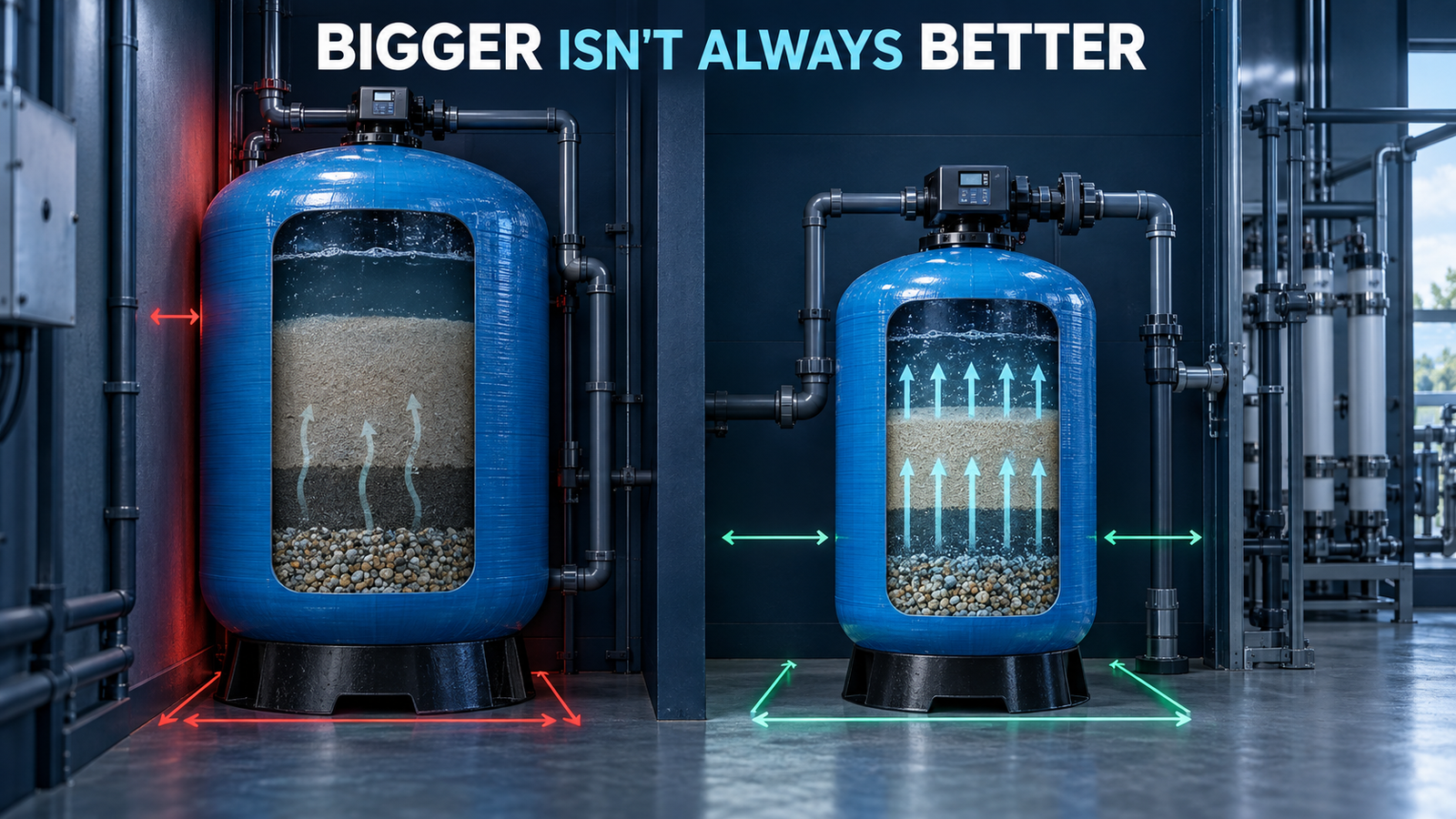
Many buyers think a larger tank is safer. I understand that thinking because larger vessels look stronger and more flexible. However, oversizing can create cost, layout, and backwash problems. Bigger is useful only when the system can support it.
A bigger FRP tank size is not automatically better. Oversizing may cause poor backwash, wasted media, higher shipping cost, difficult installation, valve mismatch, and unnecessary floor space use.12 The better choice is the size that fits the process and site.
Common Oversizing Risks
| Oversizing Risk | Possible Result |
|---|---|
| Not enough backwash flow | Dirty media, channeling, short media life |
| Excessive height | Installation or maintenance difficulty |
| Wrong port or valve match | Rework and delayed project delivery |
| More media than needed | Higher total cost |
| Larger shipping volume | Higher freight cost |
| Unchecked certification | Compliance risk in target market |
I once handled an inquiry where the buyer wanted a larger tank to “leave more safety margin.” After checking the pump and valve, the backwash flow was not enough for that tank diameter. A smaller, better-matched tank was the safer procurement choice.
Cost Is More Than Purchase Price
A low unit price or large stock size can look attractive. But wrong sizing can increase total cost through:
- Extra media purchase
- Additional piping modification
- Valve replacement
- Longer installation time
- Performance complaints
- Early maintenance
For international buyers, wrong selection can be even more expensive because replacement parts and shipping take time. I recommend confirming technical fit before confirming price.
What Product Details Should Buyers Verify Before Ordering FRP Tank Size?
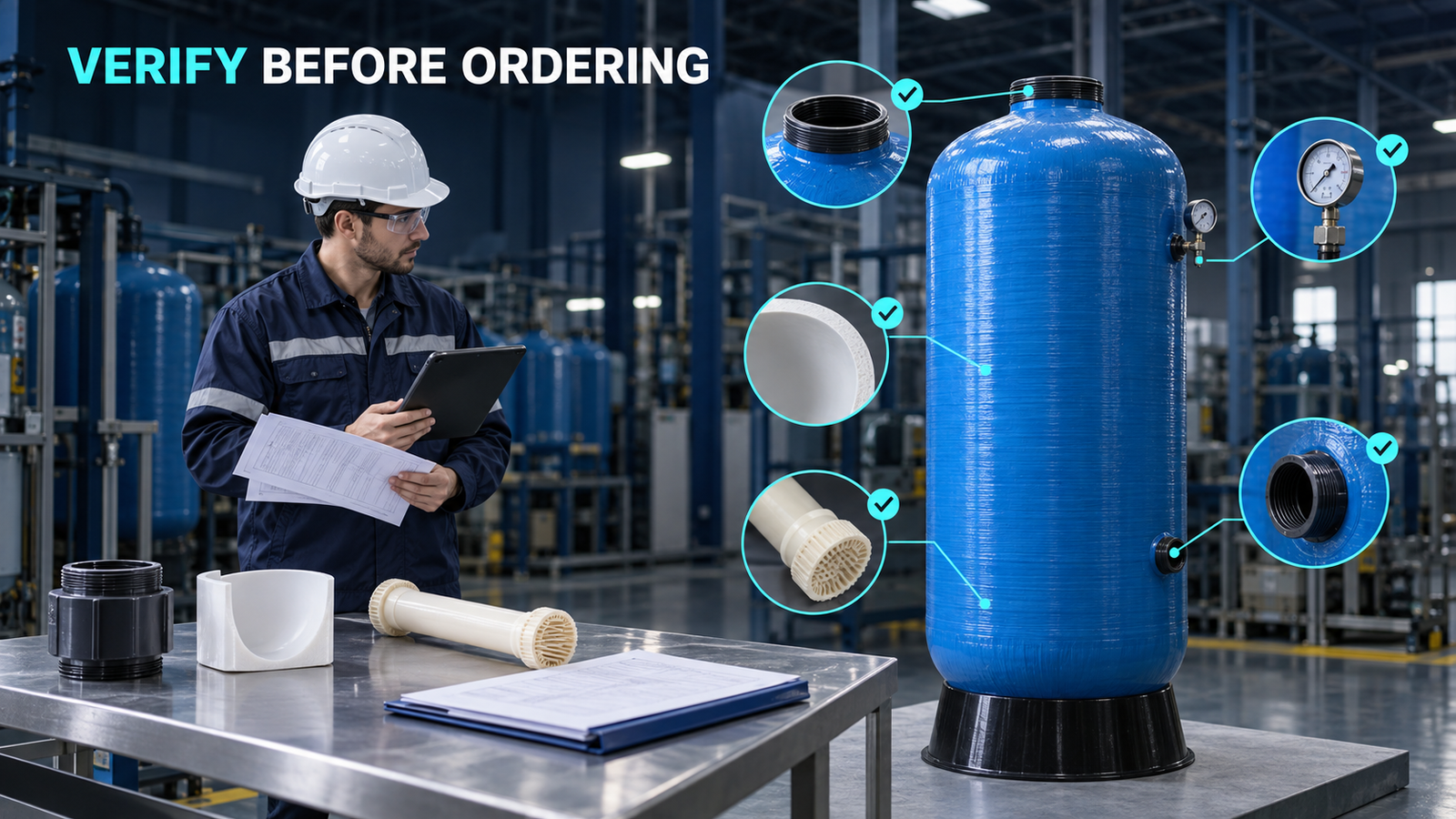
Even if the FRP tank size looks correct, buyers still need to verify product documents. Size must match pressure rating, temperature range, material safety, ports, distributors, and certification requirements. These details reduce procurement risk.
Before ordering, buyers should verify the FRP tank datasheet, working pressure, temperature range, interface type, liner material, performance test records, and certification documents. Certification claims should always be checked against actual project and market requirements.
Technical Details I Recommend Checking
For Hedelong FRP tanks, our product information includes details such as food-grade water-contact materials, polyethylene liner, fiberglass and epoxy resin outer layer, and common working conditions such as 10.5 bar / 150 psi and 1–48°C, depending on the model. Some products have test data such as fatigue cycling from 0–150 psi. Buyers should verify the exact values in the latest datasheet and certificates.
Important checks include:
- Pressure rating: Does it match the system design?
- Temperature range: Is the site water within the product range?
- Port type: 2.5” NPSM, 4”-8UN, flange, or other connection?
- Valve compatibility: Does the control valve match the tank opening?
- Distributor fit: Does the internal distributor suit the media and flow?
- Certification: Are CE, NSF, ISO9001, or hygiene documents required?
- Customization: Is color, size, or interface customization needed?
Supplier Evaluation Questions
I suggest procurement teams ask suppliers:
- Can you provide a datasheet for this exact model?
- Can you confirm pressure and temperature limits?
- Can you support batch supply for the project schedule?
- Can you provide certificates for buyer verification?
- Can you advise on interface and valve matching?
- Can you customize color or special specifications?
These questions are simple, but they prevent many avoidable problems. A reliable supplier should answer clearly and provide documents, not only a quotation.
Frequently Asked Questions
What is the most important factor in choosing FRP tank size?
The most important factor is the design flow rate combined with the treatment application. I also check media bed requirements, backwash capacity, working pressure, interface type, and installation space before recommending a tank size.
Can I choose an FRP tank only by water volume?
I do not recommend it. Water volume alone does not show service velocity, media depth, contact time, or backwash demand. A tank must match the whole water treatment process, not only the amount of media it can hold.
Why can an oversized FRP tank cause problems?
An oversized tank may need more backwash flow than the system can provide. It may also increase media cost, shipping cost, floor space, and valve matching risk. Bigger is only better when the system supports it.
Should I verify certifications before buying FRP tanks?
Yes. Buyers should verify certificates and product documents before purchasing, especially for drinking water, municipal, export, or regulated projects. CE, NSF, ISO9001, and hygiene documents should match the product and market requirement.
Conclusion
Choosing the appropriate size for FRP storage tanks is more of a strategic decision related to risk management rather than simply quickly determining the diameter. We recommend that you verify all parameters such as flow rate, application, liquid being transported, reverse emptying capability, pressure, temperature, valve interchangeability, certification requirements, and installation space before placing an order. If you plan to use FRP storage tanks in a water treatment project, we can assist you in evaluating various options and help you review relevant technical documents by providing detailed project information to Hedelong.
"Wastewater Filtration : Design Considerations", https://nepis.epa.gov/Exe/ZyPURL.cgi?Dockey=94002Z3O.TXT. A water-treatment design manual explains that filter dimensions and media-bed area determine hydraulic loading and backwash requirements, which contextualizes the article's claim that FRP tank size affects filtration stability and operating cost. Evidence role: general_support; source type: government. Supports: A neutral water-treatment design source should support that filter vessel dimensions affect hydraulic loading, filtration behavior, backwash requirements, and system design costs.. Scope note: The source would support the general design principle rather than proving cost impacts for every FRP tank installation. ↩
"Filter Backwashing", https://www.oregon.gov/oha/PH/HEALTHYENVIRONMENTS/DRINKINGWATER/OPERATIONS/TREATMENT/Documents/Backwash.pdf. Institutional guidance on granular-media filter design indicates that vessel size must be matched to service flow, media depth, and backwash capability, supporting the article's view that the largest tank is not automatically the correct tank. Evidence role: expert_consensus; source type: institution. Supports: An industry or institutional design reference should support that vessel selection should be based on process requirements, not maximum available size.. Scope note: The support is contextual because procurement risk also depends on supplier, logistics, and project-specific constraints. ↩
"Water Filtration (Grades 8-12)", https://www.cocoafl.gov/DocumentCenter/View/15448/Water-Filtration-Grades-8-12. Water-treatment design guidance distinguishes media volume from backwash hydraulic requirements and equipment connections, supporting the point that a tank with sufficient media capacity can still be unsuitable if backwash or valve compatibility is inadequate. Evidence role: mechanism; source type: institution. Supports: A design source should explain that backwash hydraulics and connection compatibility are separate from media holding capacity.. Scope note: The source would not verify any specific valve model or FRP tank interface. ↩
"Effects of Hydraulic Loading Rate and Filter Length on ... - HERO", https://hero.epa.gov/reference/4606699/. Engineering literature on water-treatment unit processes describes flow rate as a determinant of hydraulic loading, contact time, and pressure loss, supporting the article's claim that flow rate is central to tank sizing. Evidence role: mechanism; source type: research. Supports: A technical source should support that flow rate governs hydraulic loading, contact time, or service velocity, which affect treatment performance.. Scope note: The exact performance threshold depends on the treatment medium and design standard used. ↩
"Water Filtration (Grades 8-12)", https://www.cocoafl.gov/DocumentCenter/View/15448/Water-Filtration-Grades-8-12. Engineering references define filtration loading rate or superficial velocity as flow per unit cross-sectional area, supporting the statement that an undersized tank causes water to pass through the bed more quickly. Evidence role: mechanism; source type: education. Supports: A university or engineering source should explain that velocity or loading rate equals flow divided by bed area, so smaller tanks have higher velocity at the same flow.. Scope note: This supports the hydraulic mechanism, not a specific acceptable velocity for each media type. ↩
"Wastewater Filtration : Design Considerations", https://nepis.epa.gov/Exe/ZyPURL.cgi?Dockey=94002Z3O.TXT. Public water-treatment design guidance specifies backwash requirements as a rate applied over filter surface area, supporting the article's claim that larger-diameter tanks can require more backwash water. Evidence role: mechanism; source type: government. Supports: A government or public design manual should support that total backwash flow is calculated from backwash rate multiplied by filter surface area.. Scope note: Actual backwash demand also depends on media density, temperature, and target bed expansion. ↩
"Backwash of Granular Filters Used in Wastewater Filtration", https://nepis.epa.gov/Exe/ZyPURL.cgi?Dockey=9101FNWU.TXT. Institutional filtration-design guidance treats service rate, head loss, and backwash rate as key parameters in granular-media filter design, supporting the article's recommendation to verify these values before selecting a tank. Evidence role: expert_consensus; source type: institution. Supports: An institutional design source should identify service velocity, head loss, and backwash requirements as core filter design parameters.. Scope note: The source would provide general design principles and may not address all proprietary media products. ↩
"Overview of Drinking Water Treatment Technologies", https://www.epa.gov/sdwa/overview-drinking-water-treatment-technologies. Guidance on granular activated carbon treatment describes empty bed contact time as a key design parameter for adsorption performance, supporting the article's statement that carbon filters require sufficient contact time. Evidence role: mechanism; source type: government. Supports: A neutral source should support that activated carbon systems are designed using contact time or empty bed contact time.. Scope note: The required contact time varies by contaminant, carbon type, water quality, and treatment objective. ↩
"CIVL 1101 - Introduction to Water Filtration", https://www.ce.memphis.edu/1101/notes/filtration/filtration-1.html. Water-filtration design manuals define surface loading rate as flow per unit filter area and use it to size sand and multimedia filters, supporting the article's statement that these filters need suitable surface loading. Evidence role: definition; source type: government. Supports: A design manual should define surface loading rate and show its use in sand or multimedia filter sizing.. Scope note: Acceptable loading rates differ among rapid sand, pressure, and multimedia filter designs. ↩
"CIVL 1101 - Introduction to Water Filtration", https://www.ce.memphis.edu/1101/notes/filtration/filtration-1.html. Filtration engineering literature explains that backwashing expands the granular bed and increases particle detachment and transport, supporting the article's statement that bed expansion is needed to remove trapped solids. Evidence role: mechanism; source type: research. Supports: A research or engineering source should explain that upward backwash flow expands granular media and removes accumulated solids.. Scope note: The degree of expansion required depends on media size, density, water temperature, and the backwash protocol. ↩
"Tertiary Granular Filtration: Problems and Remedies", https://nepis.epa.gov/Exe/ZyPURL.cgi?Dockey=200045JL.TXT. Institutional design guidance for media filters identifies backwash flow, piping, valves, and waste-drain capacity as necessary design considerations, supporting the article's claim that inadequate site hydraulics can undermine field performance. Evidence role: general_support; source type: institution. Supports: A design reference should support that pump, piping, valve, and drain capacity must satisfy backwash flow requirements for proper filter operation.. Scope note: The source would not diagnose a particular installation without site measurements. ↩
"CIVL 1101 - Introduction to Water Filtration", https://www.ce.memphis.edu/1101/notes/filtration/filtration-1.html. Filter-design references show that vessel diameter affects media volume and total backwash flow, supporting the article's warning that oversizing can create poor backwash conditions and unnecessary material requirements. Evidence role: general_support; source type: institution. Supports: A neutral source should support the operational portion of the oversizing claim, especially larger media volume and higher backwash demand.. Scope note: The source would support the technical basis more directly than shipping cost or installation difficulty, which are project-specific. ↩