
I often see projects treat tank safety as a simple material choice. That can create corrosion, leakage, hygiene risk, and costly rework later.
I consider stainless steel water tanks safe when the grade, water quality, fabrication, installation site, and maintenance plan match the project. I do not treat every stainless steel tank as automatically safe for drinking or domestic water storage.
In my work as a water treatment equipment manufacturer, I hear one question again and again: “Is this stainless steel tank safe?” I understand the reason. A tank can look simple, but it sits at the center of project safety. If the tank fails, the whole water system may fail acceptance. So I never answer with a quick yes. I first look at the water, the site, the welding, the inspection plan, and the way the tank will be cleaned. That is where the real safety judgment begins.
When is a stainless steel water tank safe for drinking or domestic water?
I have seen safe projects become risky because the tank was selected too fast. The problem was not stainless steel itself. The problem was poor matching.
A stainless steel water tank is safe for drinking or domestic water when the material grade, water chemistry, weld quality, sealing, cleaning access, and inspection plan fit the project use.1 The tank must also meet the local rules required for the project.
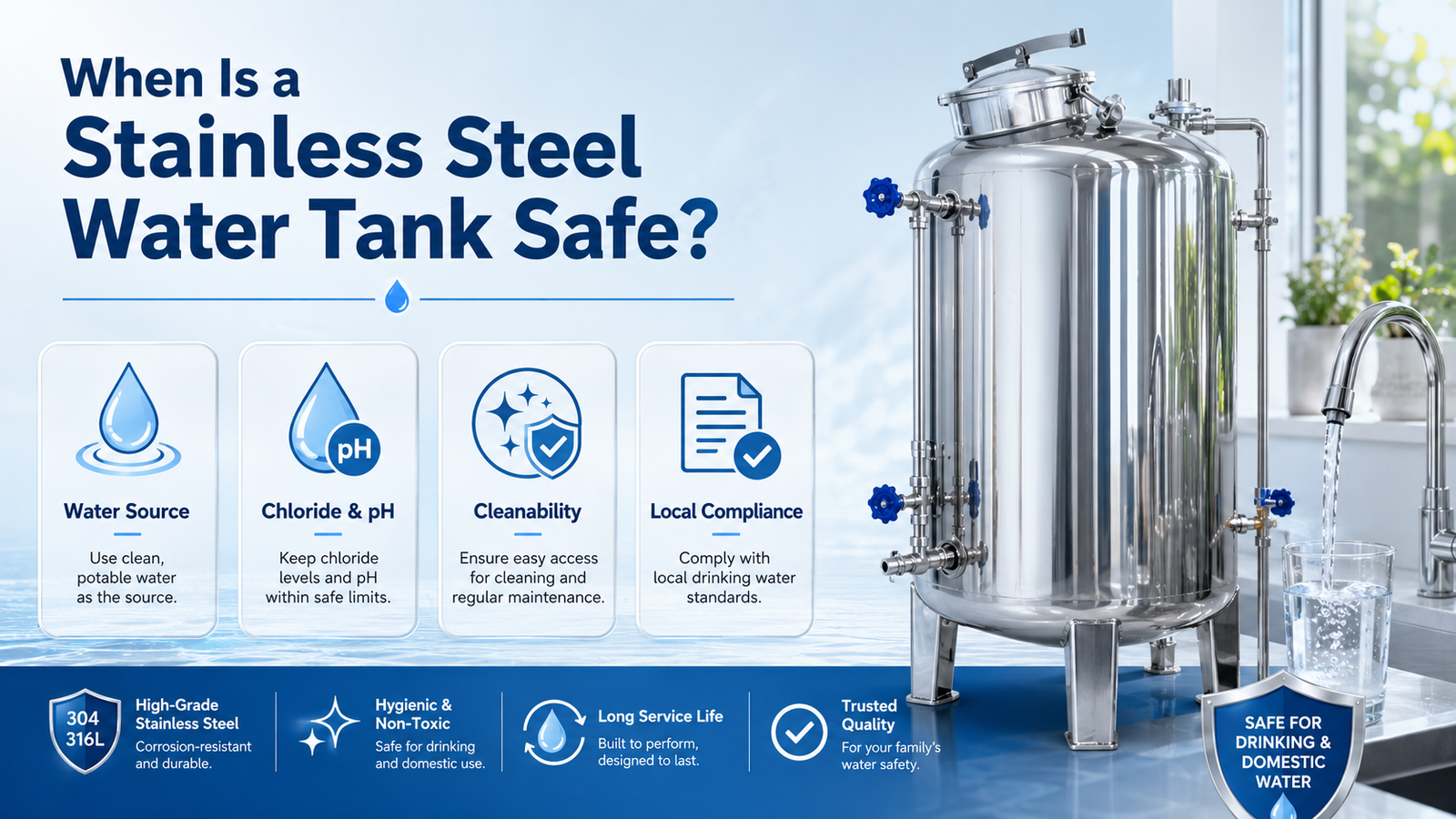
I usually start with the same basic idea. Stainless steel is not a magic material. It is a strong and common material for water storage, but it still needs the right working conditions. I ask about the water source first. I ask whether the water is municipal water, well water, desalinated water, softened water, or process water. I also ask about chloride level, salt content, pH, temperature, and disinfection method2. These points matter because they affect corrosion risk and hygiene control.
My basic safety view
| Factor I check | Why I check it | Risk if I ignore it |
|---|---|---|
| Water source | I need to know what enters the tank | The tank may face unexpected corrosion |
| Chloride or salt level | I need to judge material suitability | Rust stains or pitting may appear |
| pH value | I need to judge chemical stress | Metal surface may lose stability |
| Disinfection method | I need to know oxidizer exposure | Welds and weak points may suffer |
| Cleaning access | I need to support long-term hygiene | Sediment and biofilm may build up |
| Local compliance | I need to support project acceptance | The project may face approval delays |
I have learned that procurement teams often want a clear answer at the quotation stage. I still give a conditional answer. I say that stainless steel can be safe, but the project data must support the choice. I prefer this careful answer because it protects both the buyer and the supplier. A safe tank is not only a purchased item. It is a matched part of the full water treatment system.
Why is 304 or 316 not the first question I ask?
I have seen buyers start with “304 or 316?” before they explain the water. That can make the decision look technical, but it may hide the real risk.
I do not ask 304 or 316 first because grade selection depends on water quality, storage purpose, installation environment, and maintenance.3 The better first question is: what conditions will the tank face during operation?
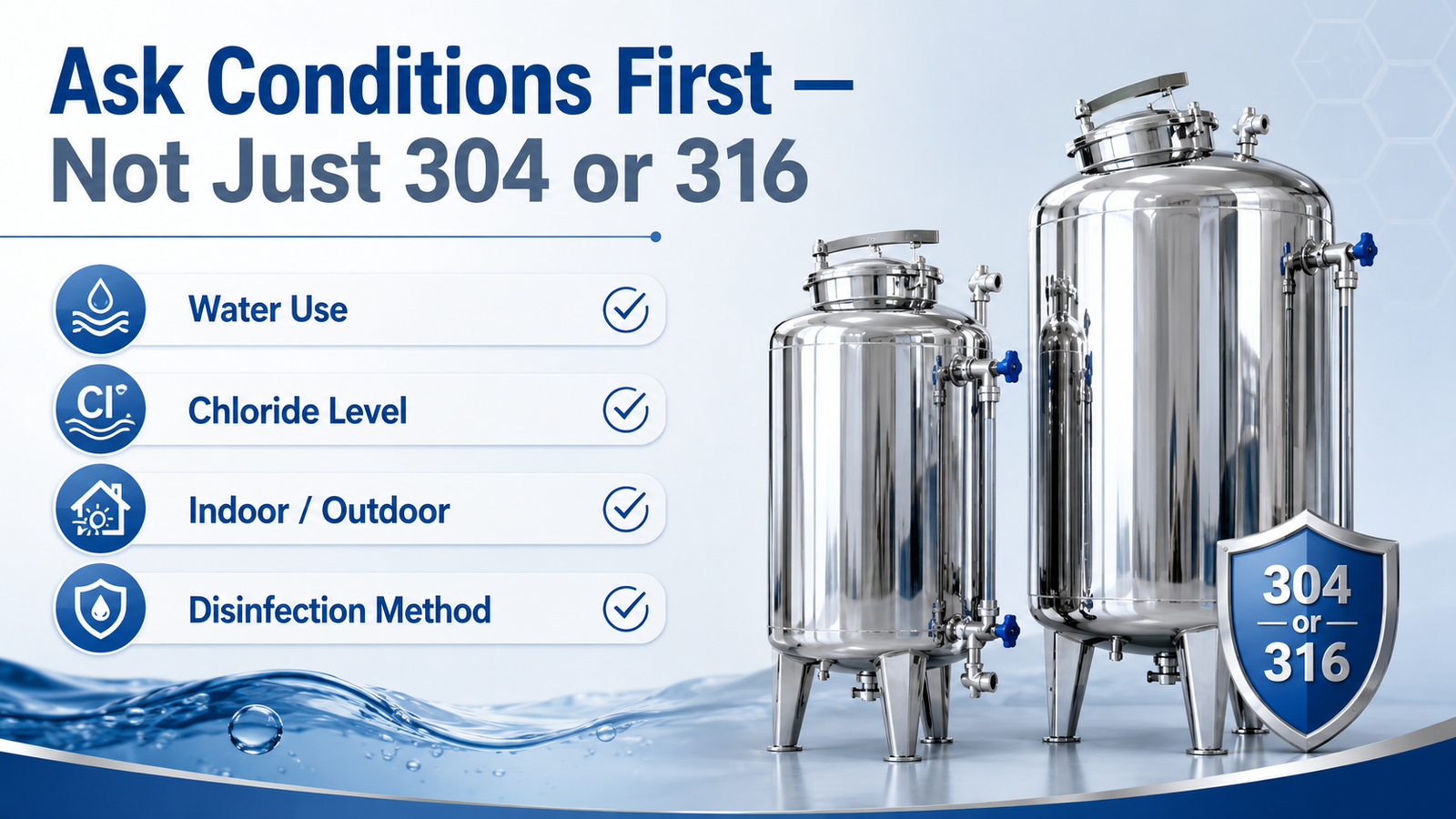
I understand why 304 and 316 get attention. They are common grades, and many project documents mention them. But I do not treat the grade as the full answer. I have seen 304 perform well in one project and struggle in another.4 I have also seen buyers pay more for 316 while ignoring welding quality, sealing design, or cleaning access. That creates a false sense of safety.
My project questions before grade selection
| Question I ask | What I want to learn | How it affects the tank choice |
|---|---|---|
| Is the water for drinking, domestic use, or process use? | I need to know hygiene risk | Drinking water needs stricter control |
| Is the water high in chloride? | I need to know corrosion stress | A higher grade or different design may be needed |
| Is the tank indoors or outdoors? | I need to know environmental exposure | Outdoor sites need stronger protection planning |
| Is the site near the sea? | I need to know salt exposure | Marine air can raise corrosion risk5 |
| Is chlorine used for disinfection? | I need to know oxidizing stress | The material and welds need careful review |
| How often will the tank be cleaned? | I need to know maintenance reality | Poor cleaning access raises hygiene risk |
I often explain this with a simple example from factory communication. A buyer may request a low-cost 304 tank for a coastal municipal project. On paper, the request looks normal. In real use, salt air and chloride in water may increase corrosion risk. If I only quote what is requested, I may win the price comparison. But I may also help create a future complaint. So I prefer to ask more questions before I recommend the final material, thickness, surface treatment, and inspection plan.
How does manufacturing quality affect tank safety?
I have seen buyers focus on material certificates and ignore fabrication. That is risky because a poor weld can damage the value of a good plate.
Manufacturing quality affects tank safety through plate thickness, welding, inner surface condition, sealing, leakage control, and factory inspection. A correct material can still fail if the fabrication and testing process is weak.6
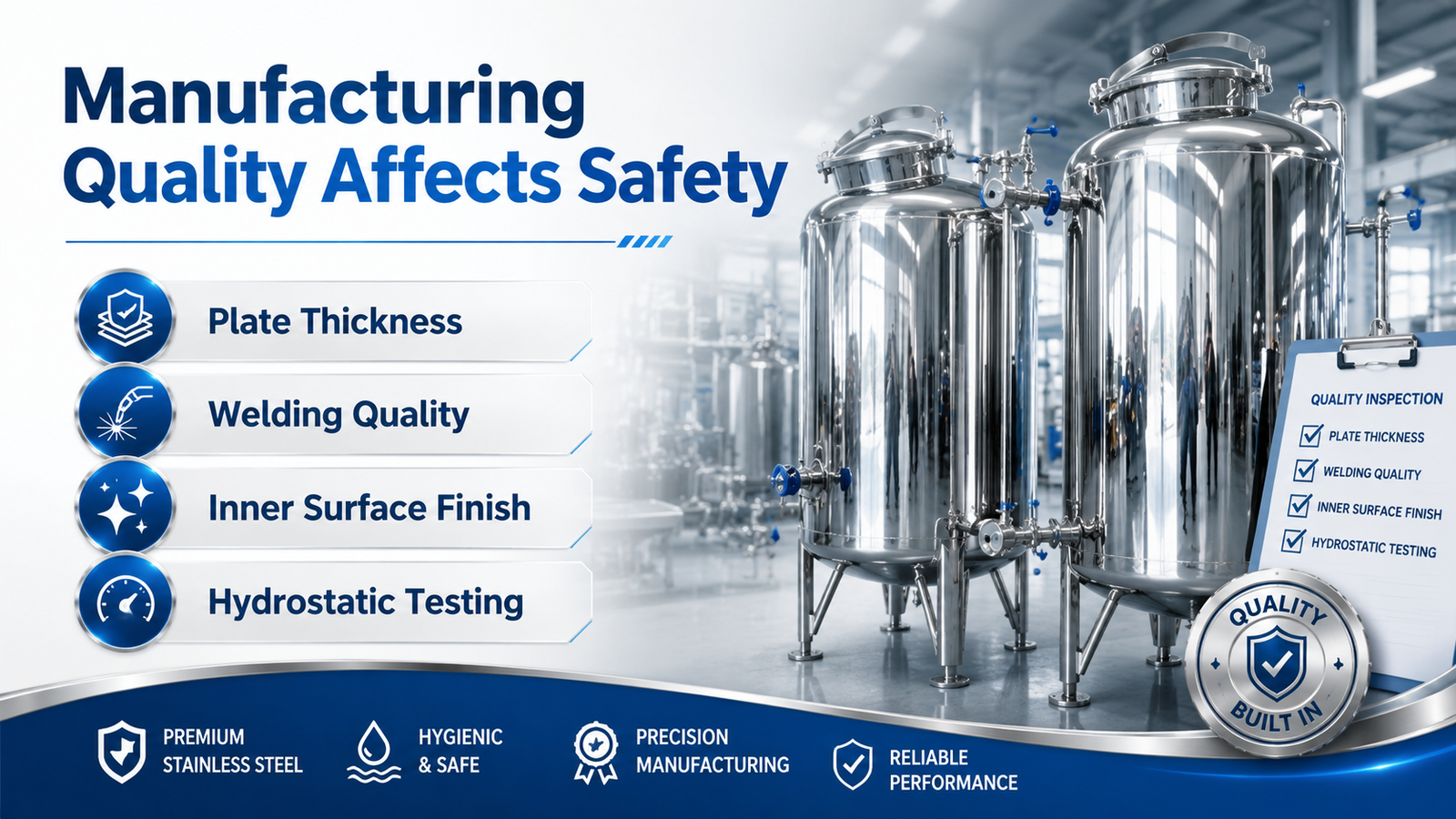
In our factory-side work, I treat safety as something built step by step. It starts with raw material checking. It continues through cutting, forming, welding, polishing, assembly, and testing. I pay close attention to the weld zone because it is often the weak point.7 A tank wall may look clean from a distance, but a bad weld can hold dirt, create leakage risk, or become a corrosion starting point.
Manufacturing points I care about
| Factory point | What I check | Why it matters |
|---|---|---|
| Plate thickness | I check whether it matches the design | Thin plates may deform or fail early |
| Welding quality | I check weld continuity and finish | Poor welds may leak or trap dirt |
| Inner surface | I check smoothness and dead corners | Rough areas can affect hygiene8 |
| Sealing parts | I check gasket and joint quality | Weak seals can cause leakage |
| Hydrostatic testing | I check tank tightness before shipment | Testing helps catch visible leakage9 |
| Final inspection | I check appearance, function, and packing | It reduces delivery and site risk |
I do not claim that one factory test proves lifetime safety. That would not be fair. But I do believe consistent inspection reduces obvious risks before shipment. For water treatment equipment, I am used to factory checks such as hydrostatic testing, functional inspection, pressure-related review where applicable, and outgoing inspection. These steps matter because project sites often have tight installation schedules. If a tank arrives with leakage, wrong openings, poor weld finish, or missing accessories, the buyer may face site delay, extra labor, and project claims.
I also look at the inside structure. A water tank should support cleaning and inspection. If internal corners, supports, or joints create dead zones, water may stay there too long. Sediment may collect. Cleaning may become difficult.10 In that situation, the material grade alone cannot solve the hygiene risk. This is why I ask for drawings, nozzle positions, manhole size, drain design, overflow design, and installation space before I feel comfortable with a recommendation.
I have seen a low unit price look attractive during bidding. I have also seen the same choice create cost after delivery.
A low-price stainless steel water tank can create hidden risks such as early corrosion, leakage, rust staining, hygiene concern, failed acceptance, rework, and after-sales disputes. The real cost may be higher than the purchase saving.
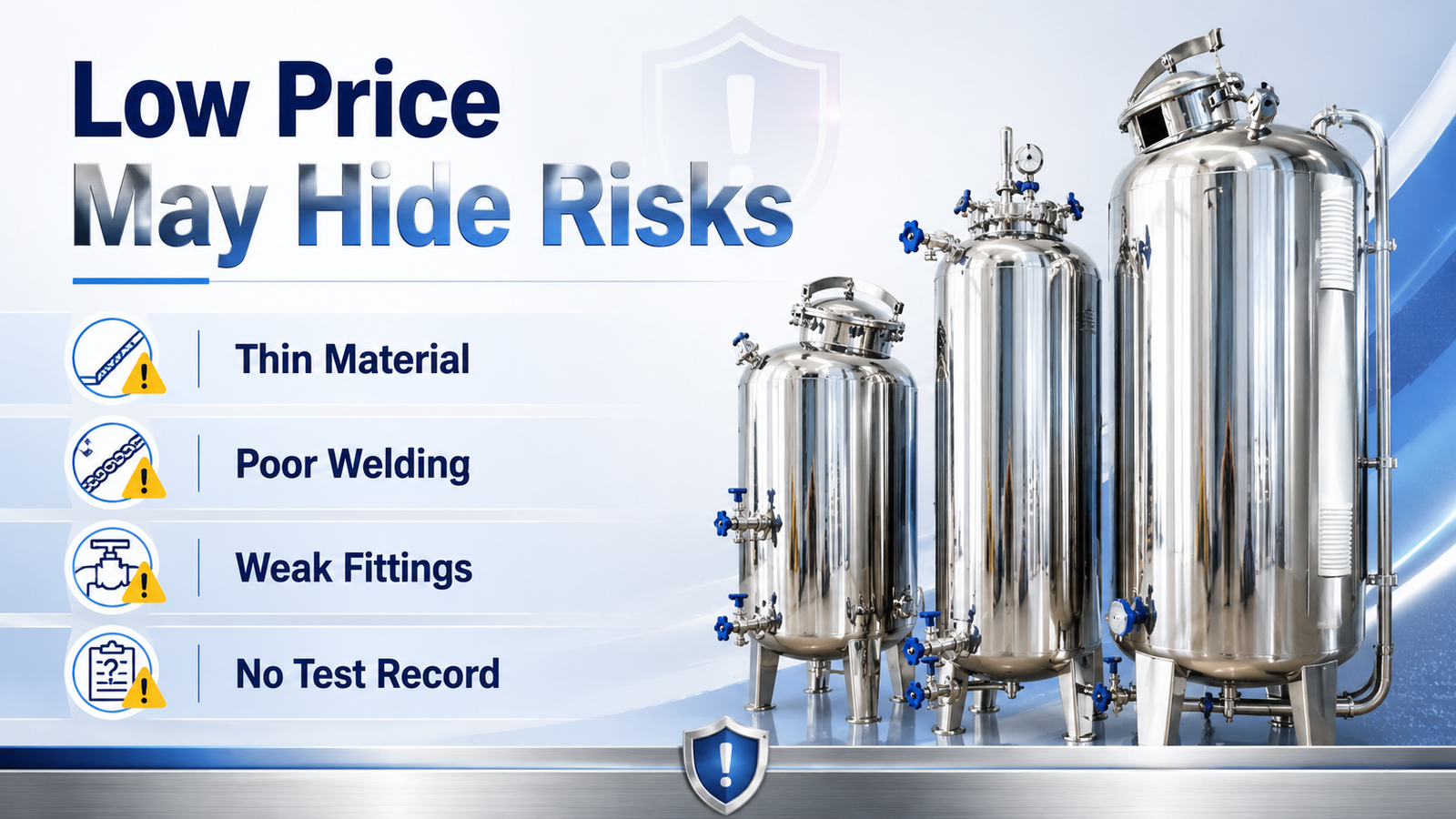
I work with procurement teams, so I respect price control. A project must meet its budget. But I become careful when the price is far below the normal market range. I ask what has been removed from the product. The saving may come from thinner plates, weaker welding, lower surface treatment, poor accessories, loose inspection, weak zah packaging, or unclear responsibility after shipment. These things may not be obvious in a quotation sheet.
Where low price may hide risk
| Low-price source | Short-term benefit | Possible project risk |
|---|---|---|
| Thinner material | I see a lower purchase price | The tank may deform or feel weak |
| Lower welding labor | I see faster production | Leakage or rough welds may appear |
| Poor surface finish | I see lower processing cost | Dirt may stay on the inner surface |
| Weak fittings | I see lower accessory cost | Connections may leak during use |
| No clear test record | I see shorter lead time | Site acceptance may become harder |
| Poor packaging | I see lower logistics cost | Panels or parts may arrive damaged |
I have had conversations where the buyer asked only for the lowest price. I usually explain that the cheapest tank is not always the most economical tank. If a tank leaks after installation, the site may need water shutdown, labor return, repair work, and sometimes replacement. If rust staining appears in a drinking water project, the customer may lose trust even before a technical review starts. If the tank fails local acceptance, the procurement saving becomes a small number compared with delay cost.
I do not say that every low-price supplier is bad. I also do not say that high price always means high quality. I say the price must be readable. A good supplier should be able to explain material grade, thickness, welding method, surface treatment, testing process, packing plan, and delivery schedule. If the supplier cannot explain these points, I treat the low price as a risk signal.
What should I check before I approve a stainless steel tank supplier?
I have seen project teams approve suppliers based on a short quotation. That makes the purchase fast, but it can make the project weak.
Before I approve a stainless steel tank supplier, I check project data, material confirmation, drawings, fabrication control, testing plan, certifications, packaging, delivery capacity, and after-sales support. I need proof, not only a promise.
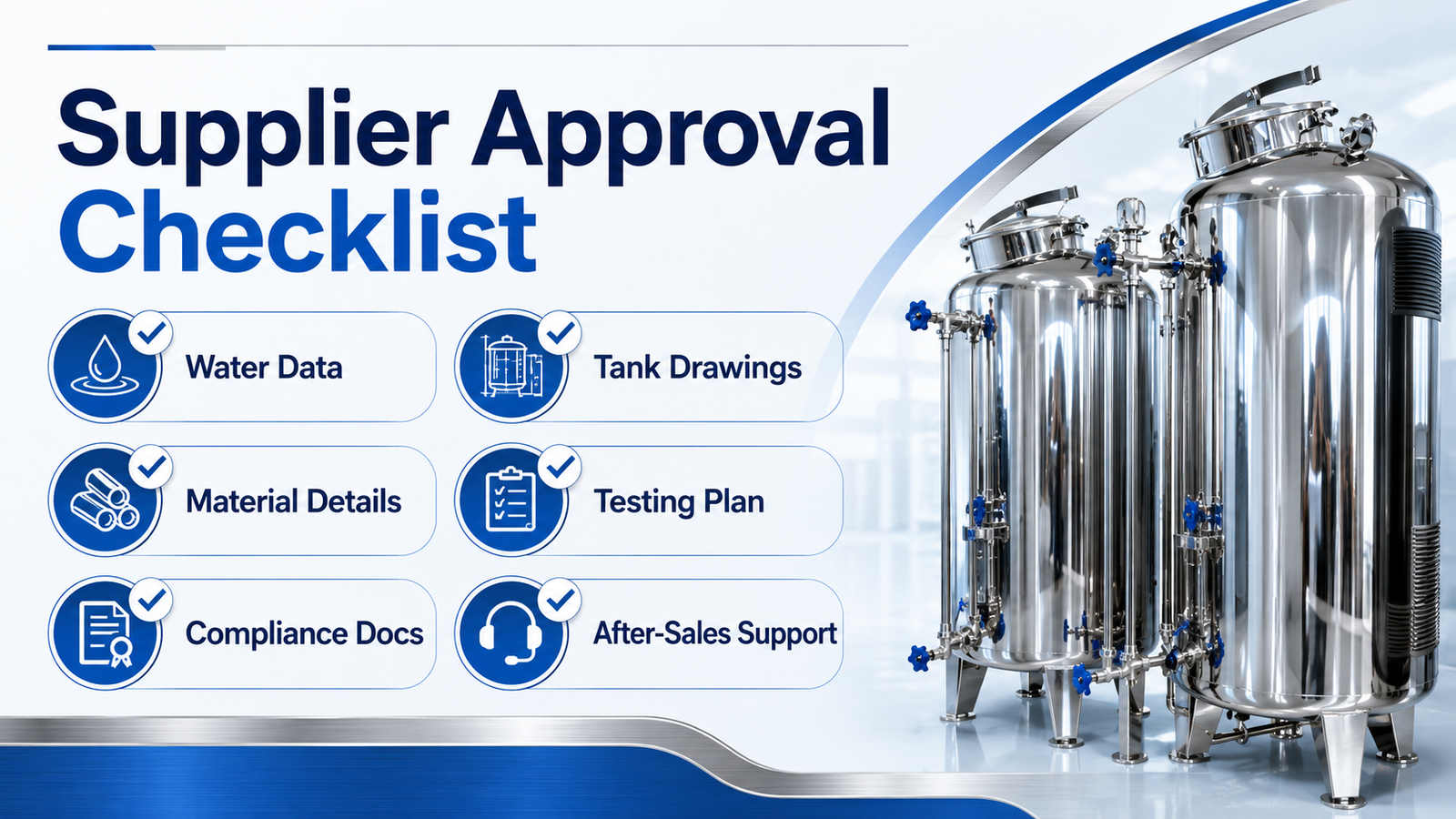
I like to turn supplier approval into a practical checklist. This helps me avoid vague discussions. It also helps the buyer compare offers fairly. A supplier who only writes “304 stainless steel tank” has not answered enough. I need to know how the tank will be built, tested, packed, and supported. I also need to know whether the supplier understands the water treatment project, not only sheet metal work.
My approval checklist
| Item I check | What I ask for | Why I need it |
|---|---|---|
| Water data | I ask for source, pH, chloride, and use | I need to judge suitability |
| Tank drawings | I ask for size, openings, drains, and manholes | I need to prevent installation problems |
| Material details | I ask for grade and thickness confirmation | I need to avoid substitution risk |
| Welding control | I ask how welds are made and inspected | I need to reduce leakage risk |
| Surface finish | I ask about inner surface treatment | I need to support hygiene |
| Testing plan | I ask about leakage or hydrostatic checks | I need factory-side risk control |
| Compliance documents | I ask what documents match the market | I need project acceptance support |
| Delivery capacity | I ask about lead time and production plan | I need schedule control |
| Packaging method | I ask how panels or tanks are protected | I need to avoid transport damage |
| After-sales plan | I ask how issues will be handled | I need clear responsibility |
I also check communication quality. This point is simple, but it matters. If a supplier answers technical questions clearly before the order, I feel more confident about problem solving after the order. If a supplier avoids questions about water chemistry, weld inspection, or document support, I slow down. I have learned that unclear communication at the quotation stage often becomes unclear responsibility at the project stage.
I also prefer suppliers who can work with engineering changes. Project conditions often change. A nozzle may need a new position. The tank height may need adjustment. The site may require different packaging. The buyer may need branding, labels, manuals, or inspection records. A supplier with OEM and ODM experience can usually handle these points with less confusion. This matters for large contractors and distributors because one tank problem can affect many connected systems.
How should I maintain a stainless steel water tank after installation?
I have seen good tanks perform poorly because maintenance was treated as optional. A safe purchase still needs safe operation.
A stainless steel water tank should be inspected, cleaned, drained, and checked on a planned schedule. Maintenance should cover sediment, seals, vents, overflow, manholes, weld areas, corrosion marks, and water quality changes.11
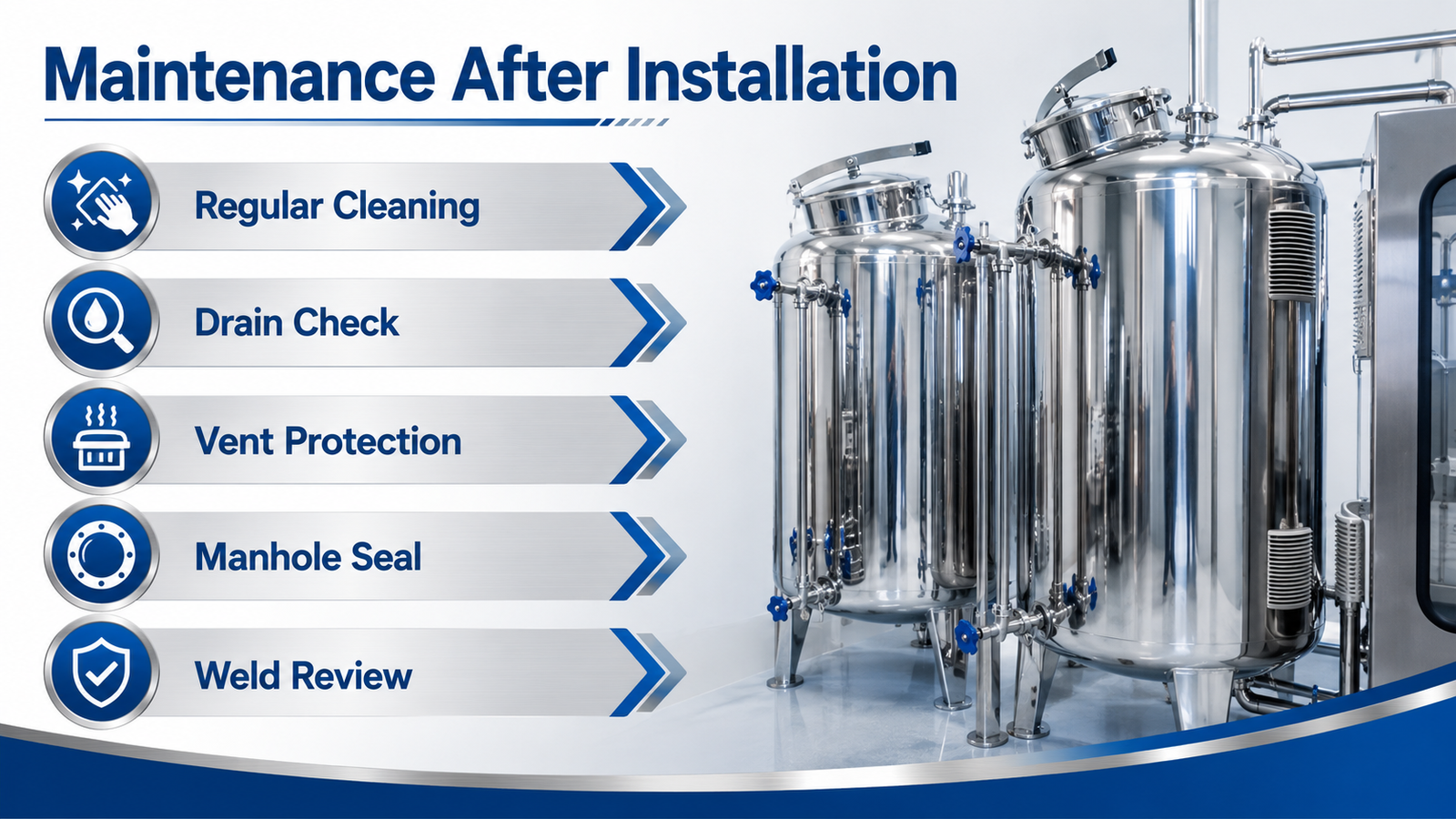
I do not see maintenance as a small after-sales topic. I see it as part of the safety plan. A tank stores water for a period of time. During that period, water quality can change. Sediment can collect. Vents can become dirty. Covers can loosen. Gaskets can age. If the site does not inspect these parts, a well-made tank may still develop hygiene or leakage problems.
Maintenance points I usually remind buyers about
| Maintenance item | What I look for | Why it matters |
|---|---|---|
| Regular cleaning | I check sediment and inner surface condition | I want to reduce hygiene risk |
| Drain function | I check whether water can fully drain | I want to avoid stagnant water |
| Vent protection | I check screen and cover condition | I want to stop insects or dust |
| Manhole sealing | I check gasket and closure | I want to reduce contamination risk |
| Weld and corner review | I check rust marks or deposits | I want early warning of corrosion |
| Overflow path | I check blockage and discharge route | I want to prevent uncontrolled water loss |
| Water quality change | I check chlorine, pH, or source changes | I want to confirm original selection still fits |
I usually tell project teams that the tank selection is based on known conditions. If the water source changes later, the safety judgment may also change. If the disinfection dose changes, the tank may face a different chemical environment.12 If the site moves from indoor to outdoor use, the external exposure changes. So I ask buyers to keep a simple operation record. It does not need to be complicated. It should show cleaning date, inspection findings, repair actions, and water quality changes.
I also remind buyers that different materials can be right in different projects. Stainless steel is a strong choice for many drinking water and domestic water systems. FRP, plastic, and concrete tanks also have suitable uses when designed and approved for the right conditions. The real task is not to praise one material and reject all others. The real task is to match the tank material and structure with the project risk.
Conclusion
I trust stainless steel tanks when the project data, fabrication quality, compliance needs, and maintenance plan support the choice. Safety comes from matching, not assumption.
"Drinking water Storage Tank Rule", https://cdphe.colorado.gov/dwtank. Drinking-water storage guidance treats tank safety as a system issue involving material suitability, protection from contamination, access for inspection and cleaning, and ongoing operation rather than as a property of one material alone. Evidence role: expert_consensus; source type: institution. Supports: Authoritative drinking-water guidance should support that storage safety is managed through source water conditions, sanitary design, inspection, cleaning, and maintenance rather than material choice alone.. Scope note: The source would provide general public-health and storage-system context, not a project-specific certification of any individual stainless steel tank. ↩
"Study of the Chlorine Influence on the Corrosion of Three Steels to ...", https://pmc.ncbi.nlm.nih.gov/articles/PMC10058086/. Corrosion studies of austenitic stainless steels show that chloride concentration, pH, temperature, and oxidizing disinfectants can alter passive-film stability and increase the risk of localized corrosion such as pitting. Evidence role: mechanism; source type: paper. Supports: A peer-reviewed corrosion source should explain how chloride concentration, pH, temperature, and oxidizing disinfectants affect stainless steel passivity, pitting, and localized corrosion.. Scope note: The source would support the corrosion mechanism generally; actual risk still depends on grade, fabrication, exposure time, and site-specific water chemistry. ↩
"[PDF] guide to the selection and use of high performance stainless steels", https://www.nrc.gov/docs/ML0334/ML033490048.pdf. Materials-engineering references describe stainless steel grade selection as dependent on service environment, water chemistry, chloride exposure, temperature, and maintenance conditions, rather than on grade name alone. Evidence role: general_support; source type: education. Supports: A neutral materials-engineering source should support that stainless steel grade selection depends on exposure environment and service conditions, especially chloride exposure.. Scope note: The source would support the selection principle, not determine the correct grade for a specific project without detailed water analysis. ↩
"[PDF] Stainless Steel Corrosion Case Studies - NATO", https://publications.sto.nato.int/publications/STO%20Meeting%20Proceedings/STO-MP-AVT-303/MP-AVT-303-01.pdf. Published corrosion research indicates that Type 304 stainless steel may remain passive in mild aqueous environments but becomes more susceptible to localized corrosion as chloride and other service stresses increase. Evidence role: general_support; source type: paper. Supports: A corrosion paper should support that 304 stainless steel performance varies with chloride concentration, temperature, oxygen, surface condition, and other environmental factors.. Scope note: The source would contextualize the author's experience; it would not prove that any particular 304 tank will fail or succeed. ↩
"Marine Atmospheric Corrosion of Carbon Steel: A Review - PMC - NIH", https://pmc.ncbi.nlm.nih.gov/articles/PMC5506973/. Atmospheric-corrosion studies show that chloride deposition in marine environments can compromise stainless steel surface passivity and increase the likelihood of staining, pitting, or crevice corrosion. Evidence role: mechanism; source type: paper. Supports: A corrosion source should support that airborne chlorides in marine atmospheres increase the risk of atmospheric corrosion and staining of stainless steels.. Scope note: The source would support the general marine-exposure risk; actual performance depends on alloy grade, surface finish, washing frequency, and sheltering. ↩
"[PDF] Localized Weld Metal Corrosion in Stainless Steel Water Tanks - OSTI", https://www.osti.gov/servlets/purl/105663. Tank and welding inspection standards require fabrication controls and testing because defects in welding, joints, or assembly can create leakage or corrosion risks even when the base material is appropriate. Evidence role: general_support; source type: institution. Supports: A tank fabrication or welding inspection standard should support that material selection must be complemented by weld quality control, inspection, and leak testing.. Scope note: The source would support the need for fabrication control generally; specific acceptance criteria vary by tank design, jurisdiction, and intended service. ↩
"[PDF] Localized Weld Metal Corrosion in Stainless Steel Water Tanks", https://www.osti.gov/servlets/purl/105663. Welding research on stainless steels identifies welds and heat-affected zones as areas where metallurgical change, surface roughness, or fabrication defects can increase susceptibility to leakage initiation or localized corrosion. Evidence role: mechanism; source type: paper. Supports: A peer-reviewed welding or corrosion source should support that weld metal and heat-affected zones can be more vulnerable to defects, roughness, sensitization, or localized corrosion.. Scope note: The source would support weld-zone vulnerability in principle; modern welding procedures and post-weld treatment can reduce these risks. ↩
"Influence of Different Stainless Steel Finishes on Biofilm ...", https://pubmed.ncbi.nlm.nih.gov/36040237/. Studies of microbial adhesion and biofilm formation report that surface roughness and crevices can promote deposit retention and microbial attachment on stainless steel and other water-contact surfaces. Evidence role: mechanism; source type: paper. Supports: A microbiology or sanitary-design paper should support that rougher surfaces can increase microbial adhesion, deposit retention, or biofilm persistence.. Scope note: The source would support a hygiene mechanism; biofilm development also depends on nutrients, disinfectant residual, temperature, hydraulics, and cleaning frequency. ↩
"Standard Test Procedures for Evaluating Leak Detection ...", https://19january2017snapshot.epa.gov/sites/production/files/2014-03/documents/volum.pdf. Water-storage tank standards and inspection guidance use hydrostatic or leakage testing as a commissioning or quality-control method to verify tank tightness and identify observable leaks. Evidence role: general_support; source type: institution. Supports: A water-tank standard or engineering guidance document should support the use of hydrostatic or leak testing to verify tightness.. Scope note: The source would support testing as a quality-control measure; passing a leak test does not prove lifetime performance under all operating conditions. ↩
"[PDF] Effects of Storage Tank Mixing on Water Quality - Open PRAIRIE", https://openprairie.sdstate.edu/context/weerc_reports/article/1001/viewcontent/Impacts_Mixing_Storage_Tank_Water_Quality.pdf. Public drinking-water storage guidance recognizes that poor circulation, stagnant areas, and sediment accumulation in storage tanks can contribute to water-quality degradation and complicate cleaning. Evidence role: mechanism; source type: government. Supports: A government or public-health water-storage source should support that poor circulation and inaccessible areas can cause stagnation, sediment accumulation, and water-quality deterioration.. Scope note: The source would support the design principle generally; the degree of risk depends on tank geometry, turnover rate, inlet-outlet placement, and maintenance practices. ↩
"Finished Drinking Water Storage Tanks Presentation", https://19january2021snapshot.epa.gov/sites/static/files/2016-05/documents/finished_drinking_water_storage_tanks.pdf. Drinking-water storage inspection guidance commonly includes evaluation of sediment, vents, hatches, overflow protection, structural condition, corrosion indicators, and water-quality-related observations as part of routine tank maintenance. Evidence role: expert_consensus; source type: government. Supports: A drinking-water storage inspection checklist should support routine assessment of tank integrity, sanitary openings, vents, overflows, sediment, corrosion, and water-quality conditions.. Scope note: The source would support a general inspection scope; exact inspection intervals and items depend on local regulation and system risk. ↩
"[PDF] Distribution System Water Quality Impact of Corrosion Control ... - EPA", https://www.epa.gov/system/files/documents/2023-08/DS%20Toolbox%20Fact%20Sheets_Corrosion_508ed_V2_082023.pdf. Research on stainless steel in disinfected water indicates that changes in oxidizing disinfectant concentration, such as free chlorine residual, can alter corrosion potential and influence localized corrosion susceptibility. Evidence role: mechanism; source type: paper. Supports: A corrosion or water-treatment paper should support that disinfectant concentration and oxidizing conditions can affect stainless steel corrosion behavior.. Scope note: The source would support the chemical-exposure mechanism; it would not define a universal safe disinfectant dose for all stainless steel grades and tank designs. ↩