
Water and wastewater treatment industry storage solutions can look simple at first, but the wrong tank choice can create leakage, corrosion, hygiene issues, and expensive after-sales problems1. I have seen buyers focus on capacity and unit price too early. A safer approach is to match the storage solution to the medium, process conditions, certification needs, and supplier capability.
Buyers should choose water and wastewater treatment industry storage solutions by evaluating application conditions first, then supplier capability. The best choice depends on the stored medium, pressure, temperature, corrosion risk, hygiene requirements, system role, customization needs, testing process, and target-market certifications2—not tank volume and price alone.
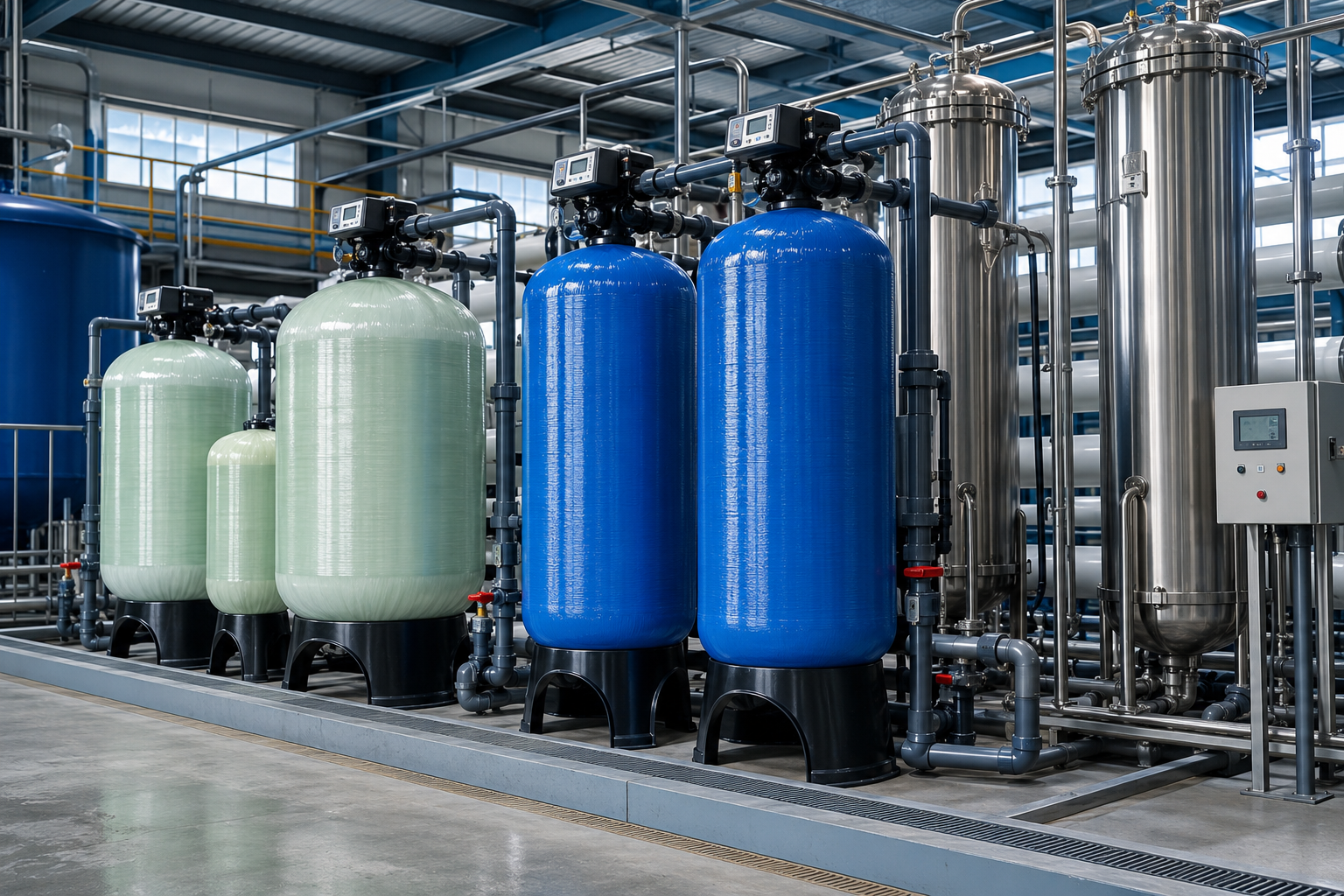
For brand owners, distributors, and EPC buyers, a storage tank is not just a container. It is a risk-control component inside a larger water treatment system. When I review storage requirements, I usually start with one question: “What failure would hurt the buyer most?”
Why Should Water and Wastewater Treatment Industry Storage Solutions Be Treated as Risk-Control Components?
A storage solution may look like a low-complexity purchase, but it can become the weak point in an RO, UF/NF, softening, or wastewater reuse project. If buyers treat it as a commodity, they may miss the real risks: material mismatch, sealing failure, unstable quality, and non-compliance in the target market3.
Water and wastewater treatment industry storage solutions should be treated as risk-control components because they directly affect system stability, product safety, and after-sales cost. Buyers should confirm the medium, pressure, temperature, capacity, installation environment, process role, and certification requirements before requesting a quotation.
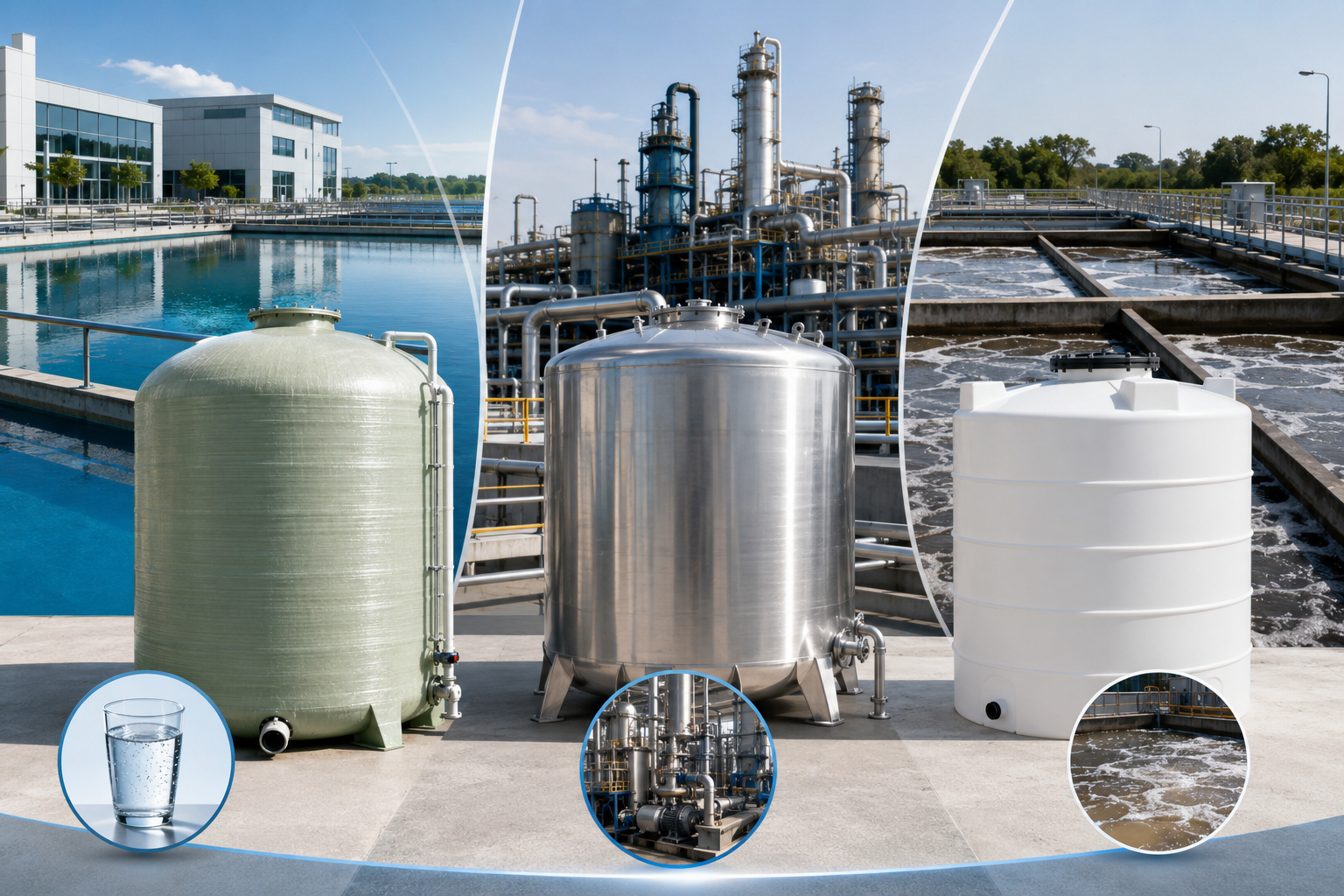
Start With the Application, Not the Tank
I always recommend that buyers define the application before comparing tank suppliers. A storage tank for drinking water, a chemical dosing tank, a raw water buffer tank, and a wastewater collection tank may all have similar shapes. However, they do not carry the same technical risk.
A practical inquiry should include:
- Stored medium: drinking water, raw water, softened water, RO permeate, brine, wastewater, chemicals, or mixed liquid
- Operating pressure: atmospheric, low pressure, or system-connected pressure
- Temperature range: normal temperature, heated water, outdoor high-temperature exposure, or cold-region use
- Capacity requirement: pilot scale, commercial system, industrial project, or municipal rollout
- System function: buffer storage, backwash water, product water, chemical contact, or process balancing
- Target market: local drinking water rules, CE requirements, NSF expectations, or other project specifications
- Connection method: flange, threaded port, customized interface, skid integration, or containerized layout
This information reduces ambiguity. It also helps the manufacturer select the right material, wall thickness, accessories, and testing procedure.
Why Price-First Buying Creates Hidden Cost
A lower unit price can look attractive during procurement. However, the real cost appears after shipment if the supplier cannot control process consistency.
Common procurement risks include:
-
Corrosion or material degradation
This can happen when the medium is more aggressive than expected. -
Leakage at seams, ports, or fittings
Poor sealing design can increase installation complaints and warranty claims. -
Inconsistent dimensions across batches
Brand owners may face assembly problems if tank openings or mounting points vary. -
Shortened service life
Wrong material selection can reduce field performance and raise replacement cost. -
Certification mismatch
A product may be acceptable in one market but blocked in another.
I see storage solutions as part of the buyer’s brand promise. If a tank fails, the end user usually blames the system brand, not the component factory.
A Better Pre-Quotation Checklist
| Procurement Question | Why It Matters |
|---|---|
| What liquid will be stored? | Determines material compatibility and hygiene requirements |
| What is the operating pressure? | Affects structural design and testing standards |
| What is the temperature range? | Influences material selection and deformation risk |
| Is the tank used with RO, UF/NF, softening, or filtration? | Impacts connection design and system layout |
| Which market will receive the product? | Determines certification and documentation needs |
| Is this batch procurement or a one-time project? | Affects quality consistency and production planning |
When buyers provide this information early, I can help them compare solutions based on risk, not guesswork.
How Should Buyers Match Storage Materials to Drinking Water, Industrial Water, and Wastewater?
Many buyers ask which tank material is best. I do not answer that directly, because no material is universally best. The wrong logic can lead to over-specification, unnecessary cost, or under-protection. Drinking water, industrial water, and wastewater applications require different selection rules.
Buyers should match storage materials by evaluating hygiene needs, corrosion risk, pressure conditions, temperature, and process compatibility. FRP, stainless steel, UPVC, and other materials can all be suitable in different applications, but the best choice depends on the stored medium and the role of the tank in the water treatment system.
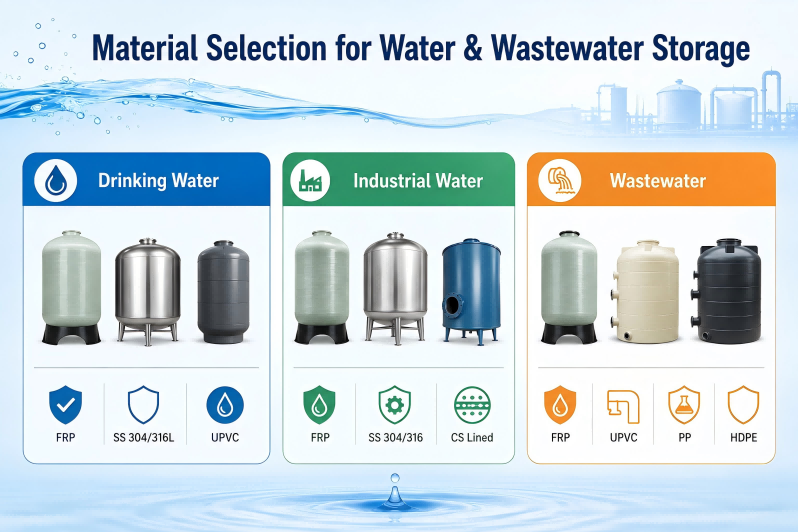
Material Choice Is Application-Specific
In water treatment projects, the same storage volume can require very different materials. I have seen buyers compare two tanks only by cubic meters and then get confused by the price gap. Usually, the difference comes from material grade, manufacturing process, pressure rating, lining design, fittings, or certification requirements.
Here is a simplified comparison:
| Application Type | Common Storage Need | Key Risk | Possible Material Direction |
|---|---|---|---|
| Drinking water | Clean water storage, direct drinking systems | Hygiene, odor, contamination | Food-grade FRP, stainless steel, qualified plastic materials |
| Industrial process water | RO permeate, boiler feed water, pure water buffer | Conductivity control, corrosion, pressure | Stainless steel, FRP, lined tanks, system buffer tanks |
| Wastewater | Collection, equalization, reuse process storage | Corrosion, suspended solids, odor, chemicals | FRP, reinforced plastic, coated steel, customized anti-corrosion options |
| Chemical dosing | Acid, alkali, antiscalant, cleaning agents | Chemical compatibility | PE, UPVC, FRP, or other compatible materials |
| Filtration and softening systems | Media tanks, brine tanks, backwash storage | Pressure, regeneration chemicals | FRP pressure vessels, brine tanks, system tanks |
This table is not a universal rule. It is a starting point for discussion.
FRP Storage Solutions
FRP is often used in water treatment because it offers corrosion resistance, relatively low weight, and flexible manufacturing4. In our manufacturing experience, FRP pressure vessels and tanks are common in filtration, softening, and certain industrial water applications.
However, FRP should still be matched carefully. Buyers should confirm:
- Resin system compatibility
- Design pressure
- Operating temperature
- Liner material
- Port design
- UV exposure conditions
- Drinking water approval requirements if used for potable water
FRP can be a strong choice when corrosion resistance and weight matter. However, I would not call it automatically superior to stainless steel or plastic. It depends on the project.
Stainless Steel Storage Solutions
Stainless steel is often selected for hygiene-sensitive applications, pure water systems, food and beverage water, pharmaceuticals, laboratories, and industrial projects where cleanability and appearance matter.5
Buyers should check:
- Stainless steel grade, such as 304 or 316L
- Welding quality
- Surface treatment
- Passivation requirements
- Internal roughness if hygiene is critical
- Chloride exposure risk
- Connection and sealing design
Stainless steel can perform well, but it is not immune to corrosion. High chloride environments, aggressive cleaning chemicals, or poor welding can still create problems.6 This is why material grade and process control matter as much as the material name.
Plastic and UPVC-Based Options
UPVC and other plastic components can be useful in low-pressure systems, chemical dosing, and certain wastewater or pretreatment areas.7 They can provide good chemical resistance in suitable conditions.
Buyers should confirm:
- Chemical compatibility
- Mechanical strength
- Temperature limits
- UV resistance
- Joint and fitting reliability
- Local compliance requirements
For distributors, the key is not to collect every possible material option. The key is to build a product line where each storage solution has a clear application boundary.
What Supplier Capabilities Matter Most for Water and Wastewater Treatment Industry Storage Solutions?
A good drawing and a low quotation do not guarantee stable batch supply. Buyers need to know whether the supplier can produce consistent storage tanks across repeated orders. Without process control, one sample may pass, while the next container may create assembly or field problems.
The most important supplier capabilities for water and wastewater treatment industry storage solutions are customization ability, material matching knowledge, dimensional consistency, sealing reliability, pressure and leakage testing, documentation support, and certification alignment. These capabilities reduce procurement risk during batch orders and project execution.
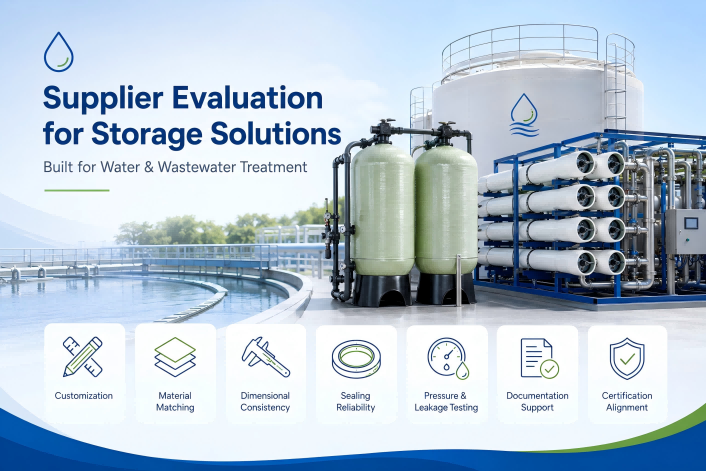
Customization Capability Is More Than Changing the Size
Many buyers use the word “customized” to mean special dimensions. In real procurement, customization is broader. It includes material, fittings, reinforcement, ports, color, branding, packaging, documentation, and integration with water treatment equipment.
For brand owners and distributors, customization may include:
- Logo and label requirements
- Packaging for local retail or project delivery
- Port position adjustments
- Skid-mounted system integration
- Containerized plant layout
- Special tank openings
- FRP or stainless steel material changes
- Pressure vessel design changes
- Documentation for customs, tenders, or engineering review
At Hedelong, I see customization as a coordination process between engineering, production, QC, and the buyer’s procurement team. If one side only discusses unit price, important design information can be missed.
Manufacturing Process Control
Storage tank quality depends heavily on process control. For example, FRP production may involve CNC filament winding, curing control, liner preparation, and pressure testing. Stainless steel production may involve cutting, welding, polishing, cleaning, and inspection. Plastic component production may involve molding accuracy and material stability.
A supplier should be able to explain:
| Capability | Buyer Benefit |
|---|---|
| Material inspection | Reduces risk of non-compliant raw materials |
| Dimensional control | Improves batch assembly consistency |
| Pressure testing8 | Confirms structural and sealing reliability |
| Leakage testing | Reduces after-sales complaints |
| Functional inspection | Verifies real use conditions |
| Traceable QC records9 | Supports claims, audits, and project documentation |
I prefer suppliers that can discuss these points clearly. A vague answer like “quality is very good” does not help a procurement manager reduce risk.
Certification Fit
Certifications matter because buyers often sell into regulated markets. However, buyers should avoid checking certificates only as a formality. The better question is: Does the certification fit the product, application, and target market?
Relevant documentation may include:
- ISO9001 quality management
- ISO14001 environmental management
- CE documentation for applicable products10
- NSF-related requirements for potable water markets11
- Drinking water hygiene compliance for specific regions
- Material safety declarations
- Pressure test reports
- Product drawings and technical files
Not every storage solution requires the same certificates. Also, not every certificate applies to every product category. Buyers should ask suppliers to match documentation to the exact model and application.
Batch Procurement Requires Consistency
A single project order can tolerate more manual coordination. A distributor program cannot. When annual procurement reaches millions of dollars, small inconsistencies become expensive.
Brand owners should evaluate whether the supplier can support:
- Stable dimensions across batches
- Repeatable sealing quality
- Consistent material sourcing
- Predictable delivery schedules
- Private-label packaging
- Spare parts and accessory continuity
- Technical communication before and after shipment
This is where manufacturing experience matters. A supplier that understands RO systems, UF/NF systems, media filters, softeners, EDI systems, and integrated package plants can usually communicate better about the storage tank’s real function in the system.
How Can Buyers Compare Water and Wastewater Treatment Industry Storage Solutions Before Batch Procurement?
Batch procurement increases both opportunity and risk. A buyer may save cost through volume purchasing, but a wrong selection can multiply defects across many projects. Before signing a large order, buyers should compare suppliers through technical review, sample validation, documentation checks, and quality-control transparency.
Buyers can compare water and wastewater treatment industry storage solutions by using a structured supplier scorecard. The scorecard should review application matching, material selection, customization capability, QC process, pressure or leakage testing, certification fit, production capacity, packaging, delivery reliability, and after-sales support.
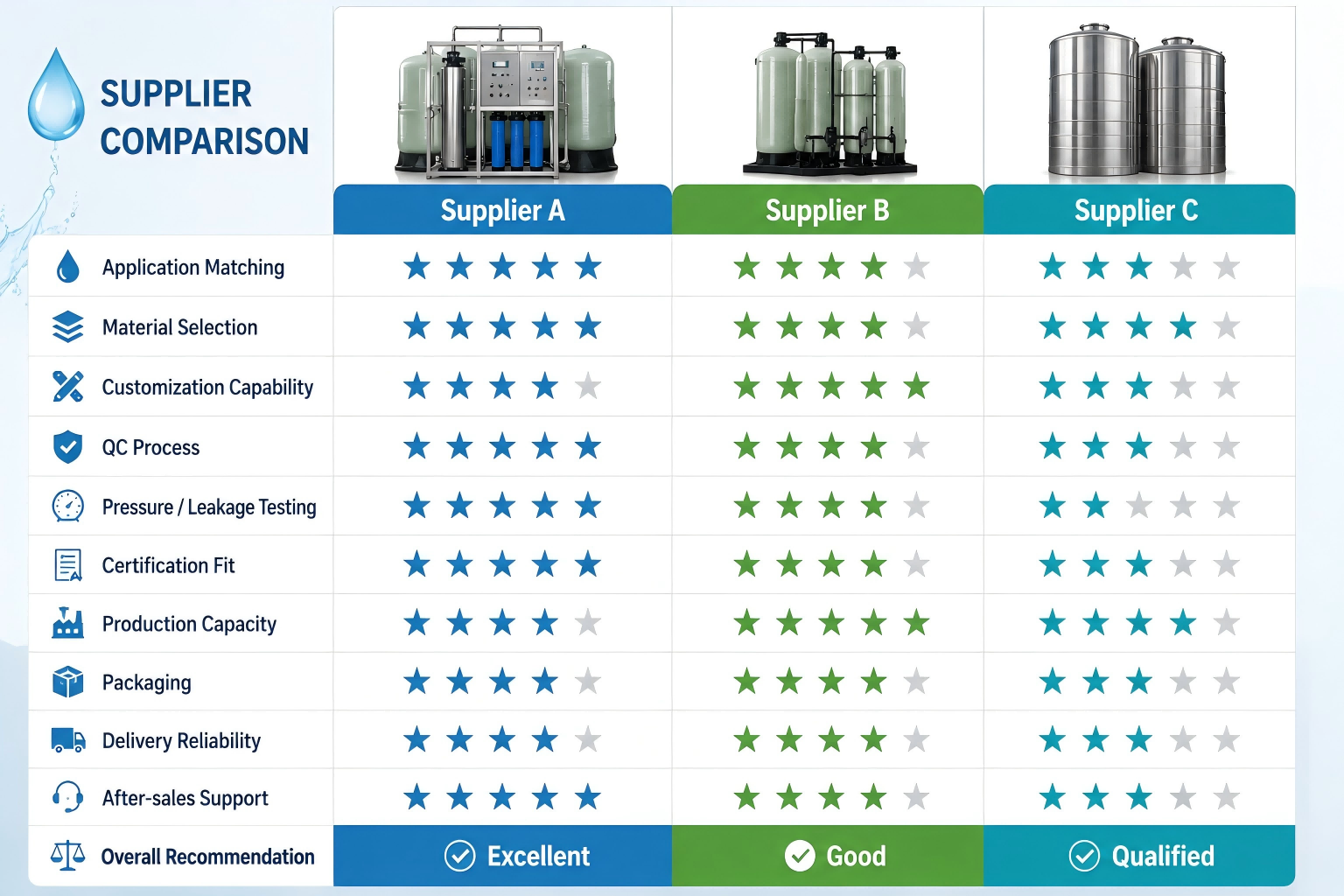
Use a Supplier Scorecard
I like scorecards because they make procurement decisions less emotional. They also help engineering, purchasing, and after-sales teams discuss the same criteria.
Here is a simple example:
| Evaluation Area | Weight | What to Check |
|---|---|---|
| Application matching | 20% | Medium, pressure, temperature, system role |
| Material selection | 15% | Compatibility, hygiene, corrosion resistance |
| Customization | 15% | Ports, dimensions, branding, packaging, drawings |
| Quality control | 20% | Testing process, inspection records, dimensional consistency |
| Certification | 10% | Market-specific documents and product relevance |
| Production capacity | 10% | Batch supply, lead time, production line stability |
| Communication and support | 10% | Technical response, problem solving, documentation |
A cheap supplier may score high on price but low on risk control. A more capable supplier may cost more at the beginning but reduce warranty issues and customer complaints later.
Ask Better Technical Questions
Buyers can learn a lot from the way a supplier answers questions. I suggest asking questions such as:
- What material do you recommend for this medium, and why?
- What is the maximum operating pressure and test pressure?
- How do you control dimensional tolerance?
- What sealing structure do you use for the ports?
- Can you provide drawings before production?
- Can you support private-label packaging?
- Which certifications apply to this product, not just your factory?
- What inspection is performed before shipment?
- Can you support repeat orders with the same specifications?
A strong supplier should give specific answers. If the supplier avoids technical details, the buyer should be careful.
Compare Total Procurement Risk, Not Only Unit Price
Unit price is important. I never ignore it. However, I believe the better comparison is total procurement risk.
Total risk includes:
- Product failure risk
- Installation or assembly risk
- Delivery delay risk
- Certification risk
- Brand reputation risk
- Warranty and replacement cost
- Communication cost
- Project execution risk
For example, if a distributor imports a batch of storage tanks for commercial RO systems and the port positions are inconsistent, the problem does not stay inside the factory. It spreads to installers, dealers, project contractors, and end users. The repair cost may exceed the initial savings.
Pilot Orders and Technical Confirmation
Before large batch procurement, I often recommend a controlled pilot process:
- Confirm application data and drawings
- Select material and accessories
- Produce sample or trial batch
- Perform inspection and testing
- Review packaging and labeling
- Confirm documentation
- Approve mass production specifications
This process may take more time at the beginning. However, it helps prevent repeated problems later.
For large distributors and brand owners, this is especially important when launching a new product line or entering a new regional market. Different markets may have different expectations for product appearance, labels, certificates, packaging strength, and after-sales documentation.
Frequently Asked Questions
What is the primary factor when choosing storage tanks for water treatment systems?
The primary factor is the stored medium and operating condition. Buyers should confirm water type, pressure, temperature, corrosion risk, hygiene needs, and system role before comparing tank capacity or price. These details determine the proper material, design, testing method, and certification requirements.
Is FRP better than stainless steel for water and wastewater storage?
FRP is not universally better than stainless steel. FRP can be suitable for corrosion resistance and lighter-weight designs, while stainless steel may suit hygiene-sensitive or pure water applications. The better choice depends on the medium, pressure, temperature, certification requirements, and long-term operating environment.
What should distributors check before bulk purchasing storage solutions?
Distributors should check material compatibility, dimensional consistency, sealing reliability, pressure or leakage testing, customization support, certification fit, packaging, and repeat-order stability. A low price is not enough if the supplier cannot maintain consistent quality across batches.
Why do drinking water and wastewater tanks need different selection logic?
Drinking water tanks prioritize hygiene, odor control, and safe material contact. Wastewater tanks often face corrosion, suspended solids, odor, and chemical exposure.12 Because the risks are different, buyers should not use the same material or supplier evaluation logic for both applications.
How can a buyer reduce after-sales risk when sourcing storage tanks?
A buyer can reduce after-sales risk by giving complete application data, requesting drawings, confirming materials, reviewing supplier QC processes, checking certifications, and starting with samples or pilot batches. Clear specifications before production help prevent leakage, corrosion, assembly issues, and compliance problems.
Conclusion
Water and wastewater treatment industry storage solutions should be chosen as part of a complete procurement risk-control strategy. I would not select a tank by capacity and price alone. I would first confirm the medium, pressure, temperature, hygiene needs, corrosion risk, system role, customization details, and certification requirements. Then I would evaluate whether the supplier can produce consistent quality at batch scale. If you need OEM/ODM storage solutions or integrated water treatment equipment for your market, contact Hedelong to discuss your project specifications and supplier requirements.
"Finished Drinking Water Storage Tanks Presentation", https://19january2021snapshot.epa.gov/sites/static/files/2016-05/documents/finished_drinking_water_storage_tanks.pdf. Institutional guidance on water-storage infrastructure identifies corrosion control, leakage prevention, sanitary design, and maintenance as factors affecting water quality and system reliability; this supports the article’s risk framing, although it does not quantify after-sales costs for commercial buyers. Evidence role: general_support; source type: institution. Supports: Storage tank selection and maintenance affect leakage risk, corrosion control, water hygiene, and lifecycle costs in water systems.. Scope note: Contextual support; the source may discuss public or utility systems rather than OEM procurement specifically. ↩
"49 CFR Part 178 Subpart H -- Specifications for Portable ...", https://www.ecfr.gov/current/title-49/subtitle-B/chapter-I/subchapter-C/part-178/subpart-H. Engineering standards and water-industry guidance treat liquid characteristics, operating pressure, temperature, corrosion exposure, sanitary requirements, and testing documentation as design and acceptance factors for storage tanks; this supports the article’s checklist approach. Evidence role: expert_consensus; source type: institution. Supports: Tank selection should account for stored liquid characteristics, pressure, temperature, corrosion exposure, hygiene requirements, testing, and applicable standards.. Scope note: Contextual support; no single source may cover every listed factor in one place. ↩
"NSF/ANSI/CAN 61 - 2022 - Drinking Water System ...", https://downloads.regulations.gov/HUD-2010-0060-0049/attachment_3.pdf. Quality-management and drinking-water product standards require control of materials, conformity, traceability, and product-relevant requirements, supporting the article’s point that treating tanks as undifferentiated commodities can overlook technical and regulatory risks. Evidence role: general_support; source type: institution. Supports: Supplier quality controls, material compatibility, sealing design, and product-specific compliance affect storage tank reliability and acceptance.. Scope note: Contextual support; the source would support the risk categories rather than prove that price-first buying always causes them. ↩
"Polyethylene Storage Tanks Strengthened Externally with ...", https://pmc.ncbi.nlm.nih.gov/articles/PMC12252400/. Peer-reviewed composites literature describes fiber-reinforced polymers as low-density materials with corrosion-resistant resin matrices and adaptable fabrication methods, supporting their use in selected water-treatment tanks and vessels. Evidence role: mechanism; source type: paper. Supports: FRP composites can offer corrosion resistance, low density, and design flexibility that make them suitable for selected water and wastewater infrastructure applications.. Scope note: Contextual support; FRP suitability still depends on resin system, temperature, pressure, UV exposure, and liquid chemistry. ↩
"Sanitary Design and Construction of Food Equipment1", https://ucfoodsafety.ucdavis.edu/sites/g/files/dgvnsk7366/files/inline-files/26502.pdf. Hygienic-design guidance for food and process equipment identifies stainless steel as a common material for cleanable surfaces in sanitary applications, supporting its selection for hygiene-sensitive water systems. Evidence role: expert_consensus; source type: institution. Supports: Stainless steel is widely used in hygienic equipment because it is cleanable, durable, and compatible with sanitary design principles.. Scope note: Contextual support; the source may address food or pharmaceutical equipment generally rather than water-storage tanks specifically. ↩
"Stainless Steel Corrosion Case Studies", https://publications.sto.nato.int/publications/STO%20Meeting%20Proceedings/STO-MP-AVT-303/MP-AVT-303-01.pdf. Materials-corrosion studies show that stainless steels may suffer localized corrosion in chloride-rich environments and that welding conditions can alter corrosion resistance, supporting the article’s caution that stainless steel is not corrosion-proof. Evidence role: mechanism; source type: paper. Supports: Stainless steels are susceptible to localized corrosion such as pitting and crevice corrosion in chloride-containing or chemically aggressive environments, and weld quality can affect corrosion resistance.. ↩
"Risk Evaluation for Vinyl Chloride", https://www.epa.gov/assessing-and-managing-chemicals-under-tsca/risk-evaluation-vinyl-chloride. Technical guidance on plastic piping and chemical-resistance ratings indicates that UPVC/PVC materials are suitable for selected low-pressure water and chemical-handling services within specified pressure, temperature, and compatibility limits. Evidence role: general_support; source type: institution. Supports: UPVC/PVC materials can be used in selected low-pressure water, wastewater, and chemical-handling applications when chemical, pressure, and temperature limits are observed.. Scope note: Contextual support; compatibility must be verified for the exact chemical concentration, temperature, and mechanical load. ↩
"Pressure Testing", https://www.nationalboard.org/SiteDocuments/General%20Meeting/2024-6-LOWER.pdf. Pressure-vessel and water-tank standards use hydrostatic or pressure tests to demonstrate pressure-retaining integrity and identify leakage before service, supporting the article’s use of pressure testing as a reliability check. Evidence role: mechanism; source type: institution. Supports: Hydrostatic or pressure testing is used to verify structural integrity and detect leakage in tanks, vessels, or related pressure-retaining components.. Scope note: Contextual support; the applicable test method depends on whether the product is atmospheric, low-pressure, or a regulated pressure vessel. ↩
"Identification and Traceability", https://the9000store.com/iso-9001-2015-requirements/iso-9001-2015-operational-requirements/identification-traceability/. ISO 9001 quality-management requirements emphasize documented information, control of production, identification, traceability where applicable, and handling of nonconforming outputs, supporting the article’s claim that traceable QC records assist audits and claims. Evidence role: expert_consensus; source type: institution. Supports: Documented quality records and traceability are recognized quality-management practices for demonstrating conformity and supporting audits or corrective action.. Scope note: Contextual support; ISO 9001 establishes management-system practices rather than product performance for a specific tank model. ↩
"CE marking", https://en.wikipedia.org/wiki/CE_marking. European Commission guidance states that CE marking is required only for product categories covered by specific EU legislation and requires supporting technical documentation, supporting the article’s qualification that CE documentation is relevant for applicable products. Evidence role: definition; source type: government. Supports: CE marking and related technical documentation apply only to products covered by relevant EU harmonization legislation.. ↩
"Using Standards to Improve Water Quality", https://www.epa.gov/vcs/using-standards-improve-water-quality. NSF/ANSI/CAN 61 establishes health-effects criteria for materials and components that contact drinking water, supporting the article’s reference to NSF-related requirements for potable-water markets. Evidence role: definition; source type: institution. Supports: NSF/ANSI/CAN 61 addresses health-effects requirements for drinking-water system components and materials in contact with potable water.. ↩
"Cleaning & Disinfection of Water Holding Tanks", https://dec.alaska.gov/eh/dw/resources/disinfection-water-storage-tanks/. Public-health and wastewater engineering guidance distinguishes potable-water storage, where sanitary contact materials and contamination prevention are primary, from wastewater handling, where corrosive constituents, solids, odors, and chemical variability are design concerns. Evidence role: general_support; source type: government. Supports: Potable-water storage requires sanitary material contact and contamination control, while wastewater storage must account for corrosion, solids, odors, and chemical variability.. Scope note: Contextual support; the source may not directly compare tank procurement categories in the same wording as the article. ↩