
How to Build a Water Treatment System by Yourself?
Building your own water treatment system is not as simple as just buying a few filters, pumps, membranes, tanks, and valves and putting them together. For actual projects in business, industry, municipal services, agriculture, and other fields, the real issue is:
Can this system consistently produce the water quality you need during actual operation?
Table of Contents
- 1. What Exactly Does “Building a Water Treatment System by Oneself” Mean?
- 2. Start With Water Quality Rather Than Choosing Equipment First
- 3. Clearly Define the Water Quality Standards You Aim to Achieve
- 4. Before Choosing Accessories, Calculate the Flow Rate First
- 5. Understand the Function of Each Treatment Process
- 6. When Is It Necessary to Customize a Water Treatment System?
- 7. Common Mistakes Made by Buyers
- 8. Before Contacting the Supplier, Prepare These Pieces of Information
- 9. Final Checklist Before Placing an Order
- 10. Summary
- Suggested Quotation Format
1. What Exactly Does “Building a Water Treatment System by Oneself” Mean?
Many buyers search for “how to build a water treatment system by themselves”, hoping to better control costs, configuration, performance, delivery time, and post-installation maintenance.
But for engineering projects, this issue cannot simply be regarded as “assembling parts.”
A water treatment system is not merely a collection of components, but a complete treatment process. Its design should be based on the following key factors:
| Key Factor | Why Is It Important? |
|---|---|
| Water source quality | Determines the pretreatment method to be used, the type of membrane to be selected, whether there will be scaling, the number of filtration stages required, and whether chemical dosing is needed. |
| Purpose of using water | The standards for drinking water, boiler make-up water, process water, irrigation, aquaculture, and reclaimed water reuse are all different. |
| Water usage method | If the system is too small, it cannot meet demand during peak hours; if it is too large, both operating cost and system load will increase. |
| Site conditions | Space size, temperature, drainage, power supply, and installation environment all affect the system layout. |
| Operating mode | Intermittent operation and continuous operation have different requirements for water storage tanks, pumps, control systems, and protection devices. |
| Operation and maintenance capability | Even with advanced technology, problems may occur if users do not maintain the system properly. |
| Compliance requirements | Some projects require CE, NSF, ISO documents, local licenses, health certificates, or third-party test reports. |
In other words, the goal is not simply to “purchase a water treatment system.”
The real goal is to design, supply, install, commission, and maintain a system that can continuously produce qualified water under actual operating conditions.
2. Start With Water Quality Rather Than Choosing Equipment First
The first step is always to understand your raw water.
Before choosing RO membranes, ultrafiltration modules, FRP tanks, pumps, filters, dosing systems, or control valves, you should first obtain a water quality test report1.
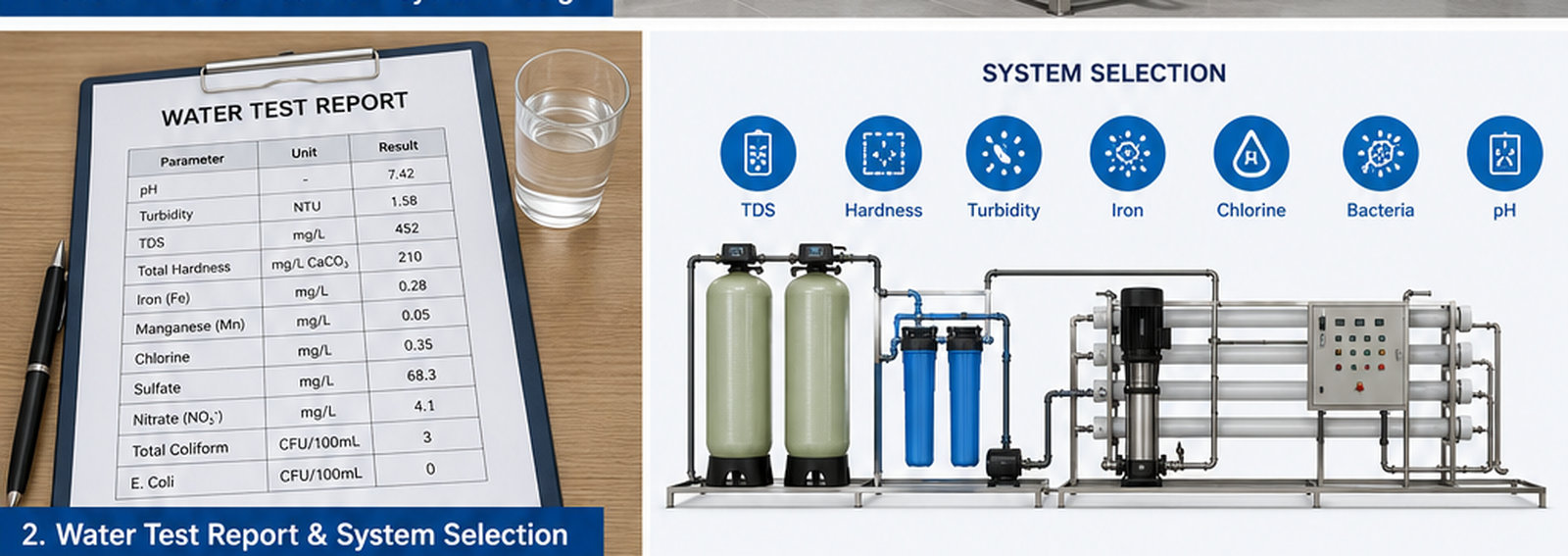
A useful water quality report usually includes the following indicators:
| Indicator | Why Does It Affect System Design? |
|---|---|
| TDS / Conductivity | Determines whether RO, NF, or desalination processes are required.2 |
| Hardness | Affects the risk of scaling and determines whether softening or antiscalant dosing is necessary.3 |
| Turbidity | Determines whether sedimentation, multimedia filtration, or ultrafiltration should be used as pretreatment. |
| Iron and manganese | May require oxidation, filtration, or other special treatment. |
| Residual chlorine | Can damage membranes and usually needs to be removed by activated carbon.4 |
| pH value | Affects corrosion, scaling, chemical dosing, and material selection. |
| Microorganisms | Determines whether UV, ozone, chlorine, or other disinfection methods are necessary. |
| Silicon dioxide | Important for boilers, industrial applications, and high-recovery RO systems. |
| Organic substances | May require activated carbon, ultrafiltration, chemical oxidation, or special pretreatment. |
A common mistake is to ask about the price before providing water quality data. Without water quality data, the supplier can only offer a rough configuration rather than a reliable solution.
3. Clearly Define the Water Quality Standards You Aim to Achieve
After understanding the raw water, the next step is to clearly define what kind of treated water quality you need.
Different uses have very different requirements for water quality.
| Purpose | Typical Water Quality Requirements |
|---|---|
| Community drinking water | Safe, stable, clear water that meets disinfection requirements and local drinking water regulations. |
| Hotel or commercial building | Stable water volume, good taste, low turbidity, moderate hardness, and reliable daily operation. |
| Boiler make-up water | Low hardness, low scaling risk, and stable conductivity. Usually requires softening + RO. |
| Food and beverage process water | Hygienic materials, stable taste, controllable microorganisms, and possibly polishing treatment. |
| Industrial process water | Customized according to production process requirements. |
| Agricultural irrigation | Removes suspended solids, controls salt content, and prevents clogging. |
| Aquaculture water | Controls turbidity, maintains dissolved oxygen and biological balance, and supports stable circulation and disinfection. |
| Laboratory or electronics water | High-purity water or ultrapure water, possibly requiring RO + EDI + advanced polishing treatment. |
A technically correct component, if used in the wrong place, may still cause project failure.
For instance, RO can remove salt, but it cannot automatically solve all problems.5 If the raw water has high turbidity, excessive iron, high hardness, or a large amount of organic matter, the RO membrane may soon become clogged without proper pretreatment.
4. Before Choosing Accessories, Calculate the Flow Rate First
Flow rate is one of the most important inputs in system design.
You need to be clear about the following points:
| Flow Item | Meaning |
|---|---|
| Hourly flow rate | How much water needs to be processed per hour? |
| Daily water consumption | How much water is consumed in total every day? |
| Peak flow rate | What is the maximum flow during peak water usage? |
| Running time | Does the system operate for 8 hours, 12 hours, 20 hours per day, or continuously? |
| Water storage tank capacity | Is it necessary to store treated water to cope with peak demand? |
| Backup requirements | Does the project require redundant or standby units? |
For instance, two projects may both state that “20 tons of water are needed every day,” but the system designs could be completely different.
| Project A | Project B |
|---|---|
| 20 tons per day, evenly distributed over 20 hours. | 20 tons per day, to be used within 5 hours. |
| Lower hourly flow requirement. | Much higher hourly flow requirement. |
| Smaller pumps and membranes may be used. | A larger system or a larger water storage tank is needed. |
| Initial investment is relatively low. | Investment is higher, but peak water supply is more stable. |
Therefore, merely stating “how many tons per day” is not sufficient. For engineering design, hourly flow rate and peak flow rate are often more important6.
5. Understand the Function of Each Treatment Process
Many buyers believe that different processes are similar and can be used interchangeably. However, in water treatment projects, each process has its own specific function.
A reliable system is not simply a combination of filters, pumps, tanks, and membranes. The key lies in whether each component is selected and arranged based on the water source quality, target water quality, flow requirements, and operation conditions.
| Process / Component | Main Function / Role | Common Uses |
|---|---|---|
| Multimedia filter | Removes suspended solids, silt, and turbidity. | Pretreatment before softening, ultrafiltration, or RO. |
| Activated carbon filter | Removes residual chlorine, odor, color, and some organic substances.7 | Drinking water treatment, RO pretreatment, and taste improvement. |
| Softener | Removes hardness through ion exchange.8 | Boiler make-up water, RO protection, commercial softened water, and scale prevention. |
| Ultrafiltration system (UF) | Removes fine particles, colloids, bacteria, and turbidity.9 | Pretreatment, drinking water, reclaimed water reuse, and surface water treatment. |
| Reverse osmosis system (RO) | Reduces dissolved salts, TDS, ions, and other contaminants.10 | Drinking water, desalination, process water, boiler make-up water, and industrial water treatment. |
| Nanofiltration system (NF) | Provides partial desalination, hardness reduction, and removal of organic substances. | Selective separation, drinking water, process water, and special industrial water. |
| EDI system | Produces high-purity water after RO treatment. | Electronics, laboratories, pharmaceuticals, power plants, and other high-purity water applications. |
| UV sterilizer | Inactivates microorganisms through ultraviolet radiation.11 | Final disinfection, circulating water treatment, and drinking water safety assurance. |
| Dosing system | Adds chemicals to adjust pH, add antiscalants, oxidants, or disinfectants. | Pretreatment, RO protection, scale control, and system safety. |
| FRP tank | A pressure vessel used for loading filtration or softening media. | Sand filters, carbon filters, softeners, manganese sand filters, and other media filtration systems. |
| FRP membrane housing | A pressure vessel used for loading RO or NF membranes. | RO systems, nanofiltration systems, desalination systems, and industrial water treatment equipment. |
| Control valve | Automatically controls backwashing, regeneration, operation, flushing, and cleaning cycles. | Automatic control of filters, softeners, and pretreatment systems. |
| Pump | Provides flow and pressure for the entire system. | Raw water lifting, pressurization, RO high-pressure operation, and treated water transportation. |
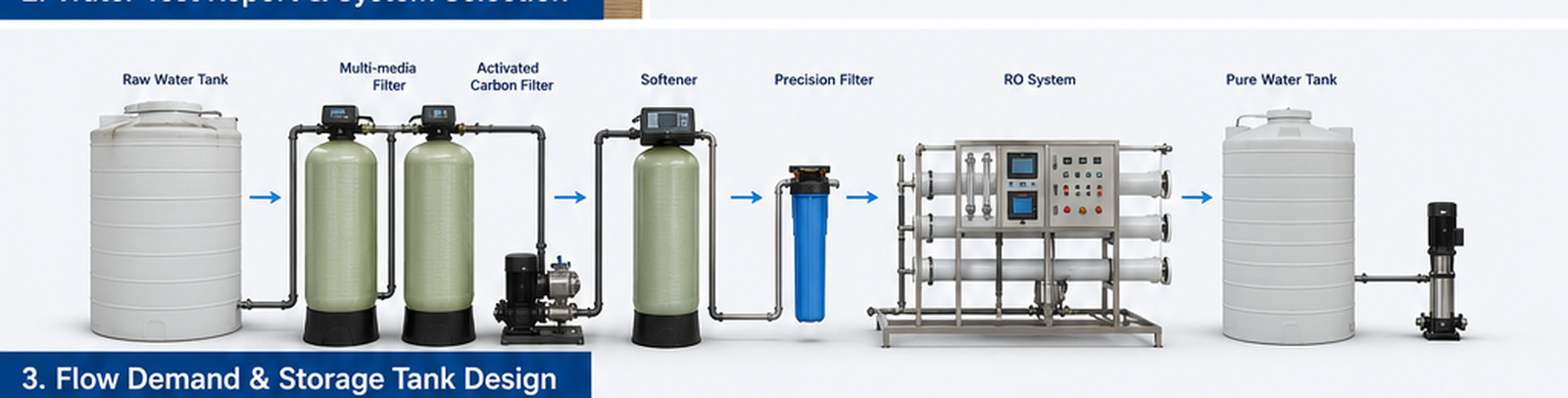
A reliable water treatment system usually depends on the correct sequence of each process.
For instance, a typical process flow might be:
Raw water → Sedimentation → Multimedia filtration → Activated carbon filtration → Softening / antiscalant dosing → Precision filtration → RO → UV sterilization → Pure water tankHowever, this is just an example and not a universal solution. Groundwater, tap water, seawater, surface water, reclaimed water, and industrial wastewater may each require different treatment routes.
6. When Is It Necessary to Customize a Water Treatment System?
A standard configuration is only applicable when the water quality is simple and stable. When the project involves high technical risks, compliance requirements, or commercial responsibilities, a customized water treatment system is usually necessary.
Customization is not merely about changing the appearance, replacing the logo, or adjusting the equipment size. More importantly, it involves adjusting the process design, equipment configuration, control method, layout, materials, documents, packaging, and after-sales service according to the actual project requirements.
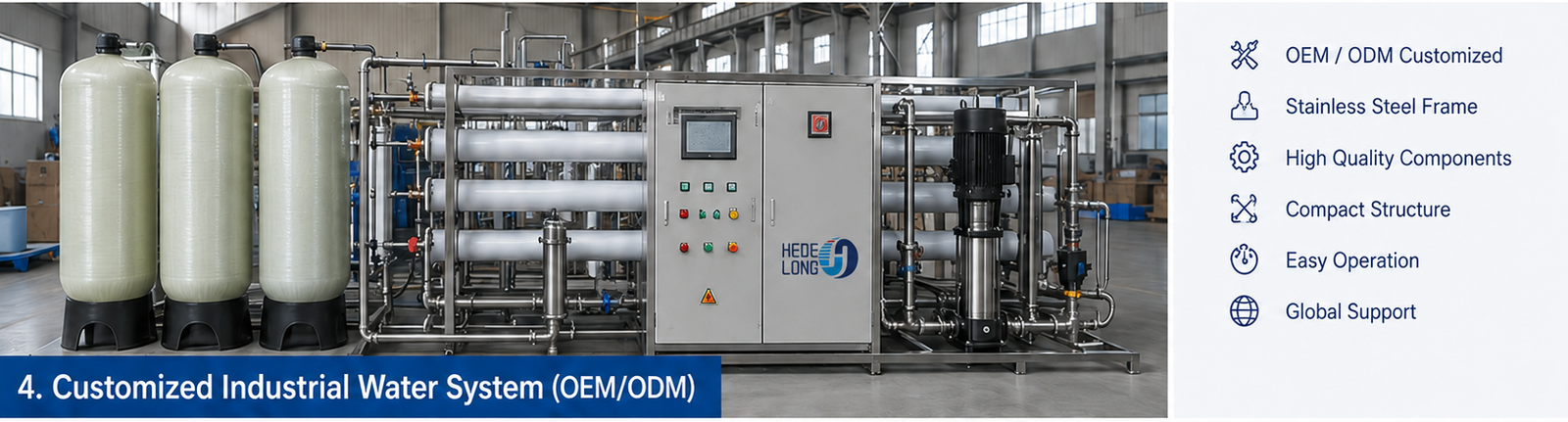
Common Reasons for Requiring Customization
| Reason for Customization | Why Is Customization Necessary? |
|---|---|
| The water source has unstable or unclear water quality. | The system may need to cope with seasonal variations, water quality fluctuations, or unknown pollutants.12 |
| The outlet water quality is strictly regulated. | Drinking water, food, industrial, or municipal projects may need to meet specific compliance or testing requirements. |
| High flow demand or continuous operation. | Pumps, water storage tanks, membrane modules, control systems, and protection devices must be precisely matched. |
| Multiple treatment processes must be integrated. | Filtration, softening, RO, UF, dosing, disinfection, and control systems must work together. |
| Limited installation space. | Skid layout, tank size, pipeline direction, maintenance space, and installation method may need adjustment. |
| Cross-border procurement. | Packaging, voltage, documents, spare parts, labels, manuals, transportation methods, and after-sales service become important. |
| Limited operation and maintenance capability. | The system should be easier to operate, clean, backwash, monitor, and maintain. |
| OEM / ODM requirements. | Customized logos, colors, labels, packaging, technical documents, and configurations may be required for brand owners or distributors. |
Before placing an order, the manufacturer can assist in evaluating whether the proposed solution is technically feasible, commercially reasonable, and suitable for long-term operation.
The purpose of customization is not to make the system more complicated, but to reduce issues such as unqualified water quality, installation problems, operational burden, compliance risks, and disputes after delivery.
7. Common Mistakes Made by Buyers
Based on manufacturer-side project communication experience, the following misunderstandings repeatedly occur.
| Common Mistake | Possible Outcome |
|---|---|
| Asking for a quotation without providing water quality information. | The quotation may be inaccurate or even misleading. |
| Thinking one plan can cover all water sources. | The system may not function properly after installation. |
| Buying parts separately without an overall process design. | When water quality problems occur, responsibility becomes unclear. |
| Only focusing on the lowest price. | Problems such as leakage, blockage, unstable water output, and short service life may occur. |
| Ignoring pretreatment. | Components such as RO membranes, pumps, and valves may fail prematurely. |
| Ignoring operation and maintenance capability. | The system may be too complex for operators to manage properly. |
| Ignoring packaging and shipping details. | Project delays, transportation damage, or missing parts may occur. |
| Ignoring documentation. | Customs clearance, project acceptance, installation, or after-sales service may be affected. |
For project buyers, price is certainly important, but incorrect configuration is usually more costly than a slightly higher initial investment.
8. Before Contacting the Supplier, Prepare These Pieces of Information
Before contacting the system manufacturer or supplier, it is advisable to prepare the following information. This will help the supplier understand the project situation and provide more accurate solutions and quotations.
| Required Information | Example |
|---|---|
| Type of water source | Municipal water, well water, river water, seawater, surface water, reclaimed water, or wastewater reuse. |
| Water quality inspection report | Key parameters include TDS, hardness, pH, turbidity, iron, manganese, residual chlorine, bacteria, conductivity, and silica. |
| Purpose of using water | Drinking water, boiler make-up water, process water, irrigation water, aquaculture water, hotel water, commercial water, or industrial water. |
| Required water quality standards | Local drinking water standards, conductivity targets, TDS targets, hardness targets, microbial requirements, or industry standards. |
| Water production capacity | 500 L/h, 2 tons/h, 10 tons/h, 100 tons/day, etc. |
| Running time | 8-hour, 12-hour, or 24-hour operation; intermittent operation or continuous operation. |
| Site conditions | Indoor or outdoor installation, usable area, environmental temperature, drainage conditions, installation environment, and maintenance space. |
| Power supply | Voltage, phase number, frequency, and local electrical requirements. |
| Automation level | Manual, semi-automatic, fully automatic, PLC control, or remote monitoring. |
| Required certifications or documents | CE documents, NSF-related product files, ISO documents, test reports, user manuals, technical drawings, or inspection documents. |
| Packaging and transportation requirements | Bulk cargo, full container, wooden cases, pallets, container loading plans, or special export packaging. |
| Maintenance requirements | Spare parts, consumables, replacement cycle, operation instructions, troubleshooting support, and after-sales service requirements. |
An excellent supplier should not merely ask:
“How many tons per hour do you need?”
Instead, they should raise sufficient technical and business questions to gain a comprehensive understanding of project risks, site conditions, water quality requirements, and long-term maintenance expectations.
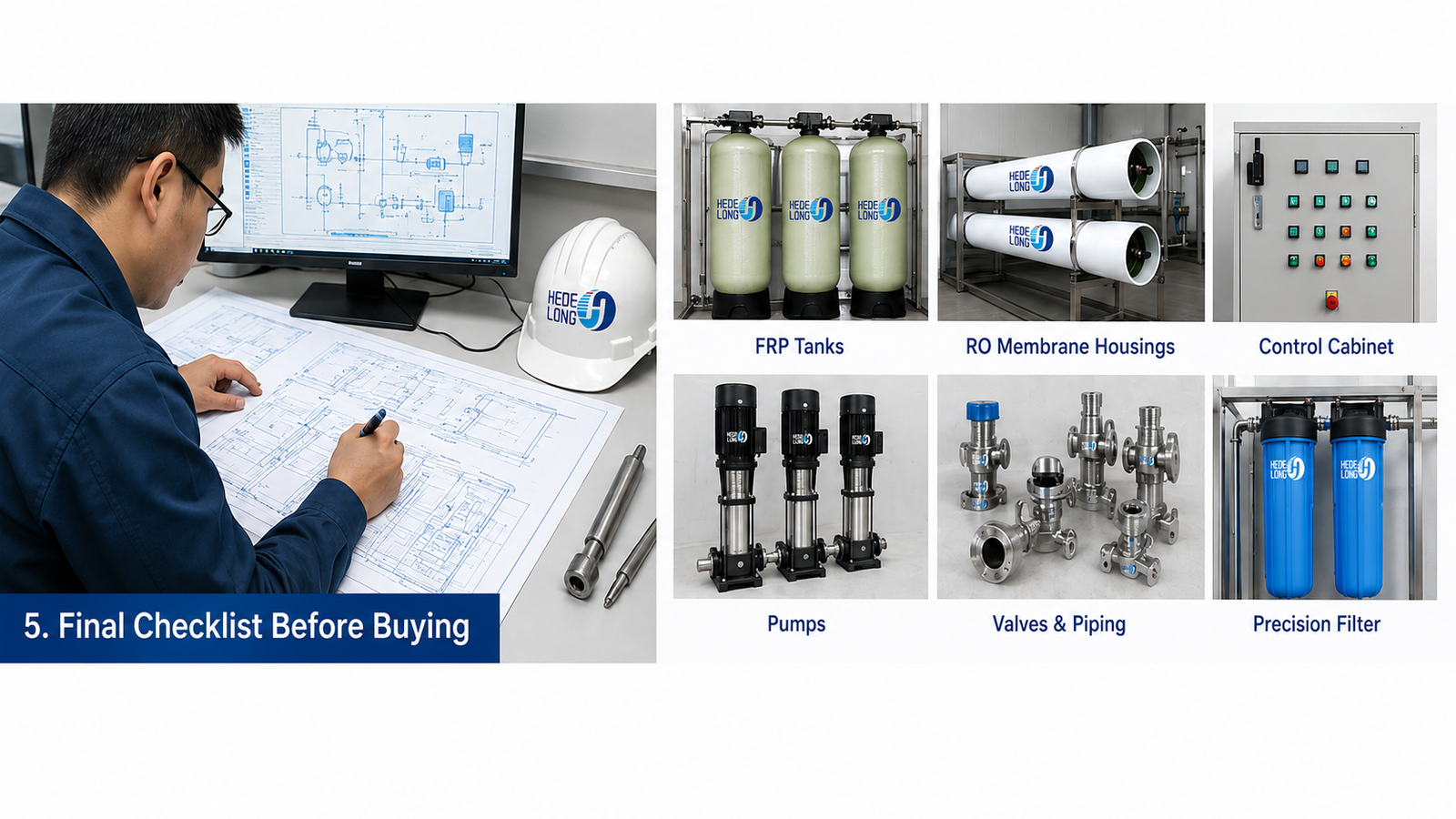
9. Final Checklist Before Placing an Order
Before confirming the order, please check each item on the following list.
| Checklist Item | Is It Confirmed? |
|---|---|
| Is the source water quality clear? | ☐ |
| Is the target water quality clearly defined? | ☐ |
| Have the hourly water demand and daily water usage been confirmed? | ☐ |
| Has peak-hour water demand been considered? | ☐ |
| Is pretreatment required? | ☐ |
| Are the pump, tank, membrane, valve, and control system compatible? | ☐ |
| Have the site layout and installation direction been considered? | ☐ |
| Have the power supply and drainage conditions been confirmed? | ☐ |
| Is the operation and maintenance method clearly defined? | ☐ |
| Have spare parts and consumables been considered? | ☐ |
| Have certification documents and technical documents been confirmed? | ☐ |
| Are the responsibilities for packaging, transportation, commissioning, and after-sales service clearly defined? | ☐ |
When purchasing a water treatment system, buyers should not merely compare equipment prices. What is more important is to confirm whether the entire solution can meet the requirements of water quality, installation conditions, operation mode, maintenance capability, and long-term project responsibility.
10. Summary
So, how exactly can one set up a water treatment system by themselves?
It does not start with buying filters, pumps, tanks, or membranes.
Instead, it begins by answering the following questions:
- What is the quality of the raw water?
- What water quality standards must be met?
- How much water is needed per hour and per day?
- What are the actual site conditions?
- Does the user have operation and maintenance capability?
- What certifications, documents, transportation, and after-sales support are required?
Only after these issues are clarified can the correct system configuration be selected.
For commercial, industrial, municipal, agricultural, and institutional projects, the water treatment system should be regarded as a solution tailored to the project, rather than a generic package of products.
A well-designed system can reduce the occurrence of substandard water quality, rework costs, compliance risks, operational burden, and liability disputes.
"Water safety plans - Guidelines for drinking-water quality - NCBI - NIH", https://www.ncbi.nlm.nih.gov/books/NBK579462/. WHO guidance on water safety planning describes source-water assessment and monitoring as inputs for selecting and managing treatment barriers, supporting the need to obtain water-quality data before choosing treatment equipment. Evidence role: expert_consensus; source type: institution. Supports: Source-water assessment and water-quality monitoring are used to determine appropriate treatment barriers and operating controls.. Scope note: The source provides general public-health and treatment-planning guidance rather than a project-specific engineering design rule. ↩
"Salinity and total dissolved solids measurements for natural waters", https://www.usgs.gov/publications/salinity-and-total-dissolved-solids-measurements-natural-waters-overview-and-a-new. Government and technical references explain that electrical conductivity is an indicator of dissolved ionic content and that pressure-driven membrane processes such as reverse osmosis and nanofiltration are used to reduce dissolved salts, supporting the use of TDS or conductivity in process selection. Evidence role: mechanism; source type: government. Supports: Conductivity is related to dissolved ionic content, and RO or NF are commonly used when dissolved salts or ions must be reduced.. Scope note: The source supports the technical basis for selection, but the exact threshold for choosing RO, NF, or another desalination method depends on local standards and project objectives. ↩
"Hardness of Water | U.S. Geological Survey - USGS.gov", https://www.usgs.gov/water-science-school/science/hardness-water. Water-chemistry references describe hardness as primarily caused by calcium and magnesium ions that can precipitate as scale, and membrane-treatment literature identifies softening and antiscalant dosing as common controls for scaling. Evidence role: mechanism; source type: education. Supports: Calcium and magnesium hardness contribute to mineral scale, and softening or antiscalant dosing is used to reduce scaling risk in treatment systems.. Scope note: The source supports the general mechanism; whether a particular system needs softening or antiscalant dosing requires site-specific water analysis and recovery calculations. ↩
"Separation, anti-fouling, and chlorine resistance of the polyamide ...", https://pubmed.ncbi.nlm.nih.gov/33706215/. Membrane-treatment literature reports that polyamide reverse-osmosis membranes are vulnerable to oxidative degradation by free chlorine and that activated carbon is commonly used for dechlorination before membrane treatment. Evidence role: mechanism; source type: paper. Supports: Free chlorine can degrade polyamide RO membranes, and activated carbon filtration is a common dechlorination method upstream of RO.. Scope note: The claim applies most directly to chlorine-sensitive membrane materials such as polyamide RO membranes; other membrane materials may have different chlorine tolerances. ↩
"Overview of Drinking Water Treatment Technologies | US EPA", https://www.epa.gov/sdwa/overview-drinking-water-treatment-technologies. Reviews of reverse-osmosis operation describe RO as a desalination process while also identifying particulate fouling, organic fouling, biofouling, and mineral scaling as operational constraints that often require pretreatment. Evidence role: expert_consensus; source type: paper. Supports: RO is effective for dissolved-solids reduction but is vulnerable to fouling, scaling, and oxidation when feedwater is not properly pretreated.. Scope note: The source supports the general limitation of RO systems but does not evaluate the specific raw-water conditions of any individual project. ↩
"[PDF] DESIGN GUIDELINES FOR WASTEWATER FACILITIES", https://mde.maryland.gov/programs/permits/watermanagementpermits/documents/wastewaterdesignguidelines-2013.pdf. Water-supply design manuals distinguish average daily demand from peak demand and use peak-flow assumptions in sizing treatment, pumping, and storage components, supporting the article’s emphasis on hourly and peak flow rates. Evidence role: general_support; source type: government. Supports: Water-system design commonly distinguishes average daily demand from peak hourly or peak day demand when sizing treatment capacity, pumps, and storage.. Scope note: The source supports standard sizing logic, but the relative importance of peak flow versus daily volume depends on the application and storage strategy. ↩
"An Evaluation of Activated Carbon for Drinking Water Treatment", https://www.ncbi.nlm.nih.gov/books/NBK234593/. Water-treatment references describe activated carbon as an adsorbent used to remove chlorine and reduce selected taste, odor, color, and organic contaminants in water. Evidence role: mechanism; source type: government. Supports: Activated carbon removes chlorine and adsorbs certain taste, odor, color, and organic compounds from water.. Scope note: Removal performance varies with carbon type, contact time, contaminant chemistry, and exhaustion state, so the source provides functional support rather than guaranteed removal efficiency. ↩
"Drinking Water Treatment: Water Softening (Ion Exchange)", https://extensionpubs.unl.edu/publication/g1491/2014/html/view. University extension materials explain that ion-exchange water softeners reduce hardness by replacing calcium and magnesium ions with sodium or potassium ions. Evidence role: definition; source type: education. Supports: Ion-exchange softeners reduce hardness by exchanging calcium and magnesium ions with other ions, commonly sodium or potassium.. Scope note: The source explains conventional ion-exchange softening; other softening methods, such as lime softening or membrane softening, are not covered by this specific mechanism. ↩
"Low Pressure Membrane Filtration for Pathogen Removal - epa nepis", https://nepis.epa.gov/Exe/ZyPURL.cgi?Dockey=P10056FL.TXT. Membrane-filtration guidance describes ultrafiltration as a low-pressure membrane process that removes suspended particles, colloids, turbidity, and many microorganisms including bacteria. Evidence role: definition; source type: government. Supports: Ultrafiltration membranes are used to remove suspended solids, colloids, turbidity, and microorganisms such as bacteria.. Scope note: The source supports typical UF capabilities, but actual microbial removal depends on membrane integrity, pore-size rating, operation, and validation testing. ↩
"Drinking Water Treatment: Reverse Osmosis", https://extensionpubs.unl.edu/publication/g1490/na/html/view. Public water-treatment references describe reverse osmosis as a pressure-driven membrane process that reduces dissolved salts, ions, total dissolved solids, and a range of other contaminants. Evidence role: mechanism; source type: government. Supports: RO uses a semi-permeable membrane and pressure to reduce dissolved ions, salts, and many other contaminants.. Scope note: The source supports general RO capability; contaminant-specific removal depends on membrane type, operating pressure, feedwater chemistry, and system condition. ↩
"[PDF] ULTRAVIOLET DISINFECTION GUIDANCE MANUAL FOR ... - EPA", https://www.epa.gov/system/files/documents/2022-10/ultraviolet-disinfection-guidance-manual-2006.pdf. Water-disinfection guidance explains that ultraviolet radiation inactivates microorganisms by damaging their genetic material, thereby preventing effective replication. Evidence role: mechanism; source type: government. Supports: Ultraviolet disinfection inactivates microorganisms by damaging nucleic acids and preventing replication.. Scope note: The source supports the mechanism of UV disinfection; effectiveness depends on UV dose, water clarity, lamp maintenance, and reactor design. ↩
"[PDF] Water Safety Plans - IRIS - World Health Organization (WHO)", https://iris.who.int/server/api/core/bitstreams/1de2d9c8-30d3-4116-a25c-db8d06e4e1d2/content. Water safety and treatment-planning guidance recognizes that source-water hazards and quality can vary over time, supporting the need for treatment designs that account for seasonal changes, fluctuations, and uncertain contaminants. Evidence role: general_support; source type: institution. Supports: Source-water quality can vary seasonally and operationally, and treatment planning should account for hazards, variability, and uncertainty.. Scope note: The source supports the general planning principle; it does not prove that customization is necessary for every project with variable water quality. ↩