
A water softener and water filter can work together, but many buyers confuse their roles. That confusion can lead to scale, poor taste, clogged valves, or unstable downstream equipment. I usually solve this by separating the raw water problem, the intended use, and the correct equipment order.
Yes, you can use a water softener and water filter simultaneously. A filter removes selected impurities such as sediment, chlorine, odor, iron, or particles depending on the media, while a softener reduces hardness to control scale.1 The right setup depends on water quality, application, flow demand, and system layout.
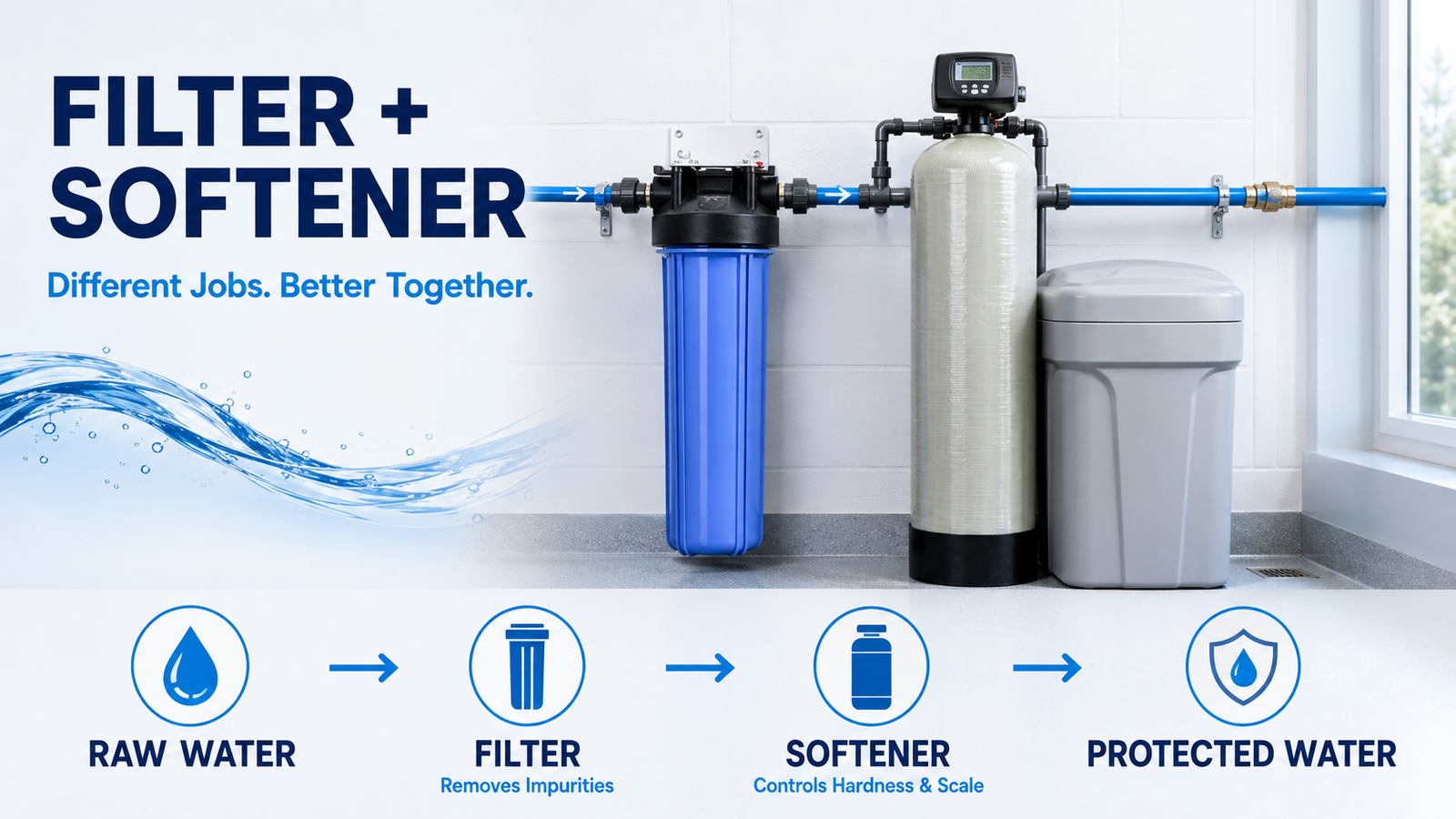
When customers ask me this question during pre-sales discussions, I rarely start with equipment. I first ask three questions: What is in the raw water? What will the treated water be used for? What flow rate must the system support? Those answers decide whether both devices make sense.
How does a water softener and water filter work together?
Many people see a water softener and water filter as two versions of the same product. That is the first problem. If I choose only by product name, I may still have hard water, dirty water, chlorine odor, or damaged equipment after installation.
A water filter and a water softener work together by treating different water risks. The filter targets specific contaminants or physical impurities, while the softener reduces calcium and magnesium hardness. In many systems, filtration protects the softener, and softening protects plumbing, heaters, boilers, RO membranes, and commercial equipment from scale.2
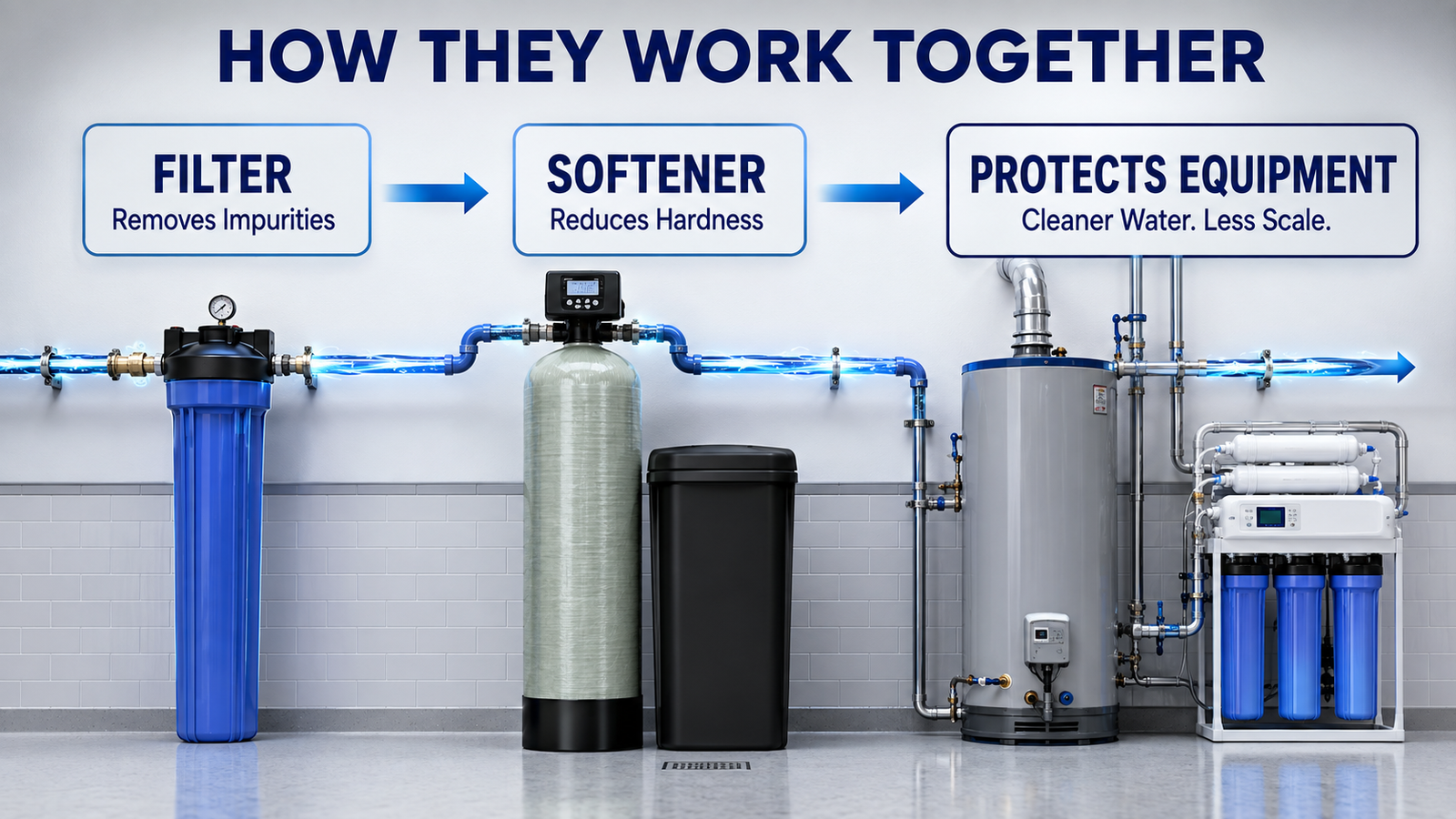
The key difference is not complicated
I explain it this way to customers:
- A filter improves water quality based on the filter media.
- A softener reduces hardness to control scale.
- Neither device automatically replaces the other.
A sediment filter may remove sand, rust, and suspended particles, but it will not remove dissolved hardness.3 A softener may reduce scale-forming minerals, but it will not remove all particles, chlorine, odor, or microorganisms.4 This is why many residential, commercial, and industrial systems combine treatment stages.
What each device usually handles
| Equipment | Main purpose | Common targets | What it usually does not solve |
|---|---|---|---|
| Sediment filter | Physical filtration | Sand, rust, silt, visible particles | Hardness, dissolved salts, chlorine |
| Activated carbon filter | Taste and odor improvement | Chlorine, odor, some organic compounds | Hardness, high TDS, heavy scaling |
| Iron/manganese filter | Specific media filtration | Iron, manganese, discoloration | General hardness unless designed for it |
| Water softener | Scale control | Calcium and magnesium hardness | Sediment, chlorine, bacteria, high TDS |
| RO system | Fine separation | Dissolved salts, many ions, TDS reduction | High fouling water without pretreatment |
In Hedelong’s OEM/ODM water treatment projects, I often see buyers focus on one visible issue. They may say, “The water has particles, so I need a filter.” Then the engineering team later finds heavy scaling in heaters or RO membranes. The reverse also happens. A buyer installs a softener because of scale, but the control valve and resin bed suffer because the raw water contains sediment or iron.
Why simultaneous use often makes sense
A combined system can reduce multiple risks:
-
Pre-filtration can protect softener resin and valves.
Sediment can scratch seals, block distributors, and increase maintenance. -
Softening can protect downstream equipment.
Hardness scale can reduce heat transfer, increase energy use, and shorten membrane life.5 -
Post-treatment can improve final water quality.
Activated carbon, precision filtration, RO, UF, or UV may be added when the application requires it. -
Correct sizing can stabilize performance.
A good system must match peak flow, not just average daily use.6
I tell procurement teams that the real question is not, “Can we install both?” The real question is, “Will this combination solve the actual water problem without creating unnecessary cost or maintenance?”
For B2B projects, that question matters even more. A hotel, bottled water line, boiler feed system, dairy plant, or municipal package plant cannot depend on guesswork. The treatment train should be based on a water analysis report, usage profile, flow demand, and local compliance needs.
Should the water filter go before or after the water softener?
Installation order creates many mistakes. If the order is wrong, a good water softener and water filter can still perform poorly. I have seen projects where resin fouled early, cartridges clogged too fast, or downstream RO systems lost output because the layout ignored raw water conditions.
In many systems, a coarse or media filter is installed before the softener to remove sediment, iron, or other impurities that may damage resin and valves. A precision filter, carbon filter, RO system, or UV unit may be installed after softening if final water quality requires it. However, no single order fits every water source.
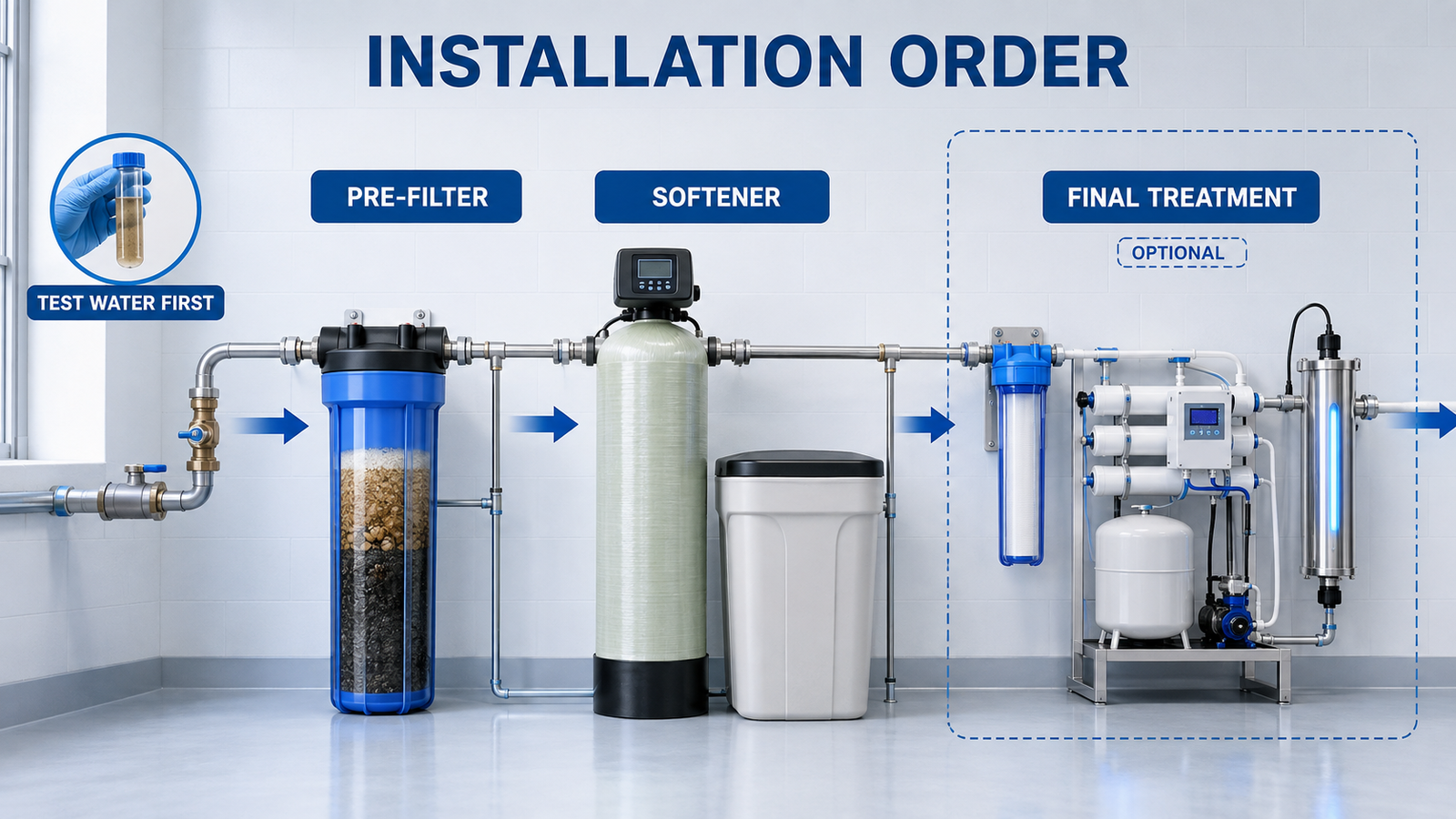
A common but not universal order
A practical residential or light commercial layout often looks like this:
- Raw water inlet
- Coarse screen or sediment pre-filter
- Media filter if needed
- Water softener
- Carbon filter or precision filter if needed
- RO, UF, UV, or final polishing if required
- Point of use or equipment supply
This order is common because it protects each stage. Still, I avoid calling it universal. Raw water from a municipal supply, deep well, surface water source, or industrial reuse stream can have very different characteristics.
Why pre-filtration often comes first
Pre-filtration before softening can help reduce:
- Sand and rust particles
- Suspended solids
- Turbidity
- Iron and manganese, if the media is designed for that
- Debris that can affect control valves
A softener uses resin beads. Those resin beads exchange hardness ions, but they are not designed as a general dirt trap.7 If the resin bed receives heavy sediment, the system may channel, lose capacity, or require more frequent service.
In our manufacturing and pre-sales work, I often explain this with a simple analogy: a softener is more like a scale-control device than a universal purifier. It needs reasonably protected inlet water to operate reliably.
Why post-treatment may still be needed
A softener may improve scaling behavior, but the softened water may still contain:
- Chlorine taste or odor
- Dissolved salts
- Fine particles
- Specific contaminants not targeted by softening
- Microbiological risk, depending on the source
That is why many drinking water systems add activated carbon, RO, UF, or UV after pretreatment. For example, an RO system often benefits from softening when hardness is high, because scale can reduce membrane performance. However, RO membranes also need sediment and chlorine control, depending on membrane type and system design.8
Procurement view: order affects lifecycle cost
For distributors, EPC contractors, and brand owners, installation order affects more than water quality. It affects warranty claims, consumable replacement, service calls, and customer satisfaction.
| Layout issue | Likely result | Procurement risk |
|---|---|---|
| No sediment filter before softener | Valve wear, resin fouling | Higher after-sales cost |
| No hardness control before RO | Membrane scaling | Shorter membrane life |
| Wrong carbon placement | Poor chlorine or odor control | Customer complaints |
| Undersized filter | Pressure drop at peak flow | Unstable user experience |
| Too many unnecessary stages | Higher cost and maintenance | Lower competitiveness |
I recommend that buyers verify the treatment sequence with a qualified water treatment professional when the application involves boilers, RO pretreatment, food and beverage production, pharmaceuticals, electronics, healthcare, or municipal supply. A supplier can provide equipment, but final configuration should match the water report and site conditions.
When do I need both a water softener and water filter?
Some users buy a filter when they need a softener. Others buy a softener when they need filtration. That mistake costs money because the system may look complete but fail in daily operation. I always return to the same basic question: what problem are we solving?
You may need both a water softener and water filter when the water has more than one problem, such as sediment plus hardness, chlorine plus scale, or iron plus hardness. A combined system is also common when protecting boilers, RO membranes, heaters, commercial appliances, or process water equipment.
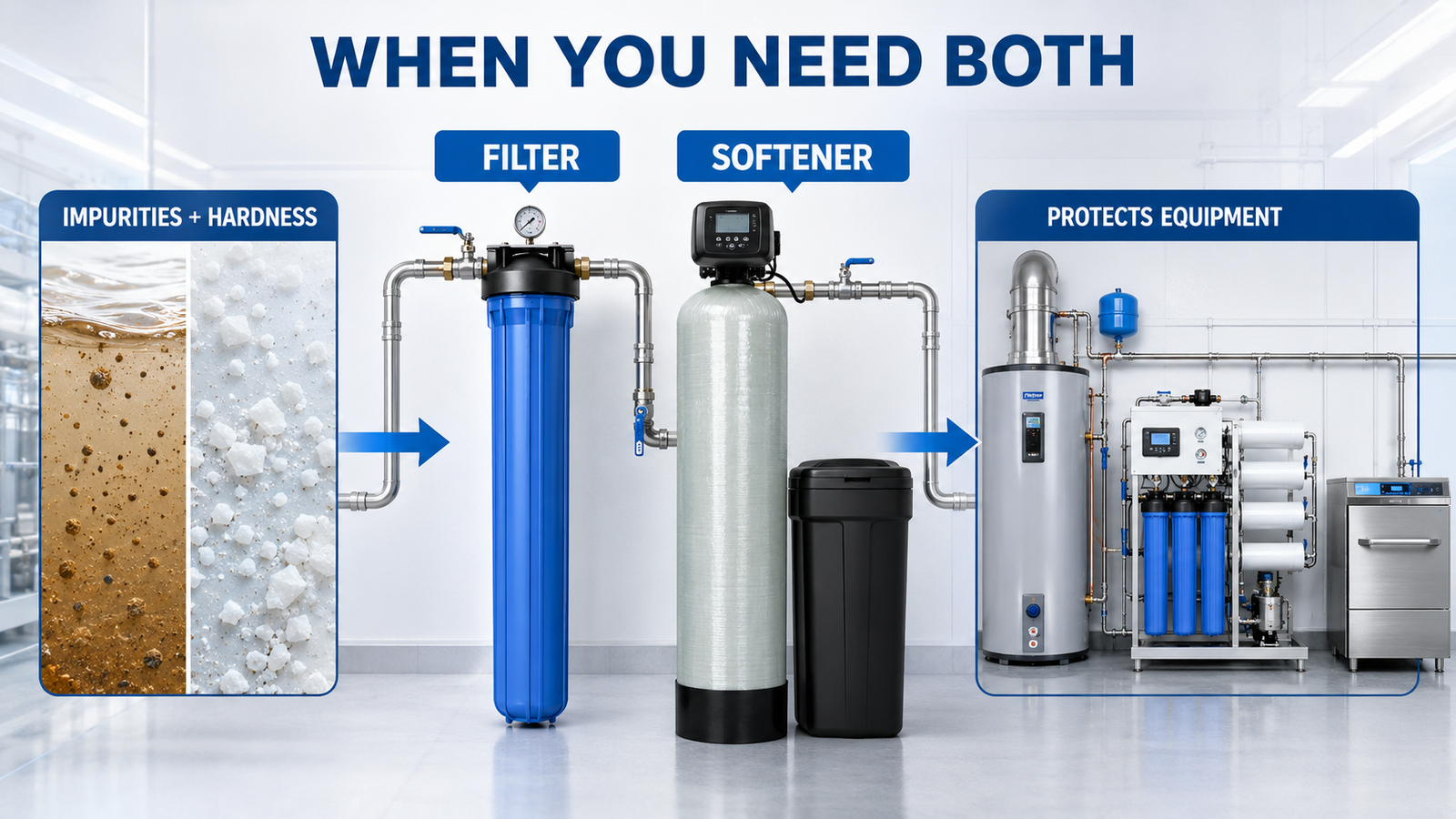
Common signs that both may be useful
You may need a combined setup if you see:
- White scale on faucets, kettles, showerheads, heat exchangers, or boilers
- Particles or rust in water
- Chlorine smell from municipal water
- Yellow, brown, or black staining
- Low RO membrane life
- Frequent boiler blowdown or scaling
- Clogged cartridges or valves
- Complaints about taste, odor, or soap performance
Hardness and sediment are separate problems. A site can have both. A municipal supply may have chlorine and moderate hardness. A well supply may have hardness, iron, manganese, sand, or turbidity. An industrial project may have complex feed water that requires a full pretreatment train.
Residential and small commercial examples
For a home, apartment building, restaurant, laundry, or small hotel, the decision often comes down to comfort, appliance protection, and maintenance.
A typical combined solution may include:
- A sediment filter to remove visible particles
- A carbon filter to reduce chlorine, taste, and odor
- A softener to control scale
- A point-of-use RO unit for drinking water, if lower TDS is desired
However, more stages do not automatically mean better water. Each stage adds pressure loss, consumables, installation space, and maintenance. I prefer to keep systems as simple as possible while still solving the actual water problem.
B2B and project examples
For industrial and commercial buyers, the risks are larger. A poor selection may affect production uptime, product quality, or contract performance.
| Application | Why filtration may be needed | Why softening may be needed | Additional treatment may be required |
|---|---|---|---|
| Boiler feed water | Remove particles that affect valves and lines | Reduce scale in boiler and heat exchange surfaces | RO, deaeration, dosing, polishing |
| RO pretreatment | Protect membranes from fouling | Reduce scaling risk | Antiscalant, carbon, precision filters |
| Hotel water system | Improve clarity and reduce complaints | Protect heaters and fixtures | Carbon filtration, UV, storage control |
| Food and beverage | Control particles, odor, or process impurities | Protect equipment and process stability | RO, UF, NF, sterilization |
| Electronics or pharma | Pretreatment for high-purity systems | Reduce load before RO/EDI | RO, EDI, UV, ultrafiltration |
Hedelong manufactures equipment such as RO systems, UF/NF systems, EDI systems, water softeners, media filters, FRP pressure vessels, and integrated package plants. In a procurement discussion, I do not present one product as a cure-all. I help buyers compare the required treatment steps against water quality reports, compliance documents, and expected service conditions.
The three questions I ask before recommending both
I usually ask these questions first:
-
What is in the raw water?
Buyers should collect a current water analysis report when possible. Key indicators may include hardness, turbidity, iron, manganese, chlorine, TDS, pH, and microbiological conditions. -
What is the treated water used for?
Drinking water, bathing water, boiler feed, RO pretreatment, bottled water, and process water all have different requirements. -
What flow rate and peak demand must the system handle?
A system that works at 1 m³/h may fail at 5 m³/h. Peak flow affects vessel size, valve size, regeneration frequency, pressure drop, and service life.
These questions help avoid overbuying and under-treating. They also help procurement managers compare quotations on a fair basis.
How should I choose the right water softener and water filter system?
Choosing equipment by price alone creates hidden risk. A low-cost water softener and water filter package may be undersized, poorly configured, or difficult to service. I prefer a procurement method that compares raw water, target water, flow demand, materials, testing, documentation, and supplier capability.
You should choose the right system by matching the equipment to raw water quality, final use, peak flow, installation space, maintenance capacity, and compliance needs. The best option is not always the system with the most stages; it is the system that reliably meets the application requirement with manageable lifecycle cost.
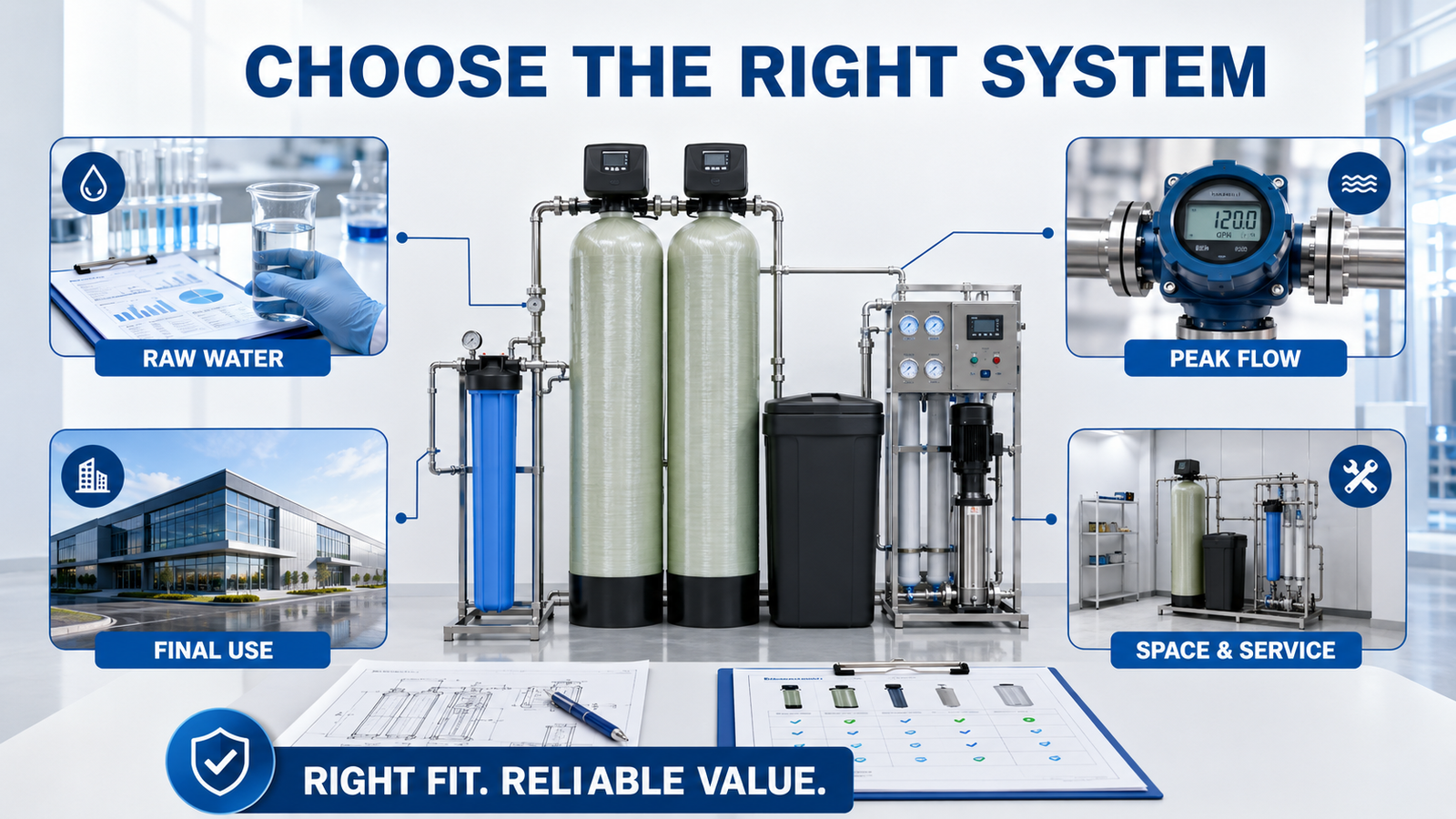
Step 1: Confirm the raw water problem
I recommend that buyers avoid assumptions such as “all well water needs the same equipment” or “municipal water only needs carbon.” A basic water report is often the best starting point.
Useful parameters may include:
- Total hardness
- Turbidity
- Suspended solids
- Iron and manganese
- Chlorine or chloramine
- TDS and conductivity
- pH
- Temperature
- Microbiological indicators, where relevant
For B2B projects, the water report should be current and representative. Seasonal changes can matter, especially for surface water, rural supply, agricultural use, and municipal package plants.9
Step 2: Define the final water use
Different applications need different levels of treatment.
A shower system may only need scale control and odor reduction. A boiler may need hardness control and specific feed water treatment. An RO system may need pretreatment to control scaling, fouling, and oxidants. An EDI ultra-pure water system requires much more than a basic softener and filter.
Step 3: Size for flow, not only volume
This is a common procurement issue. Many buyers provide daily consumption but forget peak flow. A hotel may use a lot of water in the morning. A factory may have process peaks. A commercial laundry may need high instantaneous flow.
Key sizing factors include:
- Service flow rate
- Peak flow rate
- Pressure loss
- Vessel diameter
- Resin volume
- Filter media depth
- Backwash flow requirement
- Regeneration frequency
- Drain availability
- Space and access for maintenance
If the system is undersized, pressure can drop, filters can clog faster, and softening capacity may be exhausted too quickly.10
Step 4: Compare materials and construction
For OEM/ODM procurement, buyers should review the physical construction, not just the catalog description.
Important checks include:
| Component | What I would verify | Why it matters |
|---|---|---|
| FRP tank or pressure vessel | Size, pressure rating, liner, manufacturing process | Safety and durability |
| Control valve | Flow capacity, regeneration mode, service support | Stable operation |
| Resin | Type, exchange capacity, certification documents | Softening performance |
| Filter media | Correct media for the target impurity | Treatment effectiveness |
| Piping and fittings | UPVC, stainless steel, seals, pressure rating | Leak and corrosion control |
| Instrumentation | Flowmeter, pressure gauge, conductivity meter if needed | Operation monitoring |
Hedelong’s manufacturing capabilities include CNC filament winding, rotational molding, injection molding, automated assembly, and 100% hydrostatic and functional testing before shipment. Buyers should still verify certificates, test reports, and project suitability during procurement, especially when local regulations apply.
Step 5: Check maintenance requirements
A combined system only works when it is maintained. I advise buyers to ask about:
- Cartridge replacement frequency
- Salt consumption
- Regeneration water use
- Backwash frequency
- Resin service life
- Media replacement intervals
- Cleaning procedures
- Spare parts availability
- Local service training
For distributors and brand owners, this is not a small detail. Maintenance affects brand reputation. A system with lower upfront cost can become expensive if it causes frequent service visits.
Can a combined system protect RO, boilers, and commercial equipment?
Many equipment failures start with untreated or poorly treated feed water. Buyers may blame the boiler, RO membrane, heater, or production line, but the root cause is often upstream water quality. This is why I treat pretreatment as a procurement decision, not an accessory.
A combined filter and softener system can help protect RO membranes, boilers, heaters, and commercial appliances by reducing particles, fouling load, and hardness scale. However, critical applications may require additional treatment, such as carbon filtration, antiscalant dosing, RO, UF, NF, EDI, UV, or chemical conditioning.
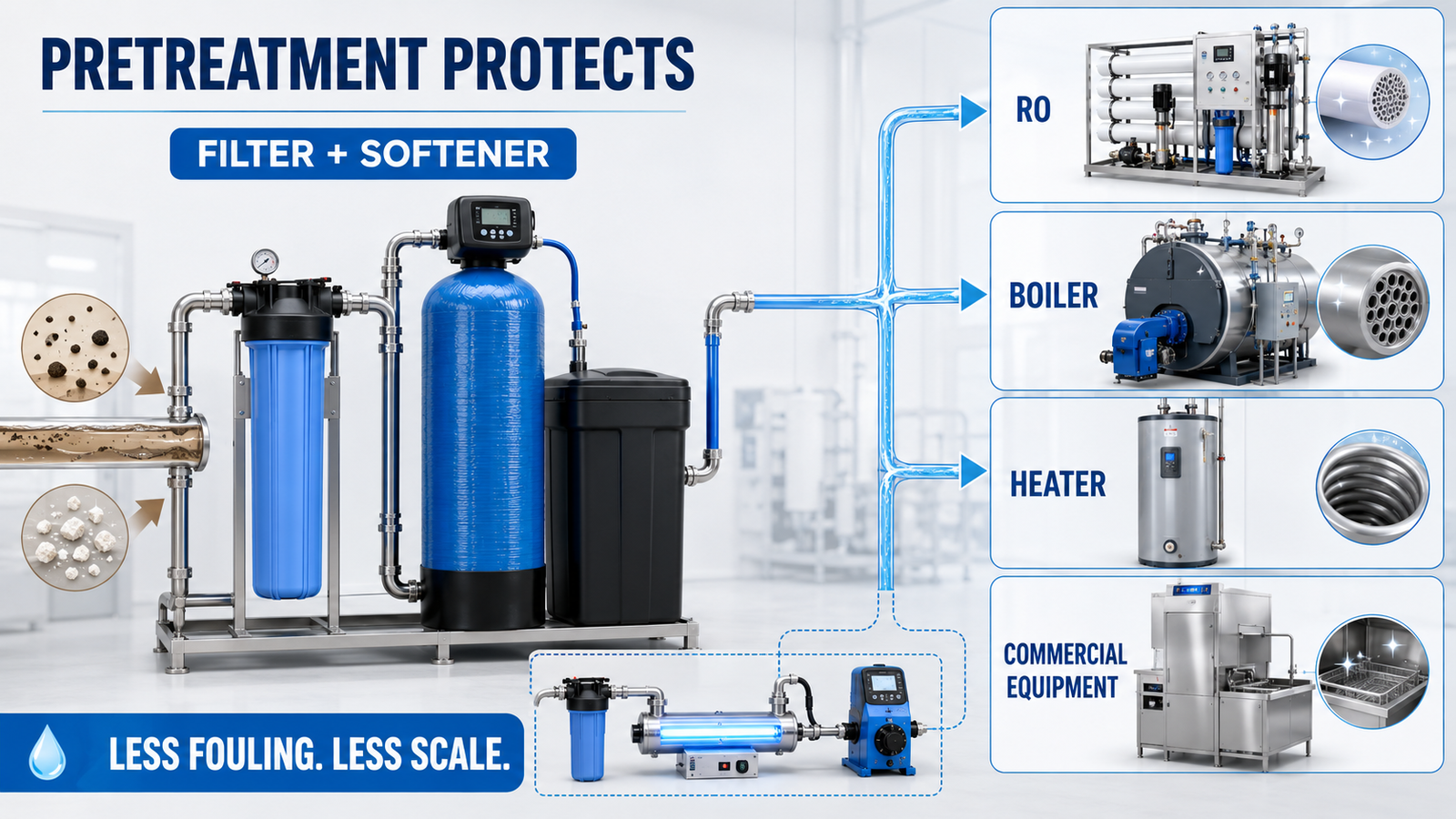
RO pretreatment
Reverse osmosis systems are sensitive to feed water quality. Hardness can create scale on membrane surfaces. Suspended solids can cause fouling. Chlorine can damage certain membrane types. Iron and manganese can create deposits.
A typical RO pretreatment line may include:
- Multimedia filtration
- Activated carbon filtration if oxidants or odor need control
- Softening or antiscalant dosing depending on design
- Precision cartridge filtration
- RO membrane system
- Post-treatment if required
Hedelong supplies integrated RO systems from small skid-mounted units to larger industrial systems. In our pre-sales conversations, I usually remind customers that the RO unit is only one part of the system. Pretreatment often decides membrane life, cleaning frequency, and stable output.
Boiler feed water
Boilers are a classic reason to use softening. Hardness scale reduces heat transfer. Even a thin scale layer can increase energy use and create safety and maintenance problems.11 Filtration can also help by reducing particles that may affect valves, piping, and auxiliary equipment.
However, boiler feed water requirements vary by boiler pressure, operating mode, local codes, and engineering specifications. Some systems need dealkalization, RO, deaeration, dosing, or condensate treatment. I would not treat a basic softener as a full boiler water treatment program.
Commercial appliances and process equipment
Combined treatment can protect:
- Coffee machines
- Ice machines
- Dishwashers
- Laundry machines
- Water heaters
- Cooling systems
- Humidifiers
- Food processing lines
- Bottle washing systems
- Laboratory pretreatment systems
The right configuration depends on the equipment manufacturer’s feed water requirements. Procurement teams should request these requirements before purchasing a system.
Why “more stages” is not always better
I see this mistake often. A buyer may request five or six treatment stages because the system looks more advanced. That can create new problems:
- Excessive pressure loss
- Higher consumable cost
- More complicated maintenance
- Larger footprint
- More spare parts
- More failure points
- Difficult operator training
A good system should be complete but not excessive. For B2B buyers, the goal is stable operation, verified compliance, and manageable lifecycle cost.
Documents buyers should request
For project procurement, I would ask suppliers for:
- Technical proposal and process flow diagram
- Equipment sizing basis
- Water quality assumptions
- Materials list
- Pressure ratings
- Electrical requirements
- Test procedures
- Operation and maintenance manual
- Certificate copies such as ISO9001, ISO14001, CE, NSF, or local approvals where applicable
- Factory inspection or hydrostatic test records when relevant
Certifications should be treated as documents to verify, not marketing slogans. Buyers should confirm whether each certificate applies to the exact product, component, or production process being purchased.
Frequently Asked Questions
Is a water softener the same as a water filter?
No. A water softener mainly reduces hardness minerals such as calcium and magnesium to control scale. A water filter removes selected impurities depending on the filter type and media. A softener is not a universal purifier, and a filter does not automatically solve hardness.
Can I drink softened water after using a water softener?
Many people use softened water for household purposes, but drinking suitability depends on local regulations, sodium sensitivity, raw water quality, and the total treatment system.12 If drinking water quality is the goal, I usually recommend verifying water test results and considering suitable post-treatment such as RO or carbon filtration.
Do I need a filter before my water softener?
Many systems use a sediment or media filter before the softener to protect the resin bed and control valve from particles, iron, or turbidity. However, the correct order depends on the raw water report and application. A qualified water treatment professional should confirm the layout for critical systems.
Will a water filter remove hard water?
Most standard filters do not remove hardness. Sediment filters remove particles, and carbon filters reduce chlorine, taste, and odor. Hardness usually requires ion exchange softening, antiscalant control, RO, or another suitable treatment method based on the application.
How often should I maintain a combined filter and softener system?
Maintenance depends on water quality, flow rate, equipment size, and media type. Cartridges may need regular replacement, softeners need salt and regeneration checks, and media filters may need backwashing. For commercial systems, I recommend a written maintenance schedule and operator training.
Conclusion
A water softener and water filter can be used simultaneously, and in many cases, that combination is the most practical way to manage both impurities and hardness scale. The important point is that they are not substitutes. I would start with raw water testing, define the final use, confirm peak flow, and then choose the simplest reliable system. If you are sourcing equipment for a project, brand, or distribution channel, contact Hedelong to discuss OEM/ODM water treatment systems, filtration, softening, RO pretreatment, and customized package solutions.
"Water softening", https://en.wikipedia.org/wiki/Water_softening. The cited source defines water softening as treatment aimed at reducing calcium and magnesium hardness and describes filtration as a media-dependent process for removing selected particulate or chemical constituents; this supports the distinction but does not validate any specific equipment layout. Evidence role: definition; source type: encyclopedia. Supports: A neutral source should define water softening as hardness reduction, usually by removing calcium and magnesium, and describe filtration as removal of selected contaminants depending on filter type or media.. Scope note: Contextual support for definitions, not direct proof of a particular system design. ↩
"Hardness of Water | U.S. Geological Survey - USGS.gov", https://www.usgs.gov/water-science-school/science/hardness-water. The cited technical guidance explains that particulate removal can reduce fouling of downstream ion-exchange equipment and that hardness control limits calcium and magnesium scale on plumbing, heaters, boilers, and membrane systems; the evidence is general engineering support rather than a site-specific performance guarantee. Evidence role: mechanism; source type: institution. Supports: A technical source should explain that particulate pretreatment reduces fouling or mechanical problems in downstream units and that hardness control reduces scale formation in plumbing, heat-transfer equipment, and membranes.. Scope note: Contextual engineering support; actual protection depends on raw water chemistry, sizing, and operation. ↩
"Drinking Water Treatment: Sediment Filtration", https://extensionpublications.unl.edu/assets/html/g1492/build/g1492.htm. The cited educational source describes sediment filtration as removal of suspended particulate matter and distinguishes it from treatment methods that reduce dissolved calcium and magnesium hardness; it does not address every proprietary filter medium. Evidence role: definition; source type: education. Supports: A source should state that sediment filters are intended for suspended particles such as sand, silt, or rust and that dissolved hardness requires other treatment such as ion exchange or membrane separation.. Scope note: Directly supports ordinary sediment filters, but specialized media filters may have additional functions. ↩
"National Primary Drinking Water Regulations | US EPA", https://www.epa.gov/ground-water-and-drinking-water/national-primary-drinking-water-regulations. The cited public health source states that water softening primarily addresses hardness and should not be treated as a substitute for filtration, disinfection, or contaminant-specific treatment; this supports the limitation but not the performance of all softener models. Evidence role: definition; source type: government. Supports: A public health or government source should explain that softening is primarily for hardness reduction and should not be relied on for disinfection or broad contaminant removal.. Scope note: General support; some combined devices may include additional treatment stages. ↩
"Calcium Sulfate and Calcium Carbonate Scaling of Thin-Film ...", https://pmc.ncbi.nlm.nih.gov/articles/PMC9783167/. The cited study describes hardness-scale deposition on heat-transfer and membrane surfaces and reports that such deposits can reduce heat-transfer efficiency, increase operating energy, and impair membrane performance; the evidence supports the mechanism, while the magnitude varies by water chemistry and operating conditions. Evidence role: mechanism; source type: paper. Supports: A peer-reviewed source should describe how calcium carbonate or hardness scaling forms on heat-transfer and membrane surfaces, decreasing efficiency and contributing to fouling or reduced membrane performance.. Scope note: Mechanistic support; specific energy or membrane-life effects require site-specific data. ↩
"Work Breakdown Structure-Based Cost Model for ...", https://www.epa.gov/system/files/documents/2022-03/biological-treatment-documentation-.pdf.pdf. The cited design guidance identifies peak or maximum flow as a required sizing parameter for water-treatment equipment and distribution components, supporting the claim that average daily use alone is insufficient; the source gives general design principles rather than a complete specification for this installation. Evidence role: general_support; source type: government. Supports: A design manual or government guidance should state that treatment capacity and hydraulic components must account for peak or maximum flow as well as total daily demand.. Scope note: Contextual design support; exact sizing depends on application, regulations, and equipment characteristics. ↩
"Drinking Water Treatment: Water Softening (Ion Exchange)", https://extensionpubs.unl.edu/publication/g1491/2014/html/view. The cited educational source explains the ion-exchange mechanism of softener resin for calcium and magnesium hardness and distinguishes it from particulate filtration; it supports the functional distinction but does not determine the sediment tolerance of any specific resin bed or valve. Evidence role: mechanism; source type: education. Supports: An educational source should explain that softener resin exchanges sodium or potassium ions for calcium and magnesium ions and that sediment removal is a separate filtration function.. Scope note: General mechanism; equipment tolerance varies by manufacturer and design. ↩
"Fouling in reverse osmosis membranes - PMC - NIH", https://pmc.ncbi.nlm.nih.gov/articles/PMC10102236/. The cited membrane literature reports that suspended solids contribute to RO membrane fouling and that oxidants such as chlorine can degrade chlorine-sensitive membrane materials, particularly polyamide membranes; the source supports pretreatment rationale but not the necessity of the same controls for every RO design. Evidence role: mechanism; source type: paper. Supports: A membrane-science source should explain that suspended solids can foul RO membranes and that chlorine can damage certain membrane materials, especially polyamide thin-film composite membranes.. Scope note: Contextual mechanism; chlorine tolerance and pretreatment requirements vary by membrane material and system design. ↩
"(F) Importance of Variations in Water Quality", https://pubs.usgs.gov/circ/circ1169/09_secf.html. The cited water-quality source documents seasonal variation in surface-water characteristics relevant to treatment, such as turbidity, temperature, organic matter, nutrients, or microbial indicators; this supports the need for representative testing but does not predict conditions at any specific site. Evidence role: general_support; source type: government. Supports: A hydrology or water-quality source should document that source-water parameters such as turbidity, temperature, organic matter, nutrients, or microbial indicators can vary seasonally.. Scope note: Contextual support; local monitoring is needed for a specific project. ↩
"is a significant drop in water pressure the typical result of a ...", https://www.reddit.com/r/DIY/comments/11zrkp4/is_a_significant_drop_in_water_pressure_the/. The cited technical guidance explains that excessive flow through undersized filters increases pressure loss and loading stress, while insufficient ion-exchange capacity can lead to early hardness breakthrough; the evidence supports the design principle rather than quantifying this article’s example system. Evidence role: mechanism; source type: institution. Supports: A technical guidance source should explain the relationship between flow rate, pressure drop, filter loading, and ion-exchange capacity or regeneration frequency.. Scope note: Contextual engineering support; actual effects depend on contaminant load, media, vessel size, and operating schedule. ↩
"Clean Boiler Waterside Heat Transfer Surfaces", https://docs.nlr.gov/docs/fy01osti/27653.pdf. The cited energy-efficiency guidance explains that mineral scale insulates boiler heat-transfer surfaces and can raise fuel consumption while contributing to overheating, maintenance, or safety concerns; the support is strongest for boilers and heat exchangers, not all household fixtures. Evidence role: mechanism; source type: government. Supports: A government energy or boiler-efficiency source should explain that scale acts as an insulating layer on heat-transfer surfaces, increasing fuel or energy use and contributing to operational risks.. Scope note: Contextual support focused on heat-transfer equipment. ↩
"Water Softening - Penn State Extension", https://extension.psu.edu/water-softening. The cited public health guidance notes that ion-exchange softening can alter sodium or potassium levels and that drinking-water suitability depends on health context, source-water quality, and applicable drinking-water standards; it supports a cautious assessment rather than a universal rule that softened water is or is not drinkable. Evidence role: expert_consensus; source type: institution. Supports: A public health source should discuss sodium or potassium addition during ion-exchange softening, health considerations for sodium-restricted individuals, and the need to meet drinking-water standards.. Scope note: General health guidance; individual medical advice and local compliance require qualified review. ↩