
Water softeners feel expensive when I only compare the purchase price, but that view can hide the real problem: hardness damage, unstable operation, and after-sales complaints. In procurement discussions, I usually see the better question emerge quickly: what risk does this softener price prevent in the buyer’s actual application?
Water softeners are expensive because buyers pay for matched capacity, reliable resin performance, stable regeneration, durable vessels, dependable valves, careful assembly, factory testing, and reduced after-sales risk. A low-cost unit may work for simple use, but it can become costly if it causes hardness breakthrough, leaks, salt waste, downtime, or customer complaints.
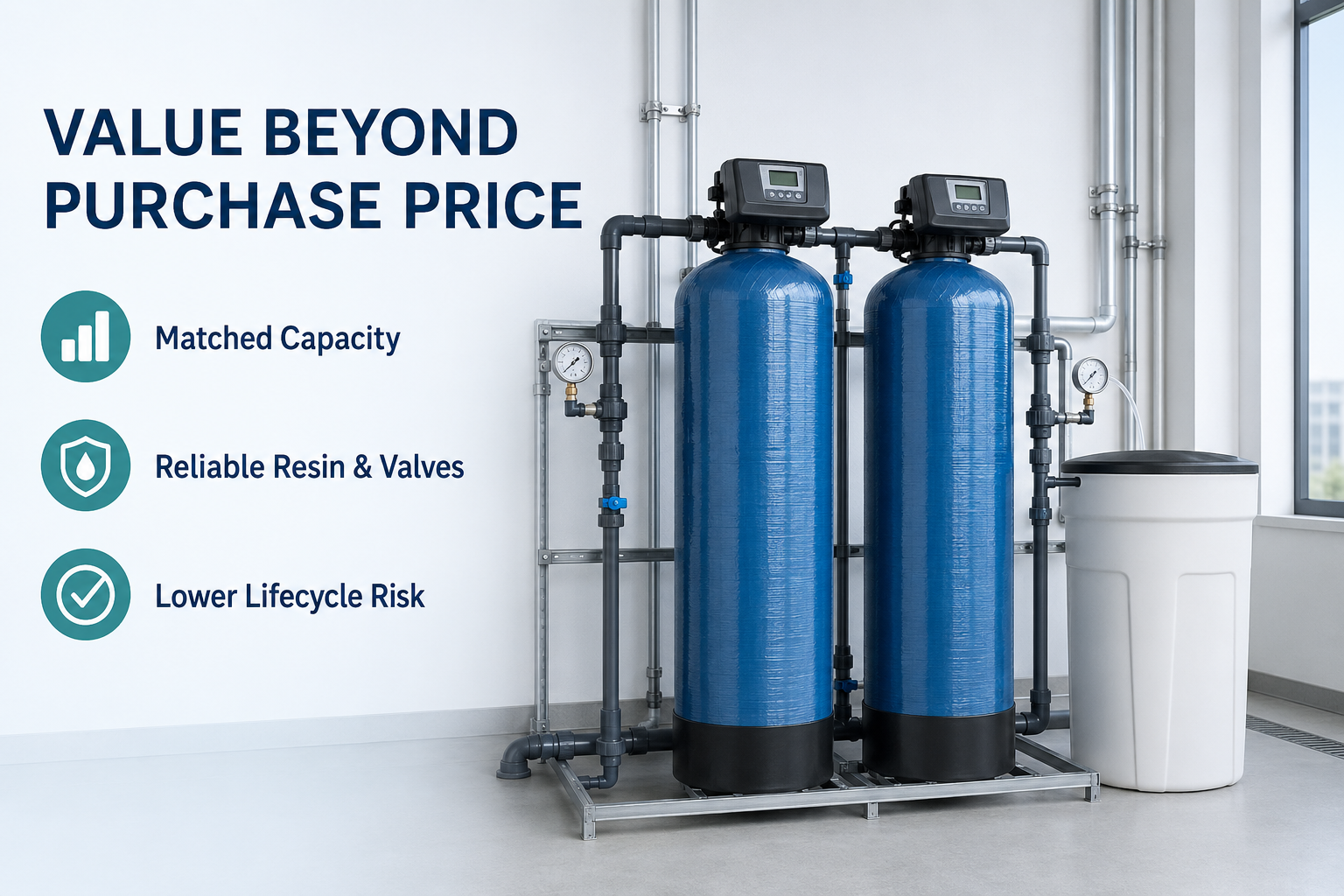
I manufacture and discuss OEM/ODM water treatment equipment with procurement teams, brand owners, and project contractors. I have learned that softener price is rarely about one component. It is usually about how well the full system matches duty conditions, service expectations, and failure tolerance.
Why do water softeners cost more than a simple filter tank?
A buyer may see a tank, a valve, resin, and some piping, then ask why the quotation is so high. I understand that reaction. The agitation starts when that “simple tank” must deliver stable softened water every day. The solution is to evaluate the system as a working process, not a container.
Water softeners cost more than simple filters because they perform ion exchange, regeneration, brine handling, flow control, and pressure containment.1 I must match resin volume, valve logic, vessel strength, brine tank design, and assembly quality to the hardness load and operating demand.
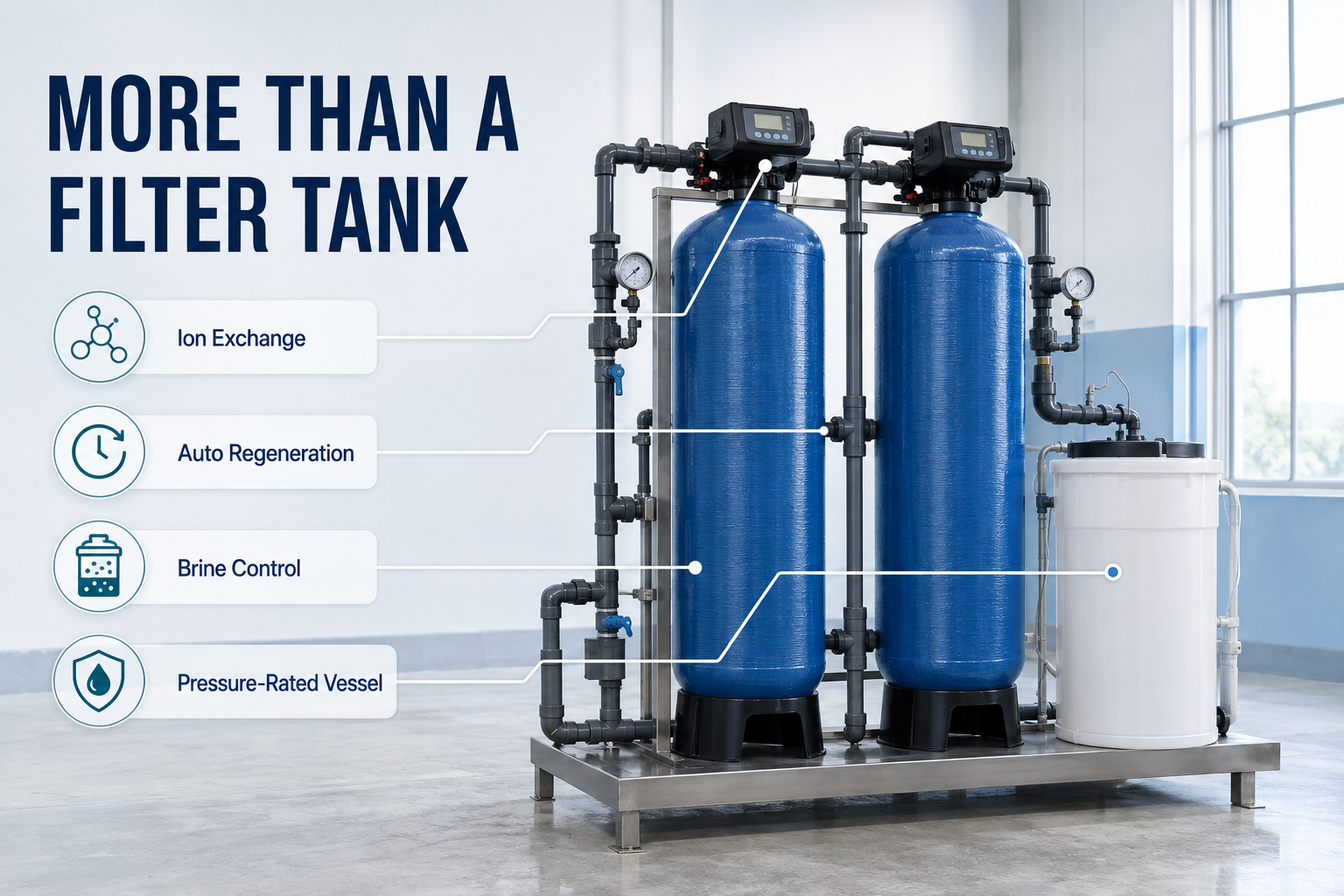
I look beyond the visible parts
When I review a softener configuration with a buyer, I do not only ask for tank size. I ask about:
- Raw water hardness
- Peak flow rate
- Daily water consumption
- Operating hours
- Required outlet hardness
- Regeneration frequency
- Available inlet pressure
- Installation space
- Local service capability
- Downtime tolerance
A water softener is not a mechanical strainer. It uses cation exchange resin to replace hardness ions such as calcium and magnesium2 with sodium ions. That process needs enough resin capacity, controlled service flow, and correct regeneration3. If one part is undersized, the whole system can look cheap on paper and expensive in operation.
Main cost elements I usually evaluate
| Cost element | Why it matters | Common procurement risk |
|---|---|---|
| Resin volume and grade | It determines exchange capacity and cycle stability | Undersized resin causes frequent regeneration |
| Control valve | It controls service, backwash, brine draw, rinse, and regeneration | Unstable valves can cause hardness breakthrough |
| Pressure vessel | It contains pressure safely over repeated cycles | Weak vessels increase leakage or deformation risk4 |
| Brine tank and injector | They support salt dissolution and brine delivery | Poor brine draw reduces regeneration quality |
| Internal distributors | They control water distribution through resin | Bad distribution creates channeling |
| Piping and fittings | They affect leakage, pressure drop, and installation reliability | Weak assembly causes complaints |
| Factory testing | It confirms basic function before shipment | Untested units transfer risk to the buyer |
I separate real value from markup
I do not believe every high price is automatically justified. Some quotations include brand premium, channel cost, special packaging, or local service margin. Those may be reasonable in some markets, but they are not the same as manufacturing value.
I prefer to help buyers separate the quotation into two groups:
-
Engineering value
- Correct resin quantity
- Reliable valve selection
- Suitable vessel pressure rating
- Proper brine system
- Consistent assembly and testing
-
Commercial value
- Brand positioning
- Warranty structure
- Local inventory
- Distributor margin
- After-sales service network
- Documentation and compliance support
For OEM/ODM projects, this distinction is important. A brand manager may need a competitive retail product. An EPC contractor may need a stable unit for a boiler feedwater pretreatment line. These two buyers should not evaluate the same quotation in the same way.
I usually tell buyers that the price is only meaningful after the application risk is clear.
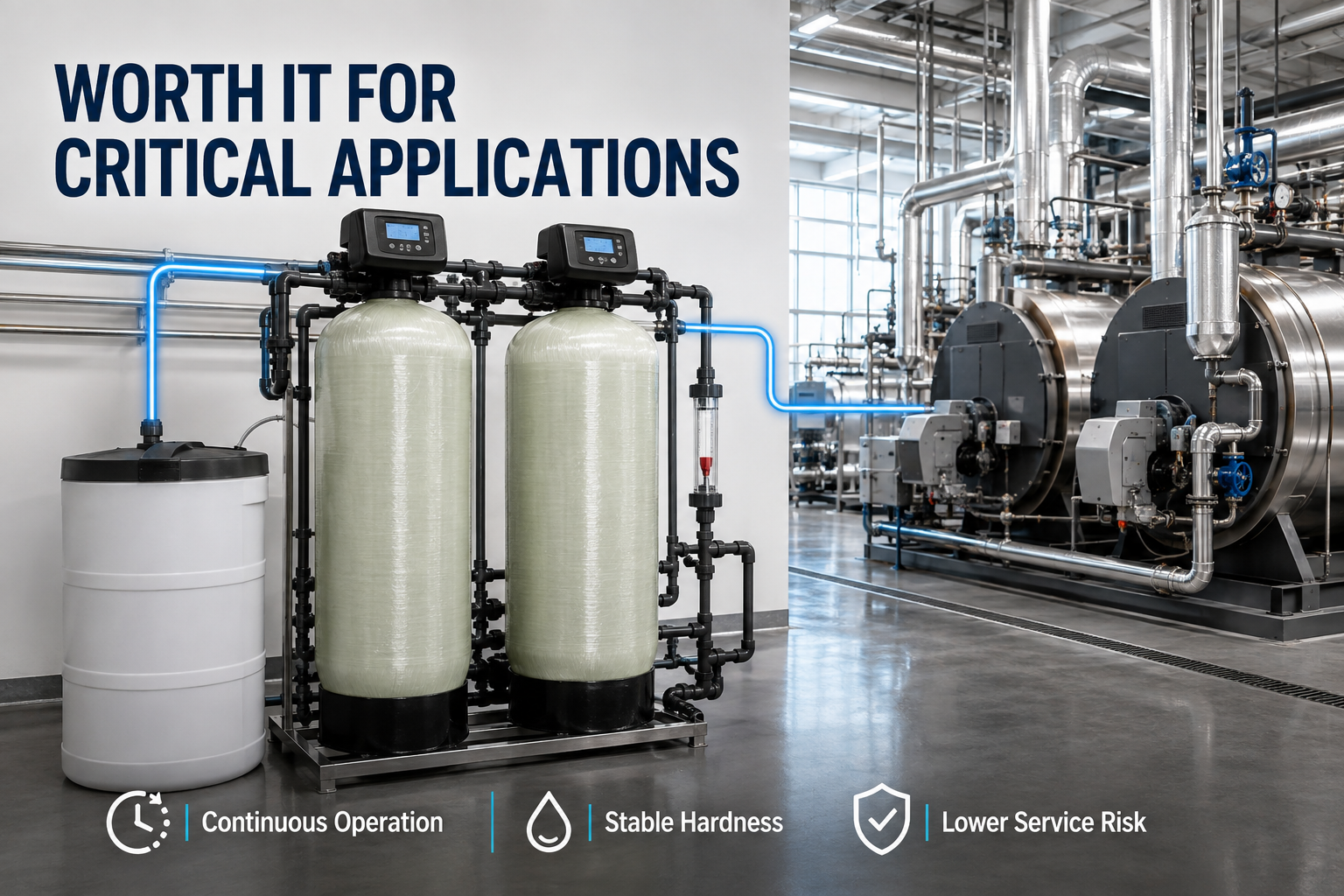
If the system protects a critical process, such as boiler feedwater pretreatment or production water, I usually treat stability as a procurement requirement. If the system only serves non-critical living water, I may accept simpler construction, as long as the buyer understands the trade-off.
How do water softeners prevent application risk?
A cheap softener can look attractive during purchasing, especially when multiple suppliers quote different configurations. The problem appears later if the unit cannot handle the hardness load, flow demand, or regeneration schedule. I reduce that risk by starting with the application, not the price.
Water softeners prevent application risk by reducing scale-forming hardness before it damages downstream equipment or affects water use. I evaluate hardness load, flow rate, duty cycle, downtime tolerance, and outlet water requirements before deciding whether a higher-cost configuration is necessary.
I start with hardness load
Hardness load is one of the first items I check because it affects resin capacity and regeneration frequency. A unit that works well in low-hardness water may fail quickly in high-hardness water if the resin volume is not adjusted.5
I usually think through these questions:
- How hard is the raw water?
- How much water passes through each day?
- How low must the outlet hardness be?
- How often can the system regenerate?
- Can the user accept temporary hard water?
- Does the softener protect sensitive equipment?
The same physical softener can behave very differently under different water conditions. A unit that is acceptable for a small commercial facility may be unsuitable for a continuous industrial line.
I compare critical and non-critical use
| Application type | Failure impact | My procurement view |
|---|---|---|
| Residential or auxiliary water | Usually limited inconvenience | A simpler unit may be acceptable |
| Hotel laundry or kitchen | Service quality complaints | Stable regeneration becomes important |
| Boiler pretreatment | Scale risk and energy loss6 | Correct sizing and reliable control are critical |
| RO pretreatment | Membrane scaling risk7 | Outlet hardness stability matters |
| Food or beverage process water | Product and cleaning impact | Engineering review is needed |
| Industrial continuous operation | Downtime and maintenance cost | I prioritize reliability over lowest price |
I do not suggest that every buyer must choose a premium unit. That would be lazy advice. I suggest that the buyer define the cost of failure first.
The price question changes after risk is defined
In procurement meetings, I often hear a buyer ask, “Can you reduce the price?” That is a fair question. My response is usually to ask where the buyer can accept risk.
For example, I may discuss:
-
Can the regeneration cycle be more frequent?
If yes, a smaller resin volume may be possible. However, salt and water use may increase. -
Can the buyer accept manual adjustment or simpler control?
If yes, a lower-cost valve option may fit. However, service consistency may drop. -
Can the system tolerate temporary hardness breakthrough?
If yes, the configuration may be simpler. If no, I must protect capacity and control stability. -
Can local service replace parts quickly?
If yes, the buyer may accept standard components. If no, I usually recommend stronger component selection. -
Does the project require documented compliance?
If yes, the buyer should verify certificates, material documents, and test records before order confirmation.
This is where a higher quotation may reflect real value. It may pay for a larger resin bed, a more stable automatic valve, better tank construction, and more consistent testing. It may also pay for reduced complaints after shipment.
However, a higher quotation can also include non-engineering costs. That is why I recommend a line-by-line technical comparison before judging whether the price is reasonable.
Which components make water softeners more expensive?
A buyer may assume resin is the main reason for the price difference. Resin matters, but it is not the whole story. The risk grows when the quotation uses a good-looking tank size but weak control, poor brine design, or minimal testing. I prefer to evaluate the complete configuration.
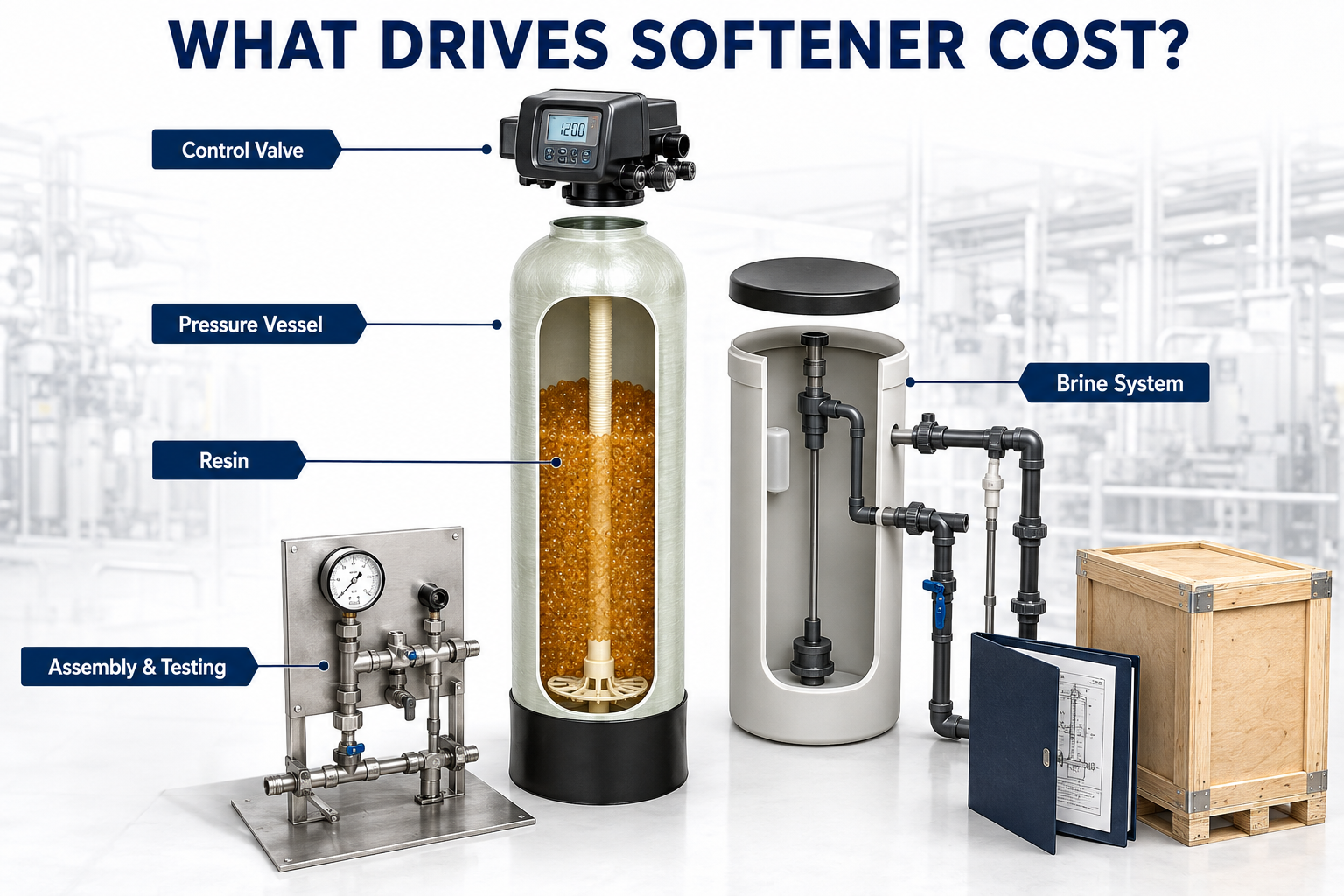
The components that make water softeners more expensive include resin grade and volume, automatic control valves, pressure vessels, brine tanks, distributors, piping, fittings, assembly labor, quality inspection, packaging, and documentation. Each item affects reliability, operating cost, and after-sales risk.
Resin volume and grade affect cycle stability
Resin is the heart of the softener. I pay attention to the resin’s exchange capacity, bead strength, fouling resistance, and suitability for the feed water. In procurement, I also check whether the supplier clearly states resin brand, model, quantity, and replacement assumptions.
A low-price configuration may use less resin to reduce cost. That can create several risks:
- Shorter service cycle
- More frequent regeneration
- Higher salt and water consumption8
- Greater chance of hardness leakage
- Faster customer dissatisfaction
I do not claim that more resin is always better. Oversizing can waste money and space. The correct decision depends on hardness load, flow demand, and regeneration strategy.
Valve stability affects regeneration quality
The control valve is one of the most important parts of an automatic softener. It must manage service flow, backwash, brine draw, slow rinse, fast rinse, and refill. If the valve is unstable, the softener may not regenerate properly.
A valve problem can create hidden costs:
- The resin may not fully regenerate.
- The outlet water may become hard before expected.
- The brine tank may not refill correctly.
- The unit may waste salt or water.
- The customer may blame the entire product line.
In OEM/ODM discussions, valve selection often becomes a cost-reduction topic. I understand that pressure. However, I usually ask buyers to consider whether the end market has strong service support. If not, saving on the valve can transfer risk to the brand owner.
The brine system is not a small accessory
The brine tank looks simple, but it has a direct effect on regeneration. Salt must dissolve properly. Brine must be drawn correctly. The float and brine line must work consistently. Poor brine design can make good resin perform like bad resin.
I usually check:
- Brine tank volume
- Salt grid or platform design
- Brine valve quality
- Injector compatibility
- Brine draw timing
- Refill control
- Overflow protection
If the brine system fails, the resin may not recover its capacity.9 The buyer may see hardness breakthrough and assume the resin is poor, even when the actual issue is brine delivery.
Pressure vessels and assembly affect leakage risk
For FRP pressure vessels and tanks, I pay attention to pressure rating, liner quality, winding consistency, opening dimensions, and connection accuracy. At Hedelong, my team works with FRP composite materials, automated production lines, and dimensional control processes. Buyers should still verify the relevant certificates, pressure ratings, and quality records for their market and application.
Assembly also matters. A softener may fail because of small issues:
- Loose fittings
- Poor sealing
- Wrong distributor installation
- Misaligned piping
- Weak packaging protection
- Incomplete functional testing
These issues may not appear in a photo or catalog page. They appear after shipment, installation, or field use. That is why I treat factory inspection as part of the price, not as an optional extra.
Quality control reduces hidden procurement cost
For water treatment equipment, I prefer procurement teams to request clear inspection checkpoints. These may include:
- Incoming material inspection
- Tank and vessel appearance checks
- Dimensional verification
- Valve function inspection
- Hydrostatic or pressure-related checks where applicable10
- Assembly leak inspection
- Regeneration function confirmation
- Packaging and labeling review
I avoid saying one certificate proves performance in every installation. Certifications such as ISO, CE, NSF, or local hygiene approvals should be treated as documents buyers verify for scope, validity, product coverage, and destination-market requirements.11
When are expensive water softeners worth it?
A high quotation can make procurement nervous, especially when a lower supplier price appears acceptable. The problem is that the cheapest unit may only be cheaper at the purchase stage. I decide whether a higher price is worth it by comparing failure cost, service burden, and operating risk.
Expensive water softeners are worth it when they protect critical equipment, support continuous operation, require stable outlet hardness, reduce service calls, or carry brand reputation risk. They may not be necessary for non-critical use where downtime, variation, and shorter service life are acceptable.
I use failure cost as the real comparison
The purchase price is only one cost. I also consider the cost of failure. In many procurement discussions, buyers focus on the quotation gap but spend less time calculating the operational gap.
A softener failure can lead to:
- Scale in pipes or heat exchange surfaces
- Reduced boiler or equipment efficiency
- RO membrane scaling risk
- More cleaning chemicals
- More maintenance labor
- Emergency service visits
- Warranty claims
- Brand complaints
- Project delay or penalties
I do not need to exaggerate these risks. I only need to ask whether the application can tolerate them. If the answer is no, then a more robust softener may be a rational purchase.
I compare acceptable and unacceptable trade-offs
| Procurement decision | Possible benefit | Possible risk |
|---|---|---|
| Smaller resin volume | Lower initial cost and smaller footprint | Shorter cycles and more regeneration |
| Lower-cost valve | Lower unit price | Less stable regeneration or service support |
| Basic brine tank | Lower material cost | Poor brine management |
| Lighter assembly package | Cheaper logistics | More damage or installation complaints |
| Minimal testing | Faster production and lower cost | Higher field failure risk |
| Verified configuration | Better reliability | Higher initial quotation |
This table does not mean the expensive option is always correct. It means the buyer should know what is being removed from the configuration.
I also recognize when a lower-cost softener is reasonable
Some projects do not need the most advanced softener. If the water use is non-critical, the flow is low, the hardness is moderate, and local maintenance is easy, a simpler unit may be enough.
A lower-cost softener may be reasonable when:
- The application is residential or auxiliary.
- The user can accept occasional service interruption.
- The outlet water requirement is not strict.
- Local spare parts are available.
- The buyer has trained installers.
- The brand strategy targets a price-sensitive market.
- The warranty exposure is limited and clearly managed.
I prefer honest configuration matching. A buyer should not pay for unnecessary features. At the same time, a buyer should not remove important components and expect industrial reliability.
I recommend a qualification checklist
Before a buyer accepts or rejects a higher quotation, I suggest checking these items:
-
Feed water data
- Hardness
- Iron and manganese
- Suspended solids
- Chlorine exposure
- Temperature
- Pressure range
-
Operating data
- Average flow
- Peak flow
- Daily consumption
- Operating hours
- Regeneration window
-
System requirements
- Outlet hardness target
- Connection size
- Space limits
- Power supply
- Drain availability
- Local installation standards
-
Supplier documents
- Product specification
- Resin information
- Valve model and manual
- Tank or vessel rating
- Test report or inspection record
- Certificate scope and validity
- Packing method
- Spare parts list
-
After-sales plan
- Warranty terms
- Spare parts availability
- Troubleshooting support
- Installation guidance
- Branding and documentation needs
For application-specific decisions, I recommend qualified engineering review. This is especially important for boiler feedwater, RO pretreatment, food and beverage water, pharmaceutical use, and other regulated or critical systems.
How should procurement teams compare water softeners from different suppliers?
A buyer may receive several quotations that look similar on the surface. The price gap can be confusing because every supplier may describe the product as automatic, reliable, or high quality. I reduce confusion by building a comparison sheet that forces every supplier to disclose the same technical details.
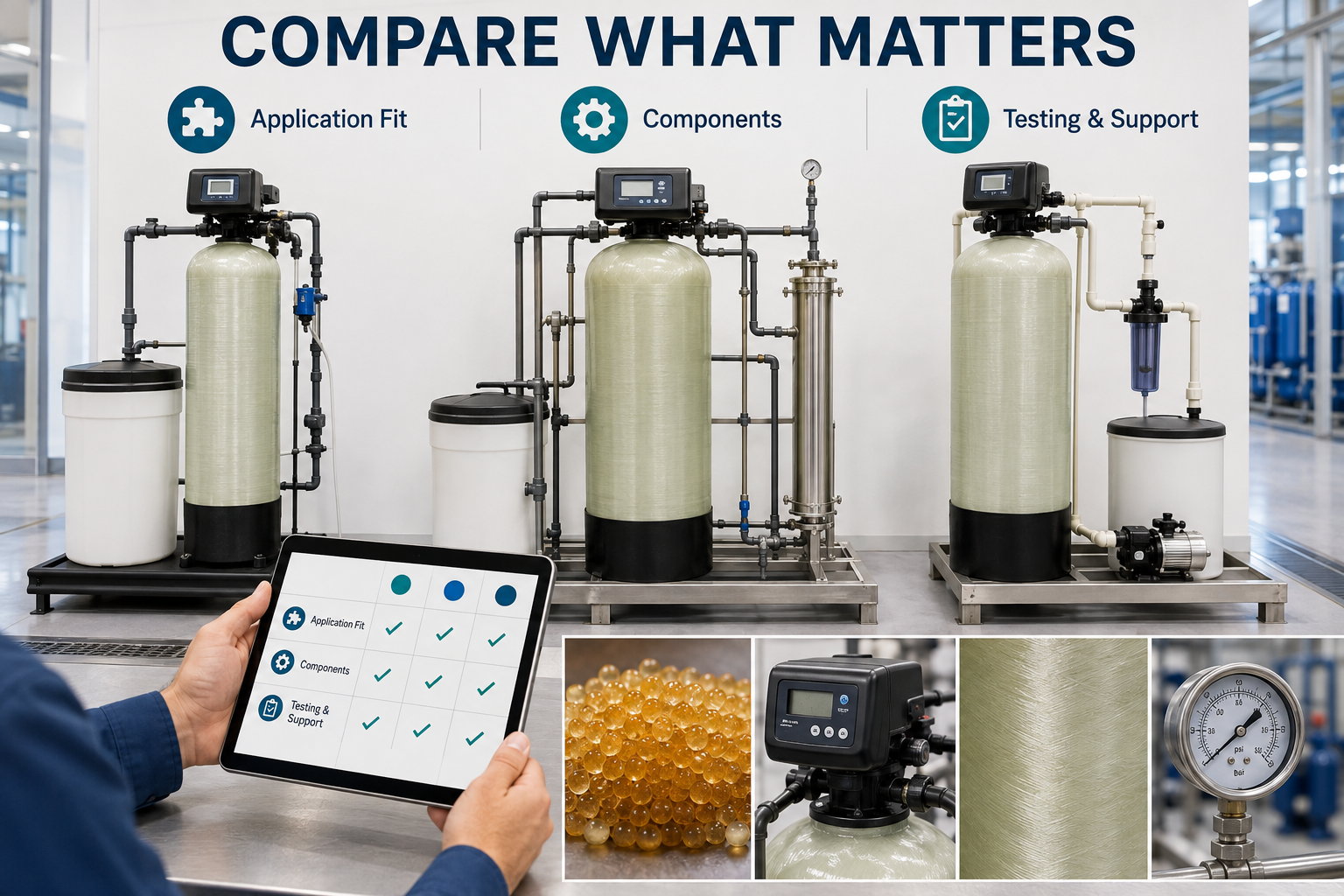
Procurement teams should compare water softeners by application fit, resin quantity, valve model, vessel specification, brine system design, assembly quality, testing process, documentation, warranty terms, and supplier production capability. A fair comparison requires more than tank size and headline price.
I do not compare quotations by title alone
Two quotations may both say “automatic water softener,” but they may not be equal. One may include a stable valve, adequate resin volume, stronger packaging, and factory function checks. Another may reduce every component to meet the lowest price.
I usually ask suppliers to complete a technical comparison table before I discuss final price.
| Comparison item | Supplier A | Supplier B | Supplier C |
|---|---|---|---|
| Resin brand and model | |||
| Resin volume | |||
| Control valve model | |||
| Tank/vessel specification | |||
| Distributor type | |||
| Brine tank size | |||
| Regeneration mode | |||
| Peak flow recommendation | |||
| Outlet hardness assumption | |||
| Factory test items | |||
| Certificates provided | |||
| Spare parts support | |||
| Packaging method |
This method often reveals why one quotation is higher. It can also reveal when a higher price is not supported by better configuration.
I ask suppliers to explain cost reduction clearly
Cost reduction is normal in OEM/ODM business. I often work with buyers who need to hit a target market price. The important point is transparency.
A responsible supplier should explain what changes when the price drops:
- Is the resin volume reduced?
- Is the valve changed?
- Is the vessel specification different?
- Is the brine tank simplified?
- Is the packaging downgraded?
- Is testing reduced?
- Is documentation excluded?
- Is the warranty scope different?
If a supplier only says “same quality, lower price,” I become cautious. Quality is not a slogan. It is a set of design choices, materials, process controls, and inspection steps.
I evaluate manufacturing capability
For large distributors, engineering contractors, and brand owners, supplier capability matters as much as product configuration. A good sample does not guarantee stable bulk shipment.12
I usually suggest checking:
- Production line consistency
- Material traceability
- Assembly process control
- Inspection records
- Custom branding capability
- Documentation accuracy
- Packaging reliability
- Delivery schedule management
- Communication speed
- Spare parts planning
At Hedelong, my business context includes OEM/ODM water treatment equipment, system customization, FRP vessels, softeners, filters, RO systems, UF/NF systems, EDI systems, and integrated package plants. This background shapes how I look at water softeners. I see them as part of a larger water treatment procurement risk, not as isolated tanks.
For buyers with annual procurement programs or project rollouts, I recommend supplier audits, sample validation, and batch inspection before scaling up. I also recommend verifying compliance documents for the exact product, market, and application.
Frequently Asked Questions
Are expensive water softeners always better?
No, expensive water softeners are not always better. I judge value by application fit, component quality, testing, and after-sales risk. A high price may include real engineering value, but it may also include brand or channel premium. Procurement teams should compare detailed configurations before deciding.
What makes a low-cost water softener risky?
A low-cost unit can be risky if it uses insufficient resin, an unstable valve, weak brine design, poor assembly, or limited factory testing. These issues can cause short cycles, salt waste, hardness breakthrough, leaks, service calls, and customer complaints.
Can I reduce water softener cost without losing reliability?
Yes, I can often reduce cost by matching the design more closely to the application. The safest approach is to define acceptable trade-offs. For example, a non-critical system may use a simpler configuration, while a boiler or RO pretreatment system should keep stronger capacity and control stability.
What documents should I request before buying water softeners?
I suggest requesting the product specification, resin information, valve model, vessel rating, assembly drawings when needed, test or inspection records, certificate copies, warranty terms, packing details, and spare parts list. I also recommend verifying certificate scope and validity for the destination market.
When should I ask for professional engineering evaluation?
I recommend professional evaluation when the softener protects boilers, RO membranes, food and beverage processes, pharmaceutical systems, electronics production, or other critical applications. A qualified engineer can review feed water, flow demand, regeneration design, compliance needs, and downstream risk.
Conclusion
Water softeners are expensive when the quotation includes matched capacity, stable regeneration, reliable components, careful assembly, testing, documentation, and lower after-sales risk. I do not believe every high price is justified, and I do not believe every project needs a premium unit. I recommend comparing the price against the failure risk in your real application. If you need OEM/ODM softener manufacturing or project-specific configuration support, I can help you review the technical trade-offs before procurement.
"Drinking Water Treatment: Water Softening (Ion Exchange)", https://extensionpublications.unl.edu/assets/html/g1491/build/g1491.htm. University extension water-quality guidance describes ion-exchange softeners as systems that exchange hardness ions for sodium or potassium and periodically regenerate the resin with brine, supporting the article’s distinction between softeners and simple particulate filters. Evidence role: definition; source type: education. Supports: A neutral source should define ion-exchange water softeners and describe regeneration with brine, distinguishing them from simple filtration devices.. Scope note: The source supports the functional complexity of softeners, not the specific claim that these functions necessarily make every unit more expensive. ↩
"Hardness of Water | U.S. Geological Survey", https://www.usgs.gov/water-science-school/science/hardness-water. The U.S. Geological Survey describes water hardness as chiefly resulting from dissolved calcium and magnesium, supporting the article’s identification of these ions as the primary hardness constituents. Evidence role: definition; source type: government. Supports: A government or public-health source should confirm that water hardness is mainly caused by dissolved calcium and magnesium ions.. ↩
"[PDF] Water Softening (Ion Exchange) - Nebraska Extension Publications", https://extensionpubs.unl.edu/publication/g1491/na/pdf/view. Water-treatment design guidance identifies resin exchange capacity, service flow rate, and regeneration conditions as core parameters governing ion-exchange softener performance, supporting the article’s emphasis on these variables. Evidence role: mechanism; source type: education. Supports: A design-oriented source should explain that ion-exchange performance depends on resin capacity, hydraulic loading or service flow, and regeneration conditions.. Scope note: The source would support the engineering mechanism generally, while the exact acceptable values depend on resin type, water chemistry, and application design. ↩
"[PDF] GLASS FIBER REINFORCED METAL PRESSURE VESSEL DESIGN GUIDE", https://ntrs.nasa.gov/api/citations/19730010205/downloads/19730010205.pdf. Pressure-vessel standards for reinforced-plastic or composite vessels specify design pressure, fabrication controls, and test requirements, supporting the article’s general link between vessel adequacy and leakage or deformation risk. Evidence role: general_support; source type: institution. Supports: An engineering standard or institutional reference should establish that pressure vessels require suitable design ratings, materials, fabrication controls, and testing to manage pressure-related failure risks.. Scope note: The source supports pressure-vessel risk control generally; it would not prove that any particular vessel in the article is weak or noncompliant. ↩
"Water Softening", https://extension.psu.edu/water-softening/. University extension or engineering guidance on softener sizing calculates treatment capacity from influent hardness and water use, supporting the article’s statement that a unit sized for low-hardness water may be inadequate under higher hardness loads. Evidence role: mechanism; source type: education. Supports: A water-softener sizing source should show that hardness concentration and water volume determine hardness load and required exchange capacity.. Scope note: The source would support the sizing principle; actual failure timing also depends on flow rate, regeneration settings, resin condition, and leakage tolerance. ↩
"Purchasing Energy-Efficient Boilers", https://www.energy.gov/cmei/femp/purchasing-energy-efficient-boilers. Government energy-efficiency guidance reports that scale deposits on boiler or heat-transfer surfaces impede heat transfer and increase fuel or energy use, supporting the article’s link between hardness scale and energy loss. Evidence role: mechanism; source type: government. Supports: A government energy or boiler-efficiency source should document that scale deposits reduce heat transfer and increase energy consumption.. ↩
"Calcium Sulfate and Calcium Carbonate Scaling of Thin-Film ...", https://pmc.ncbi.nlm.nih.gov/articles/PMC9783167/. Peer-reviewed reviews of reverse-osmosis fouling identify inorganic scaling, including calcium carbonate and other hardness-related deposits, as a mechanism that can reduce membrane performance, supporting the article’s concern about membrane scaling risk. Evidence role: mechanism; source type: paper. Supports: A peer-reviewed membrane-treatment source should explain that sparingly soluble salts such as calcium carbonate can form scale on RO membranes and reduce performance.. Scope note: The source supports the general scaling mechanism; whether softening is the required pretreatment depends on feed chemistry, recovery rate, antiscalant use, and system design. ↩
"Residential softening | Water Resources Center", https://wrc.umn.edu/residentialsoftening. University extension guidance on ion-exchange softeners explains that regeneration uses brine and rinse water, supporting the article’s statement that more frequent regeneration can increase salt and water consumption. Evidence role: mechanism; source type: education. Supports: A public water-quality or university source should explain that ion-exchange softeners consume salt and water during regeneration and that regeneration frequency affects total consumption.. Scope note: The source supports the direction of the relationship; actual consumption depends on valve programming, salt dose, resin volume, and efficiency settings. ↩
"Residential softening | Water Resources Center", https://wrc.umn.edu/residentialsoftening. Ion-exchange literature describes sodium chloride brine regeneration as the process that restores sodium-form cation resin capacity after hardness loading, supporting the article’s statement that brine-system failure can prevent full capacity recovery. Evidence role: mechanism; source type: paper. Supports: A technical source should show that sodium chloride brine regenerates exhausted cation-exchange resin and that insufficient brine contact can reduce restored capacity.. Scope note: The source supports the regeneration chemistry; field diagnosis of capacity loss may also require checking fouling, resin age, hydraulics, and valve operation. ↩
"Pressure Vessels - Standards | Occupational Safety and Health ...", https://www.osha.gov/pressure-vessels/standards. Pressure-equipment standards commonly use hydrostatic testing to verify the integrity of pressure-containing components under controlled conditions, supporting the article’s inclusion of pressure-related checks in quality inspection. Evidence role: general_support; source type: institution. Supports: A pressure-equipment standard or safety source should describe hydrostatic testing as a method for verifying pressure integrity under specified conditions.. Scope note: The source supports hydrostatic testing as a recognized practice; whether it is required depends on vessel type, design code, jurisdiction, and application. ↩
"CE marking", https://en.wikipedia.org/wiki/CE_marking. Conformity-assessment and certification bodies publish certificate scopes, product listings, applicable standards, and validity information, supporting the article’s statement that buyers should verify certification coverage for the exact product and market. Evidence role: general_support; source type: institution. Supports: Certification bodies or conformity-assessment institutions should show that certificates and listings are tied to defined scopes, products, standards, and validity periods.. Scope note: The source supports the verification principle; it does not determine whether any specific supplier certificate is valid or sufficient for a given destination market. ↩
"AM Machine and Process Control Methods for Additive Manufacturing", https://www.nist.gov/programs-projects/am-machine-and-process-control-methods-additive-manufacturing. Quality-management standards emphasize controlled production processes, monitoring, inspection, and documented records as means of achieving consistent output, supporting the article’s caution that a satisfactory sample alone does not guarantee stable bulk shipments. Evidence role: general_support; source type: institution. Supports: A quality-management source should explain that consistent production depends on controlled processes, inspection, traceability, and corrective actions, not only on sample approval.. Scope note: The source supports the quality-management principle generally; it does not quantify the probability of inconsistency for any particular supplier or production lot. ↩