
Water treatment plants make dirty water safe to drink by controlling the real risks hidden in the raw water, not just by removing visible dirt. Buyers often see muddy water and think “filter,” but unsafe water can also contain dissolved salts, bacteria, viruses, metals, odor, or chemical pollutants. The safer solution starts with testing, correct process design, reliable equipment, and ongoing verification.
Water treatment plants make dirty water safe to drink through multiple treatment barriers: screening, sediment removal, filtration, membrane separation when needed, disinfection, safe storage, and water quality monitoring.1 The exact process depends on the raw water source, target drinking water standard, required capacity, local regulations, and long-term maintenance conditions.
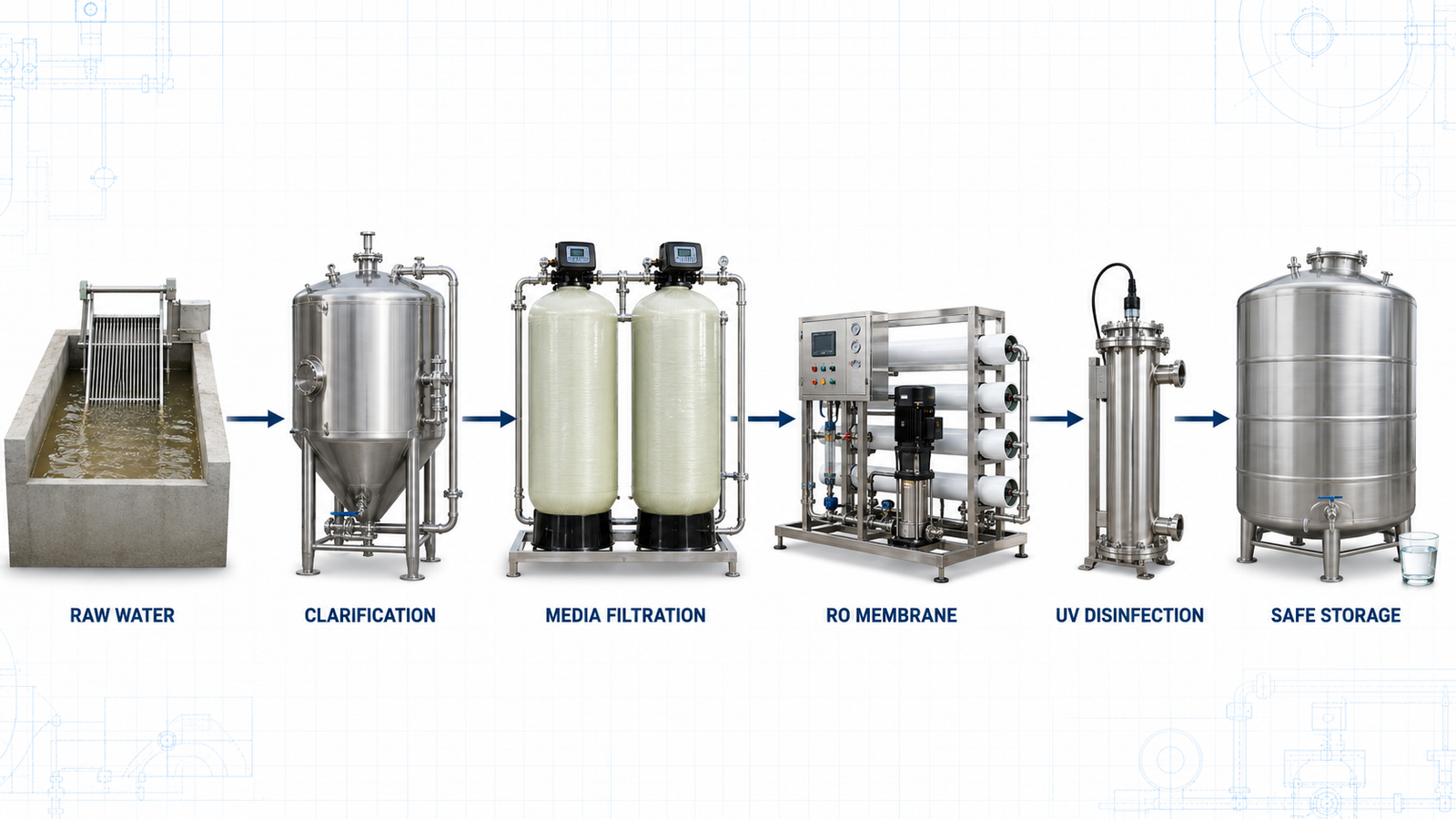
In my work with water treatment equipment buyers, I often see the same problem. A customer asks for a price or flow rate first. I usually need to step back and ask about the raw water, output standard, and project site. That is where a safe drinking water system really begins.
Why do water treatment plants start with raw water risk?
Dirty water creates a simple visual problem, but drinking water safety creates a much wider technical problem. If a buyer only focuses on turbidity or color, the system may miss dissolved contaminants or microbial risks. That mistake can lead to unstable output quality, higher operating cost, or failed acceptance testing.
Water treatment plants start with raw water risk because each source has different contaminants and treatment needs. River water, well water, brackish groundwater, lake water, and recycled water may require different barriers for suspended solids, microorganisms, hardness, salinity, iron, manganese, organic matter, odor, and local regulatory indicators.2
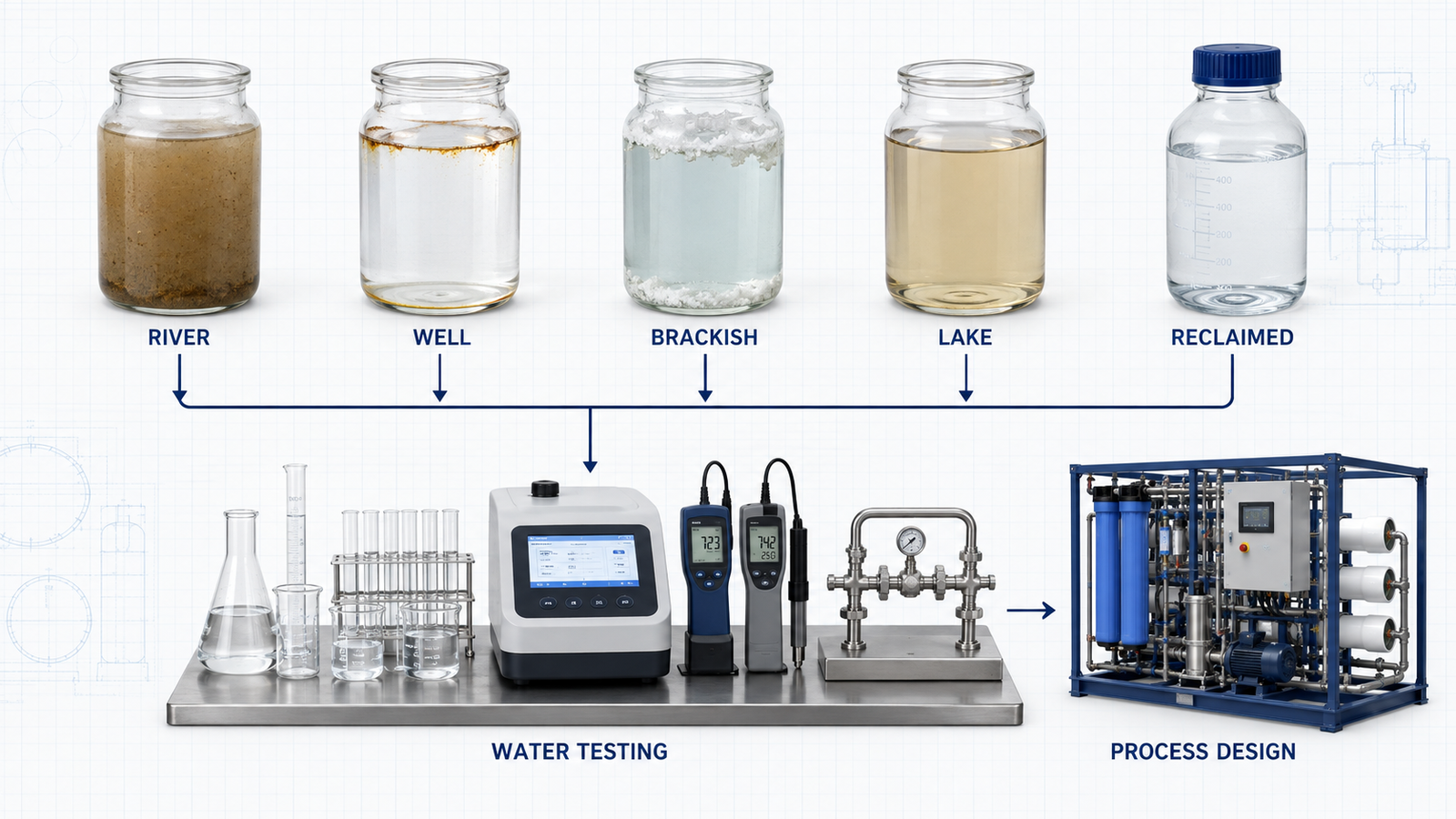
Raw water defines the treatment route
I have learned that the first question should not be, “Which filter do you sell?” The better question is:
What risks must this water source control before it can be considered drinkable?
This shift matters because dirty water is not one problem. It can include several categories of risk:
- Visible particles: sand, silt, clay, rust, and suspended solids.
- Microorganisms: bacteria, viruses, protozoa, and biofilm risks.
- Dissolved minerals: hardness, salinity, fluoride, nitrate, iron, and manganese.
- Organic matter: natural organic carbon, odor-causing compounds, and color.
- Industrial or agricultural contaminants: pesticides, solvents, heavy metals, or process chemicals.
- Operational risks: seasonal variation, algae bloom, high turbidity after rain, and fluctuating temperature.
A treatment plant that works well for one source may perform poorly on another. For example, a rural groundwater project may need iron and manganese removal, softening, or reverse osmosis. A surface water project may need coagulation, sedimentation, ultrafiltration, and disinfection. A brackish water project may require RO desalination and careful pretreatment.
Procurement meaning of raw water testing
For procurement managers, raw water testing is not just an engineering formality. It protects the project budget. A low-cost system can become expensive if it needs redesign, extra pretreatment, or frequent membrane replacement after installation.
A practical raw water report should usually include indicators such as:
| Indicator | Procurement meaning |
|---|---|
| Turbidity | Shows suspended solids load and pretreatment demand |
| TDS / conductivity | Helps determine whether RO or NF may be required |
| Hardness | Affects scaling risk in RO membranes, boilers, and pipes |
| Iron / manganese | Can stain equipment and foul membranes |
| COD / TOC | Indicates organic load and possible odor or disinfection byproduct concerns |
| Microbiology | Guides disinfection and microbial barrier requirements |
| pH / alkalinity | Affects chemical dosing, corrosion, and scaling |
| Nitrate / fluoride / arsenic | May require special treatment depending on local limits |
I do not treat one lab report as the whole truth. Raw water changes. Surface water can shift after rain. Wells can vary by season.3 Industrial areas may have unusual contaminants. Buyers should verify local testing requirements with qualified laboratories and regulatory professionals before final system selection.
Why “dirty” does not always mean “unsafe”
This point surprises some buyers. Muddy water may look terrible, but it can sometimes be clarified and disinfected with conventional treatment. Clear water can look clean but still contain dissolved contaminants or pathogens.4 That is why water treatment plants must be designed around verified indicators, not appearance.
From a manufacturing and system supply perspective, I prefer to receive four pieces of information before configuration:
- Raw water source and water report
- Target output standard
- Required production capacity
- Use scenario and local maintenance capacity
Without these, a quotation may look fast, but it may not be responsible. A technically impressive system can still fail commercially if it is mismatched to local conditions.
What steps do water treatment plants use to make water drinkable?
A single filter rarely makes dirty water safe to drink.5 If a buyer expects one device to solve every water problem, the plant may miss key contaminants or overload critical equipment. The safer approach uses multiple barriers, where each process removes or controls a specific risk before the next step.
Water treatment plants commonly use intake screening, coagulation and sedimentation where needed, media filtration, activated carbon, UF, NF, RO, disinfection, clean water storage, and monitoring. The process is selected according to raw water quality and target standards. These steps are not interchangeable, and not every project needs every step.
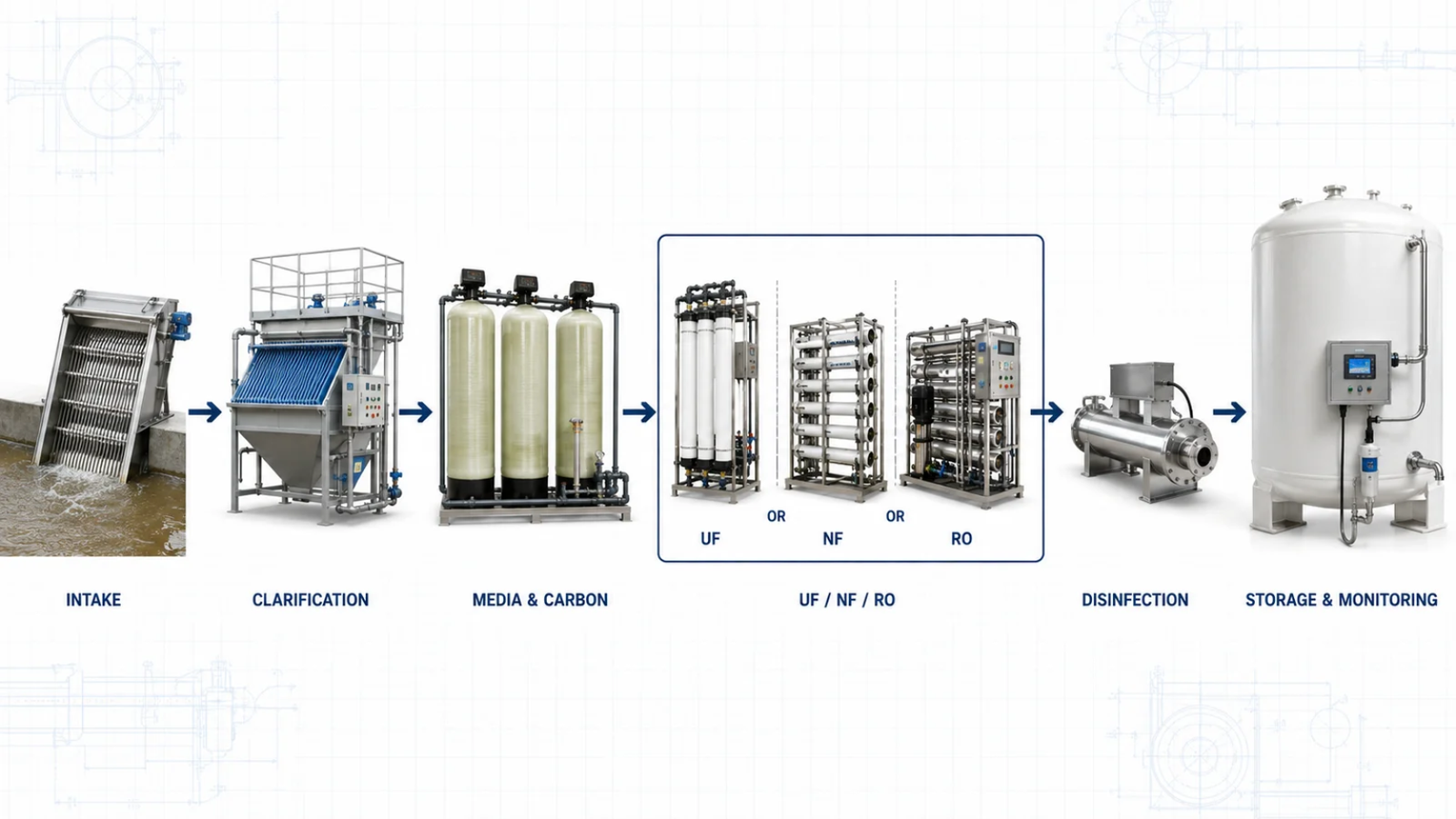
The multi-barrier idea
I like to explain the process as a chain. Each link reduces risk. If one link is weak, the next link carries too much load. This is especially important in project-based drinking water equipment procurement.
A simplified process may look like this:
- Intake and screening
- Chemical dosing, coagulation, and flocculation
- Sedimentation or clarification
- Media filtration
- Activated carbon filtration
- Membrane treatment such as UF, NF, or RO
- Disinfection
- Clean water storage
- Online monitoring and periodic lab testing
Some projects use all of these. Some use fewer. For example, a groundwater system may not need sedimentation if turbidity is low. A surface water plant may need a stronger clarification stage. A high-salinity source may need RO. A community drinking water project may need simple operation and robust maintenance planning more than a complex design that local teams cannot support.
What each step is designed to control
| Treatment step | Main purpose | Procurement note |
|---|---|---|
| Intake screening | Removes large debris | Protects pumps and downstream equipment |
| Coagulation / flocculation | Clumps fine particles | Useful for high turbidity surface water |
| Sedimentation | Settles heavy flocs | Reduces load on filters |
| Sand / multimedia filtration | Removes suspended solids | Often used as pretreatment |
| Activated carbon | Reduces odor, taste, chlorine, some organics | Media quality and replacement schedule matter |
| UF membrane | Removes fine particles and many microorganisms | Does not remove dissolved salts well |
| NF membrane | Reduces hardness and some dissolved contaminants | Selective removal, lower pressure than RO in many cases |
| RO membrane | Removes dissolved salts and many ions | Needs strong pretreatment and scaling control |
| Disinfection | Controls microbial risk | Chlorine, UV, ozone, or combined methods may apply |
| Storage and distribution | Keeps treated water available | Must prevent recontamination |
Why pretreatment protects the whole investment
Many buyers focus on the “main machine,” especially RO. I understand why. RO systems are easy to compare by capacity and desalination performance. However, pretreatment often decides whether the system runs smoothly for years or struggles after months.
For example, if feed water has high turbidity, iron, hardness, or organic matter, RO membranes can foul or scale quickly.6 That increases pressure, lowers flow, raises energy use, and shortens membrane life. In equipment manufacturing, we can perform pressure testing, flow validation, and functional testing before shipment. These checks support equipment reliability. They do not replace field water quality verification or correct pretreatment design.
Why disinfection remains essential
Membrane treatment is powerful, but disinfection still matters in many drinking water projects. Treated water can be recontaminated in storage tanks, pipelines, or distribution points.7 Disinfection provides a microbial control barrier, and in some systems, a residual disinfectant may be required by local rules.
Buyers should verify:
- Which disinfectant is accepted locally.
- Whether residual chlorine is required.
- How byproducts will be controlled.
- How operators will monitor disinfectant dosage.
- Whether UV, ozone, chlorine, or combined disinfection fits the site.
I do not recommend treating disinfection as an optional accessory. It is a project-specific safety barrier that should be reviewed by qualified water treatment professionals and checked against local drinking water regulations.
How do UF, NF, RO, and disinfection differ in drinking water systems?
Membrane names can sound similar, and this creates procurement confusion. A buyer may ask whether UF can replace RO, or whether RO can replace disinfection. If these technologies are treated as interchangeable, the plant may remove the wrong contaminants and leave important risks uncontrolled.
UF, NF, RO, and disinfection serve different purposes. UF mainly removes suspended solids and microorganisms. NF removes some dissolved ions, hardness, and organics. RO removes most dissolved salts and ions. Disinfection controls microbial risk. Water treatment plants may combine these technologies depending on raw water and drinking water targets.
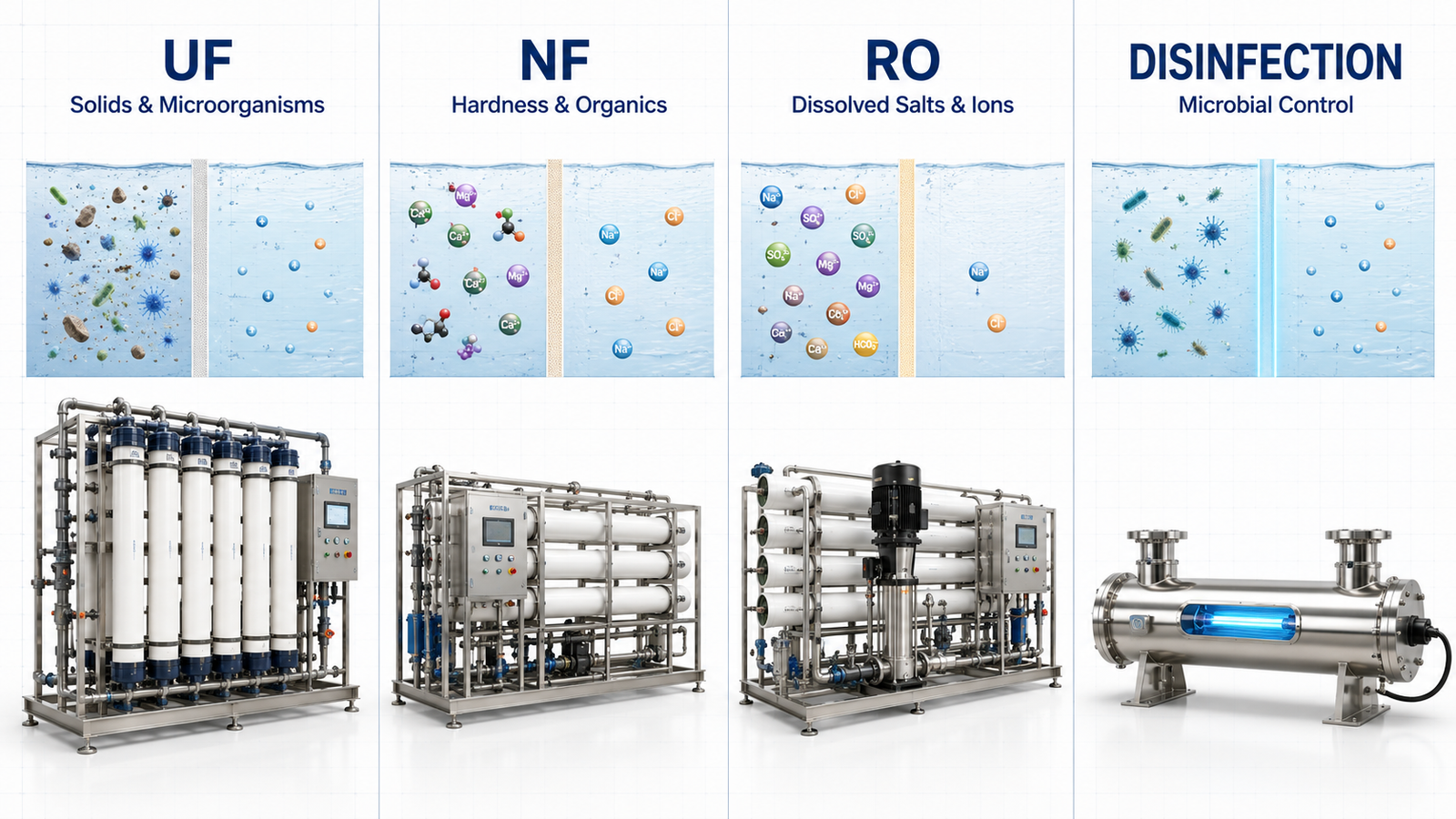
UF is not RO
Ultrafiltration is often a strong choice for surface water clarification and microbial barrier support. It can remove fine particles, colloids, bacteria, and many protozoa. It also helps produce stable low-turbidity water for downstream treatment.
However, UF generally does not remove dissolved salts, nitrate, fluoride, or many dissolved chemical contaminants.8 If the raw water has high TDS or specific dissolved pollutants, UF alone may not meet drinking water targets.
From a procurement view, UF is useful when the main problems are turbidity, suspended solids, and microbial load. It is also useful as pretreatment for RO or NF systems.
NF is selective
Nanofiltration sits between UF and RO.9 It can reduce hardness, color, larger organic molecules, and some multivalent ions. It may be used where buyers want partial desalination, softening, or organic reduction with lower energy demand than full RO in some conditions.
However, NF rejection depends on membrane type, ion composition, pressure, temperature, and system design. Buyers should not assume one NF membrane will meet every drinking water standard. Pilot testing or professional evaluation may be needed for application-specific decisions.
RO is powerful but not magic
Reverse osmosis is widely used for desalination, brackish water treatment, boiler feed water, bottled water production, and high-purity water applications. RO can remove most dissolved salts and many ions.10 It is often selected when TDS, salinity, fluoride, nitrate, or other dissolved contaminants exceed target limits.
But RO needs careful pretreatment. It is sensitive to:
- Suspended solids
- Iron and manganese
- Hardness scaling
- Organic fouling
- Chlorine exposure on certain membrane types
- Poor pressure control
- Incorrect recovery rate
In our manufacturing context, RO systems may be configured as skid-mounted units with different capacities and pretreatment options. For example, industrial pure water, boiler feed water, or bottled water projects may use different RO designs. Still, final compliance depends on raw water, local standards, system operation, and ongoing testing.
Disinfection is a safety barrier, not a filter
Disinfection does not remove dissolved salts or turbidity. It inactivates or controls microorganisms. This difference matters. If water is highly turbid, disinfection can become less effective because particles may shield microorganisms.11 That is why clarification and filtration often come before disinfection.
Common disinfection methods include:
| Method | Strength | Limitation |
|---|---|---|
| Chlorination | Can provide residual protection | Requires dosage control and byproduct management |
| UV | No chemical taste and effective under clear water conditions | No residual protection in distribution |
| Ozone | Strong oxidation capacity | More complex equipment and control |
| Combined methods | Adds multiple microbial barriers | Requires more skilled operation |
A practical comparison for buyers
| Technology | Best for | Not enough for | Common procurement mistake |
|---|---|---|---|
| Media filtration | Sand, silt, suspended solids | Dissolved salts, microbes alone | Treating it as complete drinking water treatment |
| UF | Turbidity and many microorganisms | TDS, nitrate, fluoride, salts | Expecting UF to desalinate water |
| NF | Hardness, color, some ions | Full desalination in high TDS water | Assuming rejection is universal |
| RO | Dissolved salts and many ions | Post-storage microbial control alone | Ignoring pretreatment and maintenance |
| Disinfection | Microbial safety | Particles, salts, metals | Using it without enough filtration |
I prefer to match technology to risk, not to sales language. A “more advanced” device is not always the better device. A well-matched system is usually safer, easier to operate, and more cost-effective over its life cycle.
How should buyers evaluate water treatment plants before procurement?
A water treatment project can look attractive on paper and still create problems after installation. The price may be low, the flow rate may look correct, and the equipment list may seem complete. But if the system does not match local water, standards, power, maintenance skill, and consumable supply, procurement risk increases.
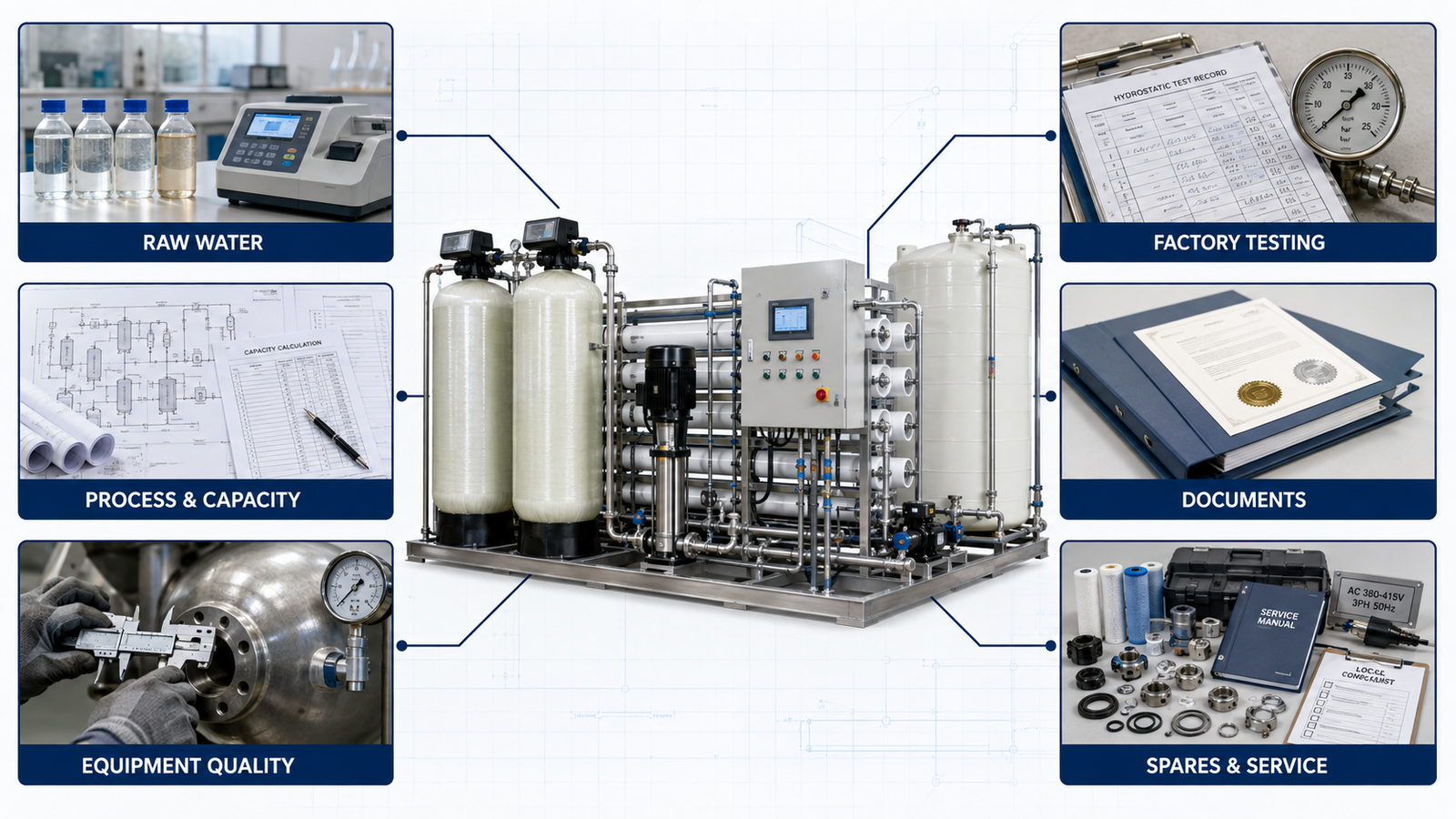
Buyers should evaluate water treatment plants by checking raw water data, target output standards, capacity, process design, equipment quality, supplier manufacturing controls, testing records, certification documents, spare parts, maintenance needs, and local compliance requirements. A qualified technical review should happen before final procurement decisions.
Start with the project definition
When I receive an inquiry, I usually want to clarify the project before discussing the final price. This approach saves time for both sides. A complete technical request should include:
- Raw water source: river, lake, well, brackish water, municipal tap water, or other.
- Raw water analysis: recent lab indicators and seasonal variation if available.
- Target water standard: local drinking water requirement or project specification.
- Capacity: hourly flow, daily production, peak demand, and storage plan.
- Site conditions: power, temperature, space, installation environment, and operator skill.
- Required format: skid-mounted, containerized, modular, or customized plant.
- Compliance documents: CE, NSF, ISO, hygiene approvals, or local documents to verify.
- After-sales plan: spare parts, consumables, remote support, and operator training.
This information turns a vague inquiry into a technical configuration. It also helps the buyer compare suppliers fairly.
Check equipment quality beyond the brochure
For B2B procurement, equipment quality is not just the material name. It includes manufacturing consistency, assembly accuracy, testing discipline, and documentation. In our factory context, quality control may include raw material inspection, dimensional checks, pressure-related testing, flow validation, functional testing, and final inspection before shipment.
Buyers can ask suppliers for evidence such as:
- Factory inspection reports
- Hydrostatic test records
- Flow rate validation records
- Electrical control cabinet inspection records
- Membrane and pump brand specifications
- Pressure vessel and tank documentation
- Packing and shipment protection plans
- User manuals and maintenance schedules
Certifications can help, but buyers should verify them as documents, not as slogans. ISO9001, ISO14001, CE, NSF, CCC, and other certificates may support supplier evaluation, but final acceptance still depends on the project standard, local regulations, and actual test results.
Compare suppliers with a balanced scorecard
A low purchase price can be attractive, but water treatment plants have long-term operating costs. Consumables, membrane replacement, chemicals, energy use, downtime, and after-sales service all affect total cost.
A simple procurement scorecard can help:
| Evaluation factor | Why it matters | Suggested buyer action |
|---|---|---|
| Raw water matching | Prevents wrong process selection | Require technical review before quotation |
| Manufacturing capability | Supports stable quality and delivery | Review factory process and production capacity |
| Testing process | Reduces shipment risk | Ask for test records and inspection plan |
| Customization ability | Fits local project requirements | Confirm OEM/ODM drawings and documentation |
| Certification documents | Supports compliance review | Verify certificate scope and validity |
| Spare parts support | Reduces downtime | Confirm recommended spare parts list |
| Operation simplicity | Improves field stability | Match design to local operator skill |
| Lifecycle cost | Protects project margin | Compare energy, chemicals, and consumables |
Understand the limit of factory testing
Factory testing is important. I consider it a serious part of responsible manufacturing. For example, equipment may undergo hydrostatic checks, functional runs, pressure validation, and flow-related inspection before shipment. These steps help confirm that the equipment is built correctly and functions as designed.
However, factory testing is not the same as guaranteeing drinking water compliance at the project site. Field results depend on:
- Actual raw water quality
- Installation quality
- Chemical dosing accuracy
- Operator behavior
- Membrane condition
- Disinfection control
- Storage tank hygiene
- Local sampling and laboratory testing
That distinction protects both supplier and buyer. A good manufacturer should support system reliability, documentation, and technical communication. A qualified local professional or authority should verify drinking water compliance according to project-specific rules.
Ask better questions before signing
Instead of asking only, “What is the price for 10 tons per hour?” I suggest buyers ask:
- What raw water indicators do you need before configuration?
- Which treatment steps control which risks?
- What assumptions are included in this design?
- What pretreatment protects the membranes?
- What testing is completed before shipment?
- What local standards must still be verified?
- What consumables will need replacement?
- What happens if turbidity or TDS changes seasonally?
- What operator training is required?
- What spare parts should be stocked locally?
These questions make procurement more technical, but they also make it safer. In large projects, especially those with annual procurement values above USD 5 million, this discipline can reduce rework, warranty disputes, and field performance surprises.
Frequently Asked Questions
Can one filter make dirty water safe to drink?
One filter usually cannot make all dirty water safe to drink. Visible dirt, microorganisms, dissolved salts, metals, odor, and chemical contaminants may need different treatment barriers. A safe system should be selected after raw water testing, target standard review, and qualified technical evaluation.
Do all water treatment plants need reverse osmosis?
Not all water treatment plants need reverse osmosis. RO is useful when dissolved salts or specific ions must be reduced. If the main risks are turbidity and microorganisms, UF, media filtration, and disinfection may be more suitable. The decision depends on raw water and output requirements.
Is clear water always safe to drink?
Clear water is not always safe to drink. It may still contain bacteria, viruses, nitrate, fluoride, arsenic, pesticides, or high dissolved solids. Appearance is only one clue. Drinking water safety should be verified through proper testing against project-specific local standards.
What information should I provide before buying drinking water equipment?
You should provide the raw water source, water analysis report, required output standard, capacity, site conditions, power supply, operating schedule, and local compliance requirements. This information helps the supplier design a system that fits the project instead of quoting a generic package.
How often should treated water be tested?
Testing frequency depends on local regulations, project scale, raw water risk, and system design.12 Many projects use online monitoring for indicators such as flow, pressure, conductivity, and turbidity, plus periodic laboratory testing for regulated drinking water parameters. Buyers should confirm the schedule with local authorities or qualified professionals.
Conclusion
Water treatment plants make dirty water safe to drink by using the right barriers for the right risks. Screening, filtration, membranes, disinfection, storage, and monitoring all have different roles. The best procurement decision starts with raw water testing, target standard confirmation, capacity planning, supplier evaluation, and lifecycle maintenance review. If you are comparing drinking water equipment for a municipal, rural, commercial, or OEM/ODM project, I recommend sharing your water report and project requirements so our technical team can help review a suitable system configuration.
"Small Systems Guide To Safe Drinking Water Act Regulations", https://nepis.epa.gov/Exe/ZyPURL.cgi?Dockey=1000478A.TXT. The multi-barrier approach is recognized in drinking-water guidance as a risk-management framework in which successive controls such as treatment, disinfection, protected storage, and monitoring reduce hazards that any single process may not fully control. Evidence role: expert_consensus; source type: institution. Supports: Authoritative drinking-water guidance describes the use of multiple barriers, including source protection, treatment, disinfection, distribution protection, and monitoring, to manage microbial and chemical risks.. Scope note: The source would support the general treatment philosophy, while the exact sequence of barriers remains site-specific. ↩
"The Quality of the Nation's Groundwater | U.S. Geological Survey", https://www.usgs.gov/news/featured-story/quality-nations-groundwater. Source-water assessments distinguish groundwater and surface-water supplies by their typical vulnerability to microbial contamination, dissolved minerals, salinity, and human-origin pollutants, supporting the need to match treatment barriers to the source. Evidence role: general_support; source type: government. Supports: Government or international guidance explains that groundwater, surface water, and saline or brackish sources differ in typical microbial, mineral, and chemical risks.. Scope note: The source would provide general source-water context rather than proving the contaminant profile of any specific project site. ↩
"As above, so below? Trends in groundwater and streamflow across ...", https://www.usgs.gov/mission-areas/water-resources/news/above-so-below-trends-groundwater-and-streamflow-across-united. Hydrological monitoring literature shows that rainfall, runoff, and seasonal recharge can alter surface-water turbidity and contaminant loads and may also affect groundwater quality in wells. Evidence role: general_support; source type: government. Supports: Hydrological sources document that precipitation and seasonal conditions can change turbidity, runoff-related contaminants, and groundwater chemistry.. Scope note: The source would support variability as a recognized phenomenon, not quantify variation at the article’s hypothetical sites. ↩
"About Drinking Water", https://www.cdc.gov/drinking-water/about/?CDC_AAref_Val=https://www.cdc.gov/healthywater/drinking/public/water_diseases.html. Public-health drinking-water guidance notes that harmful microorganisms and chemical contaminants may be present without visible signs, so water clarity alone is not evidence of potability. Evidence role: general_support; source type: government. Supports: Public-health guidance states that drinking-water contaminants may be invisible and that appearance alone cannot confirm safety.. ↩
"Systematic Review of the Microbiological Performance ... - PMC", https://pmc.ncbi.nlm.nih.gov/articles/PMC12550818/. Drinking-water treatment guidance identifies filtration as only one barrier among several, since microbial inactivation and removal of dissolved chemical contaminants may require additional treatment processes. Evidence role: expert_consensus; source type: institution. Supports: Drinking-water guidance explains that filtration, disinfection, and other processes control different hazards and that filtration alone does not address all microbial and chemical risks.. Scope note: The support is general; some specialized filters may address selected contaminants under defined certification conditions. ↩
"Fouling in reverse osmosis membranes - PMC - NIH", https://pmc.ncbi.nlm.nih.gov/articles/PMC10102236/. Studies of reverse-osmosis operation identify particulate fouling, organic fouling, biofouling, and mineral scaling as common failure mechanisms associated with inadequate feed-water pretreatment. Evidence role: mechanism; source type: paper. Supports: Research on RO operation shows that suspended solids, organic matter, iron, manganese, and sparingly soluble salts can cause fouling or scaling that reduces membrane performance.. Scope note: The source would support the mechanism, while the speed and severity of fouling are site- and design-dependent. ↩
"Drinking Water Distribution System Tools and Resources", https://www.epa.gov/dwreginfo/drinking-water-distribution-system-tools-and-resources. International drinking-water guidance recognizes post-treatment contamination as a risk, noting that storage and distribution systems must be managed to prevent microbial regrowth, intrusion, and recontamination. Evidence role: general_support; source type: institution. Supports: Drinking-water guidance recognizes that treated water can be contaminated after treatment through unsafe storage, distribution-system intrusion, or poor hygiene.. ↩
"Removal of Contaminants from Water by Membrane Filtration", https://pmc.ncbi.nlm.nih.gov/articles/PMC9229562/. Membrane-filtration literature describes ultrafiltration as a size-exclusion process for suspended and colloidal material, with limited rejection of dissolved ions such as nitrate, fluoride, and common salts. Evidence role: mechanism; source type: research. Supports: Membrane treatment references explain that ultrafiltration pore sizes are suited to particles, colloids, and microorganisms rather than dissolved ions and small molecules.. Scope note: Actual rejection can vary with membrane material and operating conditions, but the general limitation is well established. ↩
"A Review on Reverse Osmosis and Nanofiltration Membranes for Water ...", https://pmc.ncbi.nlm.nih.gov/articles/PMC6723865/. Membrane-process classifications generally place nanofiltration between ultrafiltration and reverse osmosis, reflecting its intermediate pore-size range and partial rejection of dissolved solutes. Evidence role: definition; source type: paper. Supports: Membrane science reviews classify nanofiltration as intermediate between ultrafiltration and reverse osmosis in terms of pore size, pressure, and solute rejection.. ↩
"Overview of Drinking Water Treatment Technologies", https://www.epa.gov/sdwa/overview-drinking-water-treatment-technologies. Technical descriptions of reverse osmosis identify it as a pressure-driven membrane process used for desalination because it rejects a high proportion of dissolved salts and many ionic species. Evidence role: mechanism; source type: government. Supports: Government or technical references describe reverse osmosis as a pressure-driven membrane process that removes dissolved salts and ions.. Scope note: Removal efficiency depends on membrane type, feed chemistry, pressure, recovery, and maintenance. ↩
"[PDF] REVIEW OF TURBIDITY: Information for regulators and water suppliers", https://iris.who.int/server/api/core/bitstreams/938bdda2-b77c-480b-806c-1aa06e3126d0/content. Disinfection literature notes that elevated turbidity can impair microbial inactivation because suspended particles may shield organisms from disinfectants or ultraviolet light and can increase oxidant demand. Evidence role: mechanism; source type: research. Supports: Water-treatment literature explains that particles and turbidity can interfere with chemical and UV disinfection by shielding microorganisms and increasing disinfectant demand.. Scope note: The effect depends on turbidity level, particle characteristics, disinfectant type, dose, and contact time. ↩
"Safe Drinking Water Act Compliance Monitoring | US EPA", https://www.epa.gov/compliance/safe-drinking-water-act-compliance-monitoring. Drinking-water monitoring frameworks commonly vary sampling frequency by regulatory parameter, system size, source-water risk, and treatment configuration rather than prescribing a single universal schedule. Evidence role: general_support; source type: government. Supports: Regulatory and guideline documents set monitoring frequencies according to contaminant type, system characteristics, population served, and risk management requirements.. Scope note: The source would support the principle; actual testing schedules must be determined under the applicable local regulation. ↩