
Industrial water treatment systems can look similar on a quotation sheet, but a wrong match can create unstable water quality, higher maintenance cost, and early component failure. I often see buyers start with a product name or price target. A better approach is to match the system to the water source, output standard, application, and operating load.
The best industrial water treatment systems are the systems that fit the feed water quality, required treated water standard, application process, flow demand, operating hours, and project constraints. Buyers should compare configurations first, then evaluate suppliers by manufacturing consistency, testing, customization ability, documentation, delivery reliability, and technical communication.
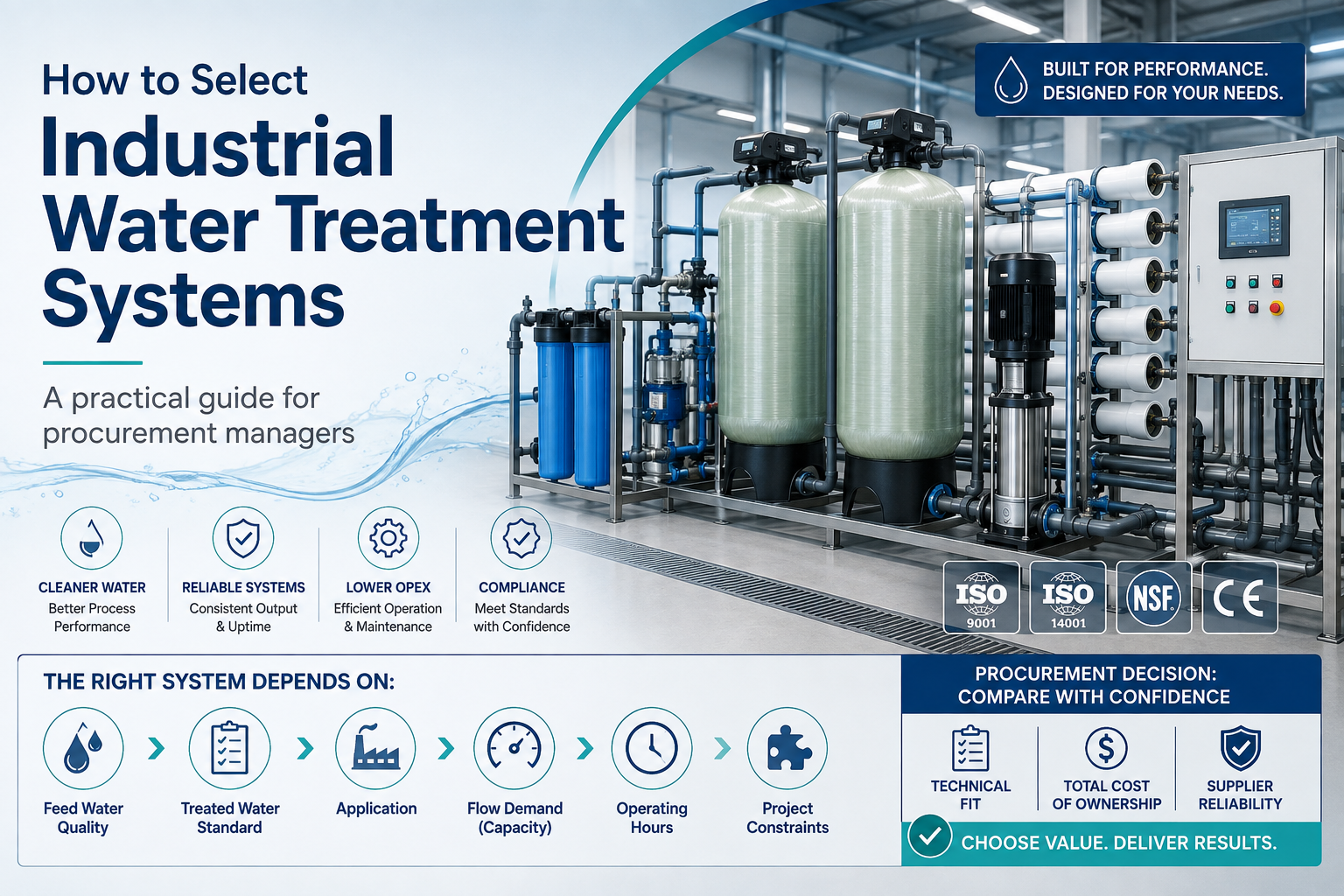
The word “best” is useful only when it is tied to a real project requirement. In my pre-sales communication with brand owners, distributors, and industrial procurement teams, I usually find that the most important decisions happen before the buyer asks for a quotation.
What makes industrial water treatment systems the best fit?
Many buyers want a quick answer because procurement timelines are tight. That pressure is understandable. However, if the system is selected before the water quality and output target are clear, the project may face rework, unstable water output, or avoidable after-sales issues.
The best-fit industrial water treatment systems are not defined by one technology. They are defined by how well the process matches raw water quality, treated water requirements, production use, flow rate, operating hours, installation limits, and lifecycle maintenance expectations.
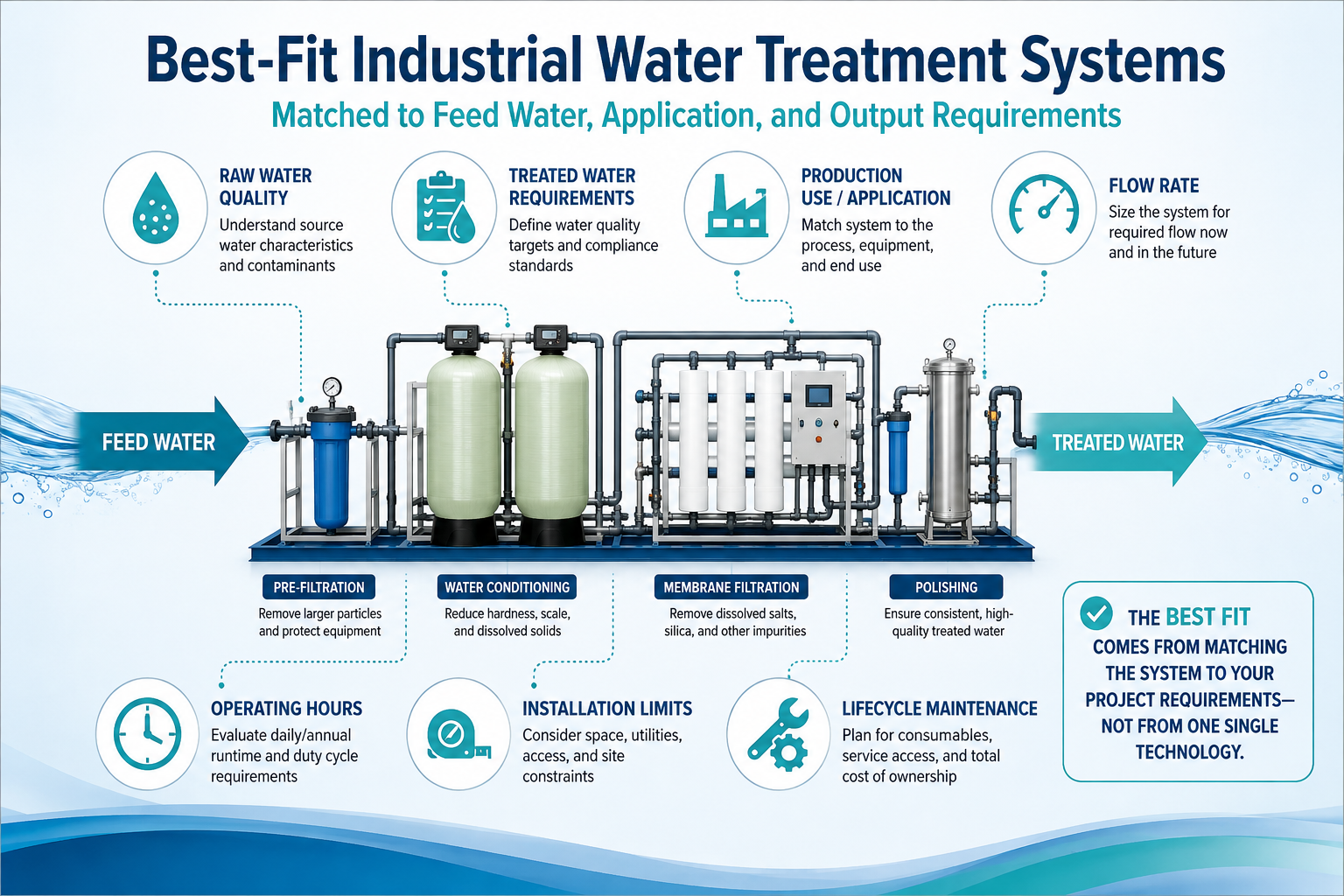
“Best” means matched, not most advanced
I have seen buyers ask, “Is RO better than UF?” or “Is EDI better than mixed bed resin?” These questions are common, but they are incomplete. A technology can be excellent in one condition and unsuitable in another.
For example:
- Ultrafiltration (UF) can be useful for suspended solids, colloids, bacteria reduction, and pretreatment1.
- Reverse osmosis (RO) is often used for desalination and dissolved solids reduction2.
- Nanofiltration (NF) may fit selective separation needs3, depending on water chemistry and target quality.
- Water softening is commonly used to reduce hardness and protect downstream equipment4.
- EDI can support continuous high-purity water production when feed water conditions are controlled5.
None of these is universally “best.” The right configuration depends on the full treatment chain.
Key variables buyers should define first
When I receive an inquiry, I try to move the conversation from equipment labels to engineering variables. This does not replace a professional design review, but it helps procurement teams avoid early mistakes.
| Selection variable | Why it matters | Common procurement risk |
|---|---|---|
| Raw water source | Groundwater, tap water, river water, seawater, and wastewater have different risks | Wrong pretreatment selection |
| Water analysis report | TDS, hardness, turbidity, iron, manganese, silica, organics, and microbiology affect process design6 | Membrane scaling, fouling, or unstable output |
| Treated water standard | Boiler feed, process water, drinking water, electronics, pharma, or food use require different quality targets | Under-treatment or over-investment |
| Flow rate | Hourly capacity must match real demand | Equipment cannot meet peak production |
| Operating hours | A system running 8 hours and a system running 24 hours need different assumptions | Shortened membrane, pump, or resin life |
| Site constraints | Space, power, drainage, temperature, and operator skill all matter | Installation delays or difficult maintenance |
A practical way to reframe the question
Instead of asking, “Which system is best?”, I recommend asking:
“What water quality, output standard, application, and operating load must this system handle?”
This question changes the purchasing logic. It pushes the buyer to compare process suitability, not just brand names or equipment categories.
Application examples buyers often consider
Industrial buyers usually purchase water treatment equipment for a specific use, such as:
-
Boiler feed water
- The system must reduce scaling and corrosion risk.7
- Softening, RO, and polishing processes may be considered depending on the boiler pressure and water standard.
-
Food and beverage production
- The system must support hygiene, taste stability, and process consistency.
- Materials, cleaning design, and documentation become important.
-
Electronics and laboratory water
- The system may need very low conductivity or high resistivity water8.
- RO, EDI, polishing, and strict monitoring may be part of the design.
-
Textile, plating, or manufacturing process water
- The target may focus on conductivity, hardness, suspended solids, or specific contaminants.
- Operating cost and wastewater handling may be major concerns.
The most reliable decision starts with these needs. The product name comes later.
Why do shortcuts fail when comparing industrial water treatment systems?
Shortcuts are attractive because they save time during early sourcing. The problem is that water treatment mistakes are often delayed. A system may look acceptable at shipment, then show problems after months of scaling, fouling, unstable output, or frequent consumable replacement.
Shortcuts fail because industrial water treatment systems must be selected by water chemistry, application requirements, and operating load. Choosing only by equipment label, quoted capacity, or lowest price can hide pretreatment gaps, oversized or undersized components, and long-term maintenance risks.
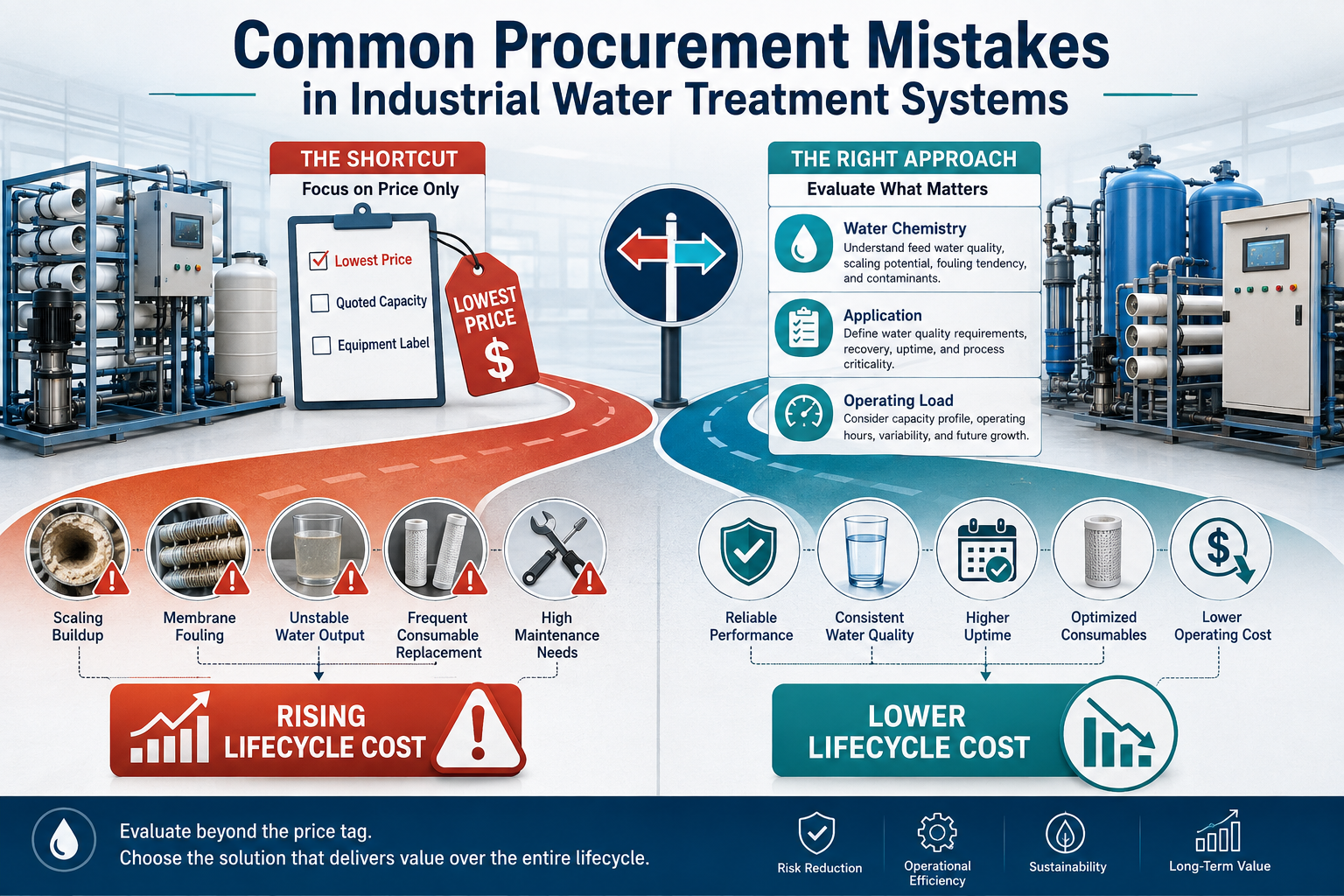
Shortcut 1: Choosing by technology label
A buyer may say, “I need an RO system,” when the real need is stable boiler feed water or process water with a defined conductivity limit. RO may be part of the answer, but it may not be the whole answer.
RO performance depends on feed water conditions. If pretreatment is weak, the RO membranes may suffer from:
- Scaling from hardness, silica, or barium/strontium risks9
- Fouling from suspended solids or organics
- Biological growth if disinfection control is poor10
- Frequent cleaning and reduced membrane life
- Unstable permeate quality under changing feed conditions
The same logic applies to UF, NF, softeners, media filters, and EDI. The equipment label is only the visible part of the process.
Shortcut 2: Choosing by quoted capacity
Capacity can also mislead buyers. A quotation may show “10T/H” or “20T/H,” but the real question is: under what feed water condition, recovery rate, temperature, and operating schedule?
For membrane systems, water temperature affects production. Lower temperature reduces permeate flow.11 Feed water TDS and pressure also affect output and energy use.12 A system designed only around nominal capacity may disappoint the operator during peak load or seasonal changes.
| Capacity question | Better procurement question |
|---|---|
| “Can you supply 10T/H?” | “Can the system maintain required output at our worst-case feed water condition?” |
| “What is the flow rate?” | “What is the net treated water output after backwash, flushing, and regeneration?” |
| “What is the tank size?” | “How much buffer capacity is needed for peak production?” |
| “What is the recovery rate?” | “Is the recovery rate safe for our water chemistry and scaling risk?” |
Shortcut 3: Choosing by low upfront price
Low price is not automatically bad. Procurement teams must control budgets. However, the lowest upfront price can become expensive if it causes higher chemical use, higher cartridge replacement frequency, frequent shutdowns, or early membrane replacement.
When I review buyer requirements, I like to separate purchase cost from operating risk. A lower-cost system may be acceptable for a simple duty. A more robust configuration may be justified for continuous production, high-value process water, or remote sites where service access is difficult.
Key lifecycle cost factors include:
- Cartridge filter replacement frequency
- Chemical dosing and cleaning frequency
- Membrane, resin, or media replacement schedule
- Pump energy consumption
- Wastewater discharge volume
- Downtime cost during maintenance
- Spare part availability
- Operator training requirements
Shortcut 4: Ignoring local regulations and documentation
Industrial buyers often sell equipment into different markets. A brand owner or distributor may need product documentation for local approvals, EPC tender files, or end-user compliance review.
Depending on the application, buyers may need to verify documents such as:
- Material safety and food-grade declarations
- Pressure vessel documentation
- Electrical drawings
- Operation and maintenance manuals
- Factory test records
- Component datasheets
- Applicable CE, NSF, ISO, or local compliance documents
I always suggest that buyers verify certificates and test documents directly. Certifications should be treated as procurement evidence to review, not as marketing language to accept without checking.
What pre-sales questions should define industrial water treatment systems?
A serious supplier should not rush to quote a complete system before understanding the core conditions. If the supplier asks no technical questions, the buyer should be careful. Fast quotations can be useful, but only after the main selection variables are clear.
The most important pre-sales questions for industrial water treatment systems cover raw water source, water analysis, treated water standard, application, flow demand, operating hours, peak load, site conditions, automation needs, and documentation requirements. These answers guide the process configuration and reduce procurement risk.
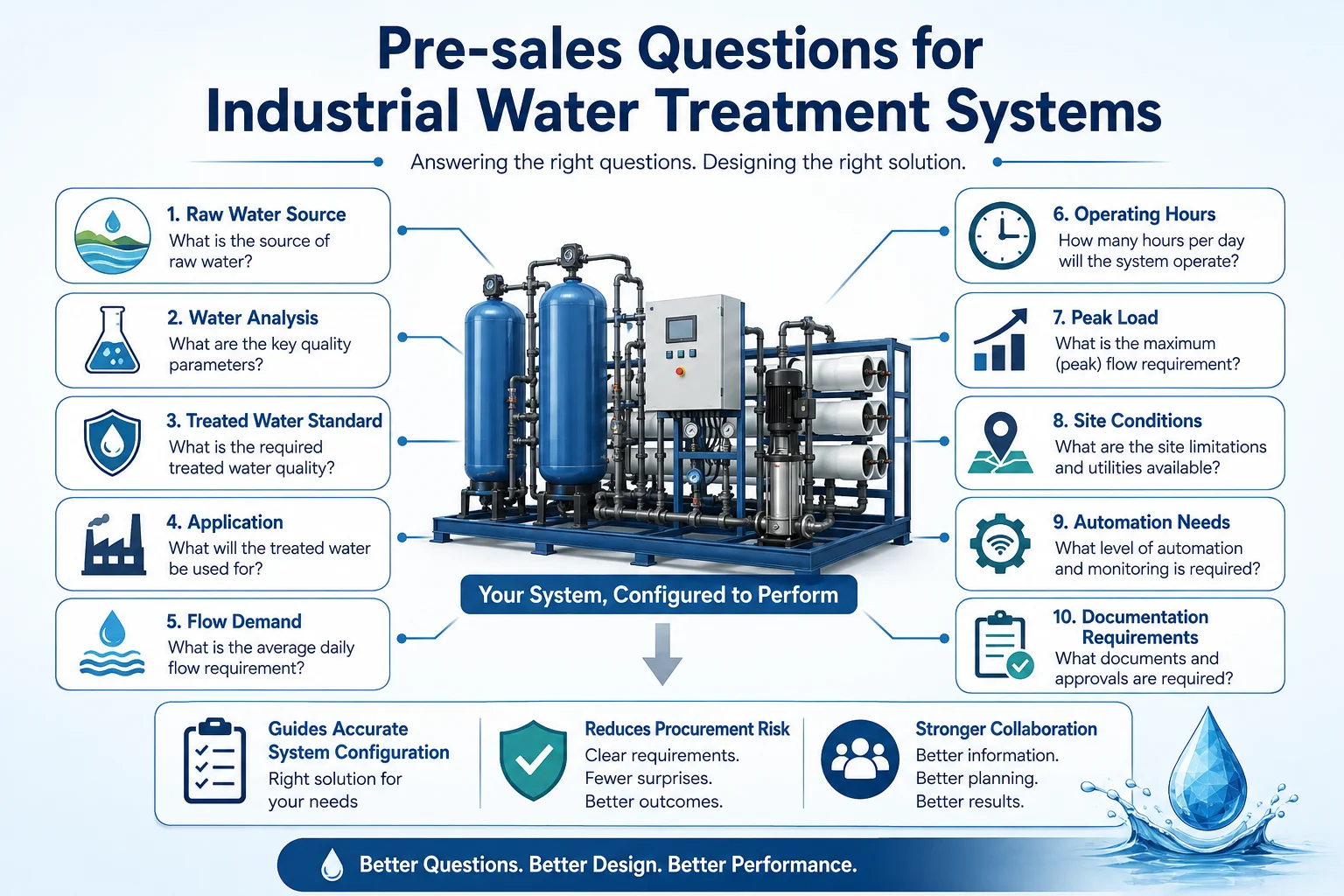
Question group 1: What is the raw water source?
The raw water source is the starting point. Tap water, groundwater, surface water, seawater, and reclaimed water can require very different treatment routes.
A supplier should ask:
- Is the feed water municipal tap water, well water, river water, lake water, seawater, or wastewater?
- Does the water quality change by season?
- Is there a recent water analysis report?
- Are iron, manganese, hardness, silica, turbidity, or organics a concern?
- Is microbiological control required?
A water report is one of the most useful procurement documents. If the report is missing, the buyer should arrange testing through a qualified laboratory or local professional before final system selection.
Question group 2: What is the target water quality?
The treated water standard defines the goal. Without this goal, the system cannot be properly judged.
Common targets may include:
| Application | Possible target focus |
|---|---|
| Boiler feed water | Hardness, conductivity, silica, alkalinity |
| Industrial process water | TDS, hardness, turbidity, specific ions |
| Food and beverage | Taste, odor, microbiology, hygiene materials |
| Electronics | Conductivity, resistivity, TOC, particles |
| Pharmaceutical support water | Conductivity, microbial control, validation-related documents |
| Cooling tower makeup | Hardness, scaling tendency, suspended solids |
I do not recommend guessing the target. The buyer should use project specifications, local standards, production process requirements, or professional engineering guidance.
Question group 3: What flow and operating load are required?
Flow demand is more than a single number. A factory may need 5 m³/h on average but 10 m³/h during peak production. Another site may run only one shift, while a continuous production plant may operate 24 hours per day.
A supplier should ask:
- What is the required treated water flow rate?
- How many hours per day will the system run?
- Is the demand stable or intermittent?
- What is the peak hourly demand?
- Is treated water storage allowed?
- Is redundancy needed for maintenance or critical production?
This is where many early quotations become inaccurate. A system can be technically capable of a flow rate but still unsuitable if it cannot support the actual duty cycle.
Question group 4: What are the project constraints?
Industrial projects rarely happen in perfect conditions. Procurement teams must also consider:
- Available installation area
- Inlet pressure and power supply
- Drainage capacity
- Ambient temperature
- Site water storage
- Chemical storage rules
- Operator experience
- Remote monitoring requirements
- Packaging, labeling, and shipping requirements
- Local spare part availability
For OEM/ODM buyers, branding and documentation may also matter. A distributor may need customized nameplates, packaging, manuals, and electrical standards. These requirements should be discussed early because they can affect production planning and delivery.
A simple pre-sales checklist
Before asking for a final quotation, I suggest preparing this basic file:
- Raw water source description
- Recent water analysis report
- Target treated water standard
- Application description
- Required flow rate and operating hours
- Peak load information
- Site layout or space limit
- Power supply information
- Preferred automation level
- Required documentation and certification copies for verification
This information helps a supplier propose a more realistic process. It also helps the buyer compare quotations on equal terms.
How should buyers evaluate suppliers after choosing industrial water treatment systems?
Supplier evaluation matters, but it should come after the system requirement is clear. If the process is mismatched, even a strong factory cannot make it suitable. If the process is correct, the supplier’s manufacturing control, testing, documentation, and communication decide whether the project runs smoothly.
Buyers should evaluate suppliers of industrial water treatment systems by checking manufacturing consistency, quality control, test procedures, customization ability, documentation support, delivery reliability, and technical communication. Certifications and claims should be verified through documents, inspection, and qualified professional review when needed.
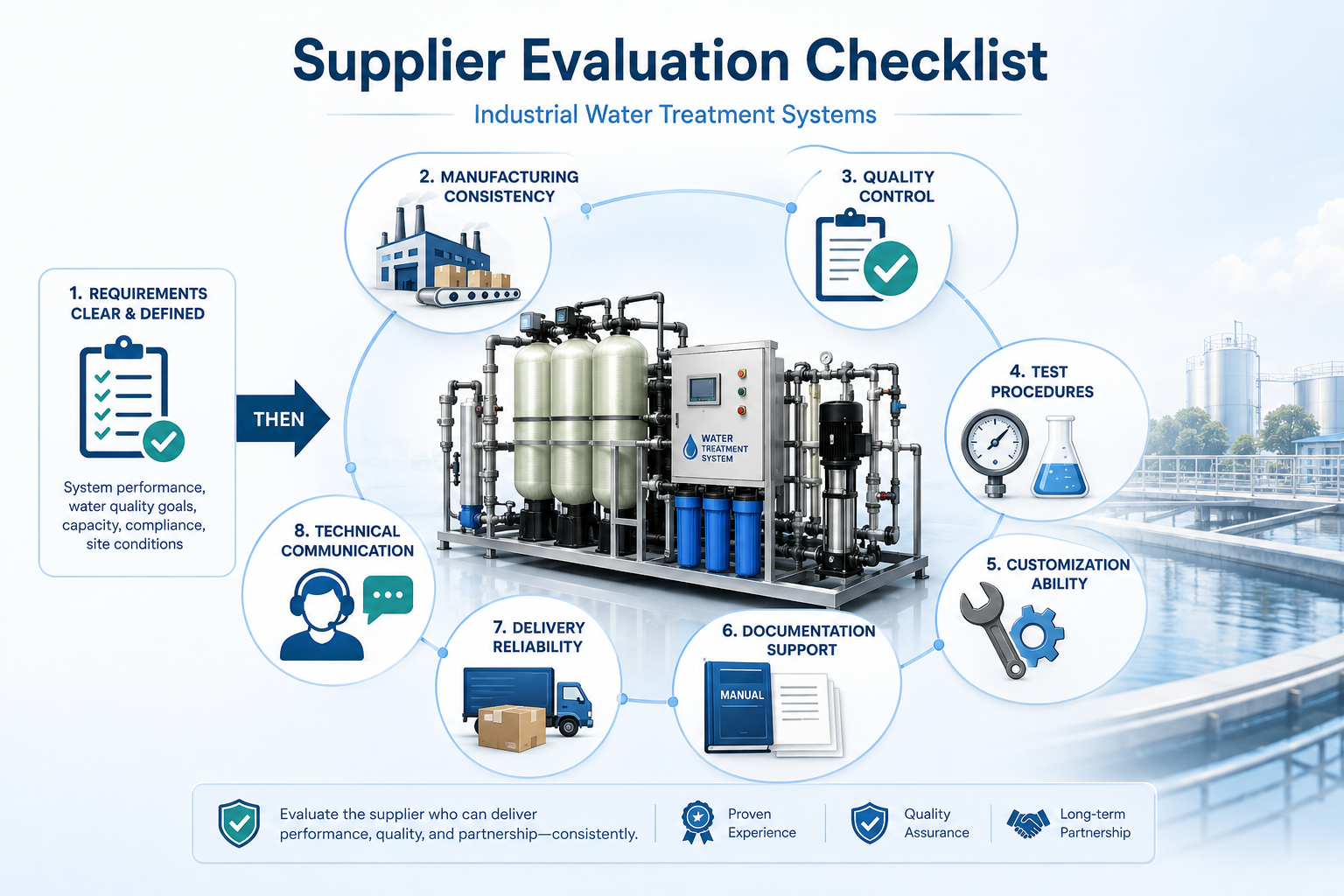
Manufacturing consistency
For industrial buyers, consistency is often more important than a single attractive sample. A brand owner or large distributor needs repeatable quality across batches, especially when annual procurement is large or projects are delivered in stages.
In our manufacturing context at Hedelong, we focus on standardized production lines, automated processes, and quality control checkpoints. Buyers should ask any supplier clear questions such as:
- Are key components traceable?
- Are pressure vessels, housings, skids, and pipework inspected before assembly?
- Are dimensional tolerances controlled?
- Are assembly procedures standardized?
- Are workers trained for repeat production?
- Are nonconforming parts recorded and handled through a defined process?
These questions are not only for factory audits. They also show whether the supplier understands long-term procurement risk.
Testing before shipment
Water treatment equipment should not be judged only by appearance. Buyers should ask what tests are performed before shipment and what records can be supplied.
Depending on the product type, relevant checks may include:
| Equipment type | Useful factory checks |
|---|---|
| RO/NF systems | Pressure test, flow test, electrical test, desalination performance check where applicable |
| UF systems | Pressure holding, integrity-related checks where applicable, backwash function test |
| Softeners and filters | Valve function, tank pressure checks, flow direction verification |
| FRP pressure vessels | Hydrostatic testing, visual inspection, dimensional checks |
| Integrated systems | Control logic, pump rotation, leakage inspection, instrument function |
In our own buyer communication, I prefer to clarify test expectations before production. This avoids disputes after the equipment is finished.
Customization ability
Many industrial projects do not fit standard catalog products. OEM/ODM buyers may need changes in:
- Skid layout
- Pipe material
- Membrane brand preference
- Control system language
- Electrical standard
- Instrument configuration
- Branding and packaging
- Containerized or modular structure
- Documentation format
Customization should be practical, not cosmetic only. A good supplier should explain what can be changed safely and what should not be changed because it may affect performance, maintenance, or compliance.
Documentation and certification review
For international procurement, documentation is part of the product. Buyers should request copies for review and verify them when relevant.
Important documents may include:
- Technical proposal
- Process flow diagram
- General arrangement drawing
- Electrical drawing
- Component list
- Operation manual
- Maintenance guide
- Factory test report
- Packing list
- Warranty terms
- Certificate copies, such as ISO9001, ISO14001, CE, NSF, CCC, or other applicable documents
I recommend treating certifications as documents to verify. The buyer should check whether the certificate applies to the product, the factory, the component, or only the management system.
Technical communication
Good communication does not mean giving the fastest answer. It means asking the right questions, explaining trade-offs, and making assumptions visible.
A useful supplier should be able to explain:
- Why a certain process is proposed
- What feed water assumptions were used
- What output standard is expected
- What pretreatment is included
- What consumables are required
- What maintenance actions are expected
- What risks remain and need buyer confirmation
- What information still needs professional engineering review
This is especially important for brand owners and large distributors. Their end customers will ask technical questions later. If the supplier cannot explain the selection logic, the distributor carries more after-sales pressure.
Frequently Asked Questions
Are RO systems always the best industrial water treatment systems?
No. RO systems are useful for reducing dissolved salts, but they are not always the best choice alone. The right solution depends on feed water quality, target water standard, scaling risk, pretreatment needs, flow demand, and application requirements.
What information should I prepare before requesting a quotation?
You should prepare the raw water source, recent water analysis report, target treated water quality, application, required flow rate, operating hours, peak demand, site conditions, power supply, and documentation requirements. This helps suppliers give comparable and realistic proposals.
Why do two suppliers quote different systems for the same project?
Different suppliers may use different assumptions about feed water, recovery rate, pretreatment, component quality, automation level, and safety margin. Buyers should ask each supplier to state assumptions clearly, then compare process logic instead of only comparing total price.
How can I reduce lifecycle cost when buying water treatment equipment?
You can reduce lifecycle cost by matching the system correctly, verifying pretreatment, checking consumable replacement needs, reviewing energy use, confirming spare part availability, and requesting factory test records. A slightly higher initial cost may reduce maintenance risk in demanding applications.
Should I verify certifications before purchasing?
Yes. You should verify certificates and confirm what they cover. Some documents apply to the factory management system, while others apply to products or components. For regulated applications, you should request qualified professional review and local compliance confirmation.
Conclusion
The best industrial water treatment systems are not defined by a single technology, brand, or lowest price. They are defined by fit: feed water quality, output standard, application, flow demand, operating load, and project constraints. After the configuration is clear, buyers can evaluate suppliers through manufacturing consistency, testing, customization, documentation, and communication. If you are comparing options for OEM/ODM supply, distributor programs, or industrial projects, Hedelong can help review your requirements and prepare a practical system proposal for further evaluation.
"Low Pressure Membrane Filtration for Pathogen Removal", https://nepis.epa.gov/Exe/ZyPURL.cgi?Dockey=P10056FL.TXT. Government membrane-filtration guidance describes ultrafiltration as a pressure-driven process used to remove particulate matter, colloids, and microorganisms from water; this supports the general treatment role but does not determine suitability for a specific feed-water chemistry. Evidence role: mechanism; source type: government. Supports: UF membranes are used to remove fine particles, colloids, and microorganisms and are commonly applied in water treatment and pretreatment.. Scope note: The support is contextual and does not prove that UF is adequate for every industrial feed-water condition. ↩
"Desalination | U.S. Geological Survey", https://www.usgs.gov/water-science-school/science/desalination. Public technical references describe reverse osmosis as a membrane separation process widely used in desalination to reduce dissolved salts and total dissolved solids; this supports the general application rather than the design of any particular RO system. Evidence role: definition; source type: government. Supports: Reverse osmosis is a membrane process used to separate water from dissolved salts and other dissolved constituents.. Scope note: The source would support the broad technology function, not specific rejection rates or operating costs. ↩
"Membrane", https://en.wikipedia.org/wiki/Membrane. Peer-reviewed membrane literature characterizes nanofiltration as a selective pressure-driven process whose rejection depends on solute size, charge, membrane properties, and feed-water chemistry; this supports the general selection principle but not a specific system configuration. Evidence role: mechanism; source type: paper. Supports: Nanofiltration membranes can selectively reject certain solutes, often including multivalent ions and organic molecules, depending on membrane properties and water chemistry.. Scope note: The support is mechanistic and does not replace project-specific pilot testing or water analysis. ↩
"Water Softening", https://extension.psu.edu/water-softening/. University extension and water-quality guidance explains that softening reduces calcium and magnesium hardness, thereby limiting scale formation in water-using equipment; this supports the protective function in general terms. Evidence role: mechanism; source type: education. Supports: Softening reduces calcium and magnesium hardness, which are associated with scale formation in pipes, heaters, boilers, and other equipment.. Scope note: The source would not establish the correct softener size or whether softening alone is sufficient for a given industrial process. ↩
"Combined ultrafiltration-electrodeionization technique for ...", https://pubmed.ncbi.nlm.nih.gov/28659529/. Technical literature on electrodeionization describes it as a continuous ion-removal process used for high-purity water polishing, typically downstream of pretreatment such as reverse osmosis; this supports the stated role but not the adequacy of EDI for all feed waters. Evidence role: mechanism; source type: paper. Supports: Electrodeionization is used for continuous deionization or polishing of pretreated water and requires controlled feed-water quality.. Scope note: The source would provide general process support, while actual performance depends on inlet conductivity, hardness, silica, organics, and system design. ↩
"Factsheets on Water Quality Parameters", https://www.epa.gov/awma/factsheets-water-quality-parameters. Public water-treatment guidance identifies physical, chemical, and microbiological parameters—including dissolved solids, hardness, turbidity, metals, organic matter, and microbial indicators—as factors relevant to treatment selection and control; this supports the article’s design-screening logic. Evidence role: general_support; source type: government. Supports: Core chemical, physical, and microbiological water-quality parameters influence treatment-process selection and operational risk.. Scope note: The source would support the relevance of the parameters but not rank their importance for every industrial application. ↩
"BASIC WATER TREATMENT OF STEAM BOILERS", https://ir.library.oregonstate.edu/xmlui/bitstream/handle/1957/5199/Basic_Water_ocr.pdf. Boiler-water treatment guidance from engineering institutions identifies control of hardness, dissolved solids, alkalinity, oxygen, and related parameters as necessary to limit scale and corrosion in boiler systems; this supports the application requirement. Evidence role: general_support; source type: institution. Supports: Boiler feed-water quality control is used to manage scale-forming impurities and corrosion mechanisms.. Scope note: The source would provide general boiler-water principles, while exact limits depend on boiler pressure, design, and applicable standards. ↩
"Ultrapure water", https://en.wikipedia.org/wiki/Ultrapure_water. Laboratory and high-purity-water standards use conductivity or resistivity as defining quality parameters, with the highest grades requiring very low conductivity or high resistivity; this supports the stated quality focus. Evidence role: definition; source type: institution. Supports: High-purity laboratory and electronics water is commonly specified using conductivity or resistivity measurements.. Scope note: The source would support the parameter requirement generally, not the complete specification for a particular electronics or laboratory process. ↩
"Control of silica scaling phenomena in reverse osmosis systems", https://repositories.lib.utexas.edu/items/95418f12-0a53-4acc-9ee1-11dc618ffe80. Peer-reviewed studies of reverse-osmosis operation identify mineral scaling from hardness constituents, silica, and sparingly soluble barium or strontium salts as recognized causes of membrane performance decline; this supports the mechanism but not the probability of scaling in a specific project. Evidence role: mechanism; source type: paper. Supports: RO membrane scaling can be caused by sparingly soluble salts and silica, including calcium compounds, barium sulfate, strontium sulfate, and silica deposits.. Scope note: Actual scaling risk depends on feed-water analysis, recovery rate, pH, antiscalant program, and operating conditions. ↩
"Chlorine disinfection significantly aggravated the biofouling ...", https://pubmed.ncbi.nlm.nih.gov/30798179/. Membrane-biofouling research describes microbial attachment, growth, and biofilm formation as established causes of reverse-osmosis performance loss, particularly when pretreatment and biological control are insufficient; this supports the article’s stated risk. Evidence role: mechanism; source type: paper. Supports: Microbial growth and biofilm formation can foul RO membranes when biological control and pretreatment are inadequate.. Scope note: The source would not specify which disinfection method is appropriate for a particular membrane material or site. ↩
"A Review of Temperature Effects on Membrane Filtration - PMC", https://pmc.ncbi.nlm.nih.gov/articles/PMC10819527/. Membrane-process references use temperature-correction factors to account for reduced permeate flow at lower feed-water temperatures, supporting the statement as a general operating principle. Evidence role: mechanism; source type: research. Supports: Membrane permeate flux decreases at lower temperatures because water viscosity and mass-transfer conditions change.. Scope note: The magnitude of flow reduction depends on membrane type, pressure, salinity, and manufacturer-specific correction factors. ↩
"Breakthrough in reverse osmosis may lead to most energy-efficient ...", https://www.purdue.edu/newsroom/archive/releases/2021/Q2/breakthrough-in-reverse-osmosis-may-lead-to-most-energy-efficient-seawater-desalination-ever.html. Desalination and reverse-osmosis literature explains that feed salinity determines osmotic-pressure constraints, while applied pressure affects permeate flow and pumping energy; this supports the article’s general operating claim. Evidence role: mechanism; source type: paper. Supports: Higher salinity increases osmotic pressure requirements, and operating pressure influences permeate production and energy demand in RO systems.. Scope note: The source would not quantify energy use for a specific quoted system without design data. ↩