
The cost of industrial water treatment systems is one of the issues that overseas purchasing managers usually consider first, but it is also the most difficult problem to handle properly. If the estimation is made too hastily, there may be hidden problems such as defects in the pre-treatment stage, vulnerable components, or compatibility issues.A better approach is to define the water, duty, quality target, and supplier requirements first.
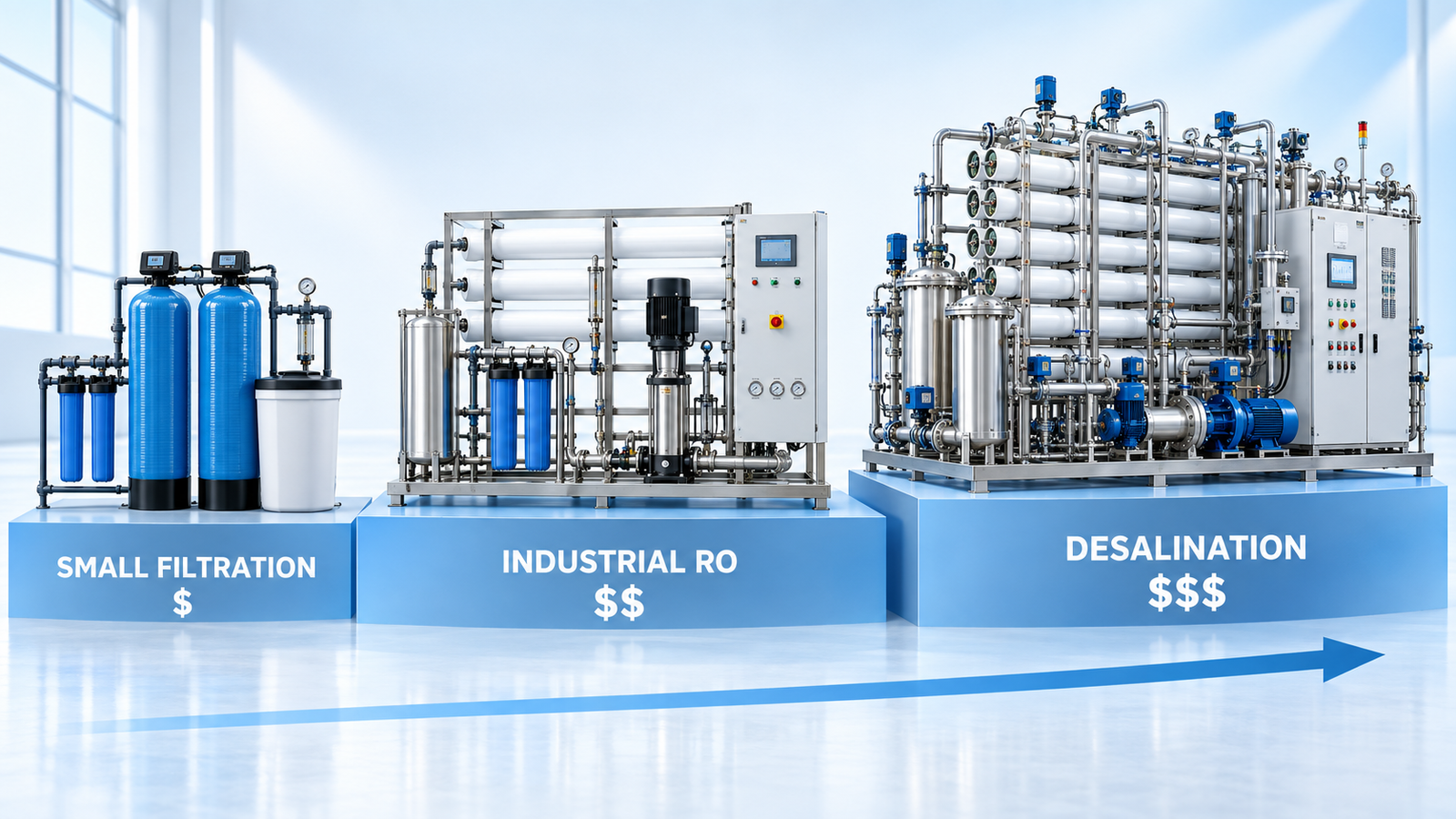
An industrial water treatment system can cost from a few thousand dollars for a small basic filtration or softening skid to hundreds of thousands of dollars for a larger RO, desalination, or high-spec process water system1. The final price depends on raw water quality, flow rate, treatment goal, materials, automation, pressure rating, certifications, installation scope, and lifecycle reliability.
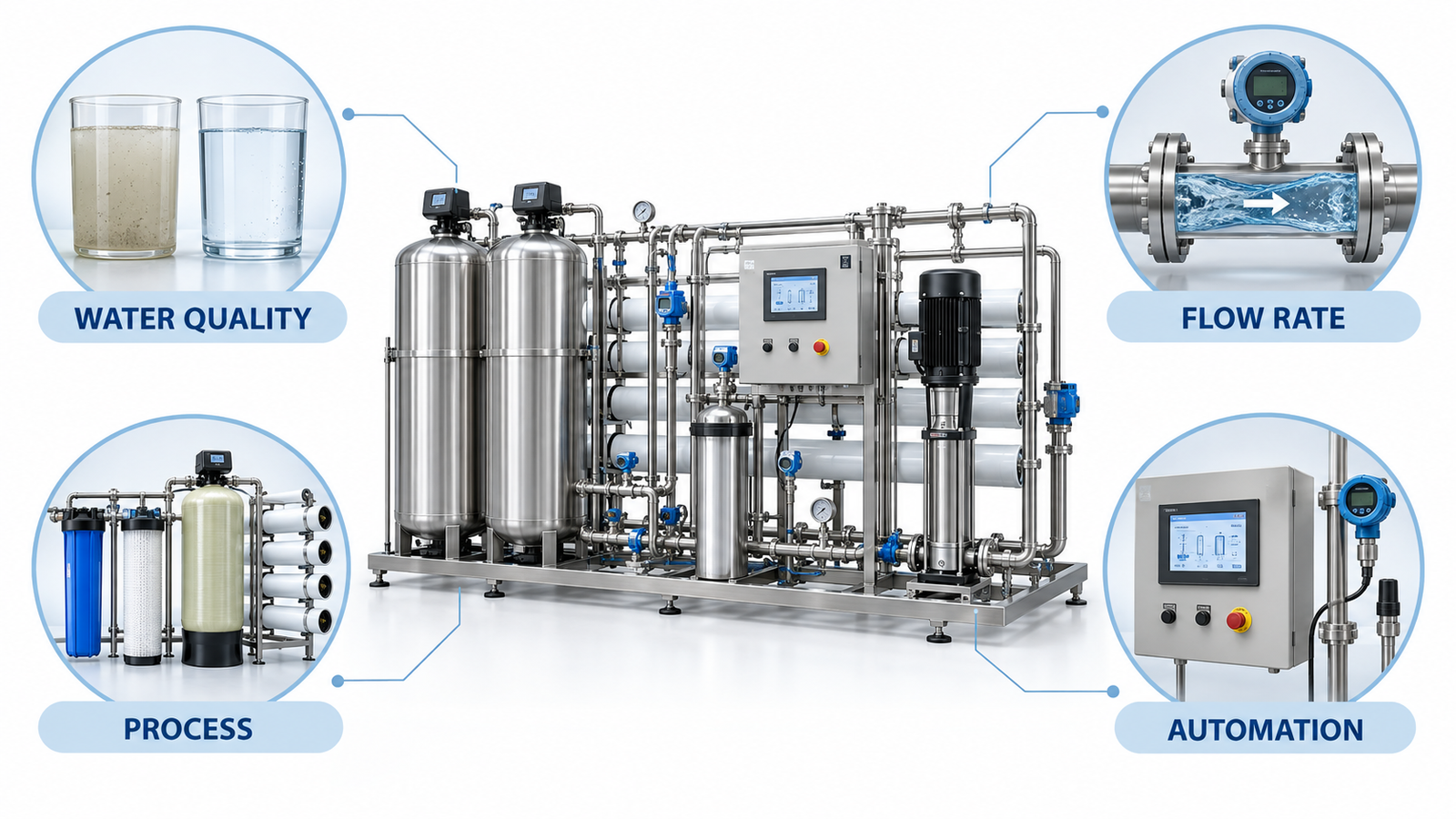
I do not treat “How much does it cost?” as a simple product-price question. I treat it as a project-risk question. Once I understand the water source, flow, output standard, component specification, and buying purpose, the cost range becomes much more meaningful.
What Factors Change Industrial Water Treatment System Cost?
Many buyers ask for a price before they define the system. That creates a problem. If I quote too quickly, the number may look attractive but fail the project later. If I ask too many questions, the buyer may think I am complicating the purchase. The solution is to understand the main cost drivers first.
An industrial water treatment system cost changes mainly because of raw water quality, required treated water quality, flow rate, operating pressure, process configuration, component quality, certification needs, automation level, and delivery scope2. Two systems with the same capacity can have very different prices if their water sources, materials, and compliance requirements are different.
I Start With Water Quality, Not Equipment Size
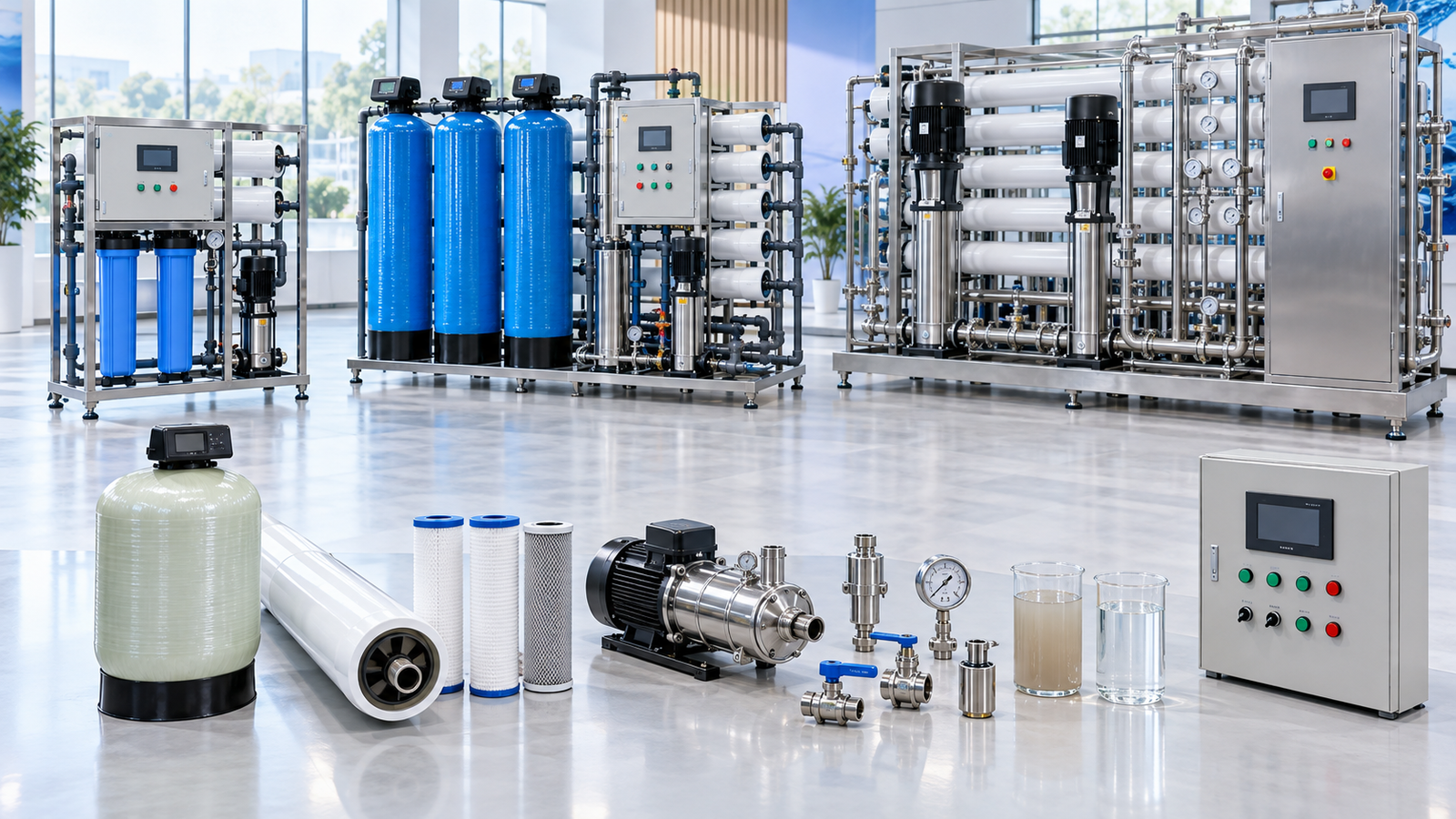
In my experience at Hedelong, incomplete inquiries often mention only “10 tons per hour” or “RO system price.” That is not enough. A system treating clean municipal water usually needs a different budget from a system treating brackish groundwater, high-iron well water, oily wastewater, or seawater.
A useful inquiry should include:
- Raw water source: municipal water, groundwater, river water, seawater, recycled water, process wastewater
- Raw water report: TDS, hardness, turbidity, iron, manganese, silica, COD, bacteria, chlorine, pH
- Required output quality: drinking water, boiler feedwater, process water, irrigation water, ultrapure water
- Flow rate: m³/h, GPM, daily demand, peak flow
- Operating schedule: 8 hours/day, 24 hours/day, batch operation, continuous duty
- Local compliance needs: CE, NSF-related requirements, drinking water hygiene rules, pressure vessel rules
- Installation context: indoor/outdoor, temperature, electrical supply, space limits, automation needs
The Main Cost Drivers I Check
| Cost Driver | Why It Affects Price | Buyer Action |
|---|---|---|
| Raw water quality | More contaminants require more pretreatment stages | Share a recent water analysis3 |
| Flow rate | Larger flow needs larger pumps, tanks, valves, piping, membranes | Confirm peak and average demand |
| Output quality | Higher purity requires RO, polishing, UV, EDI, or mixed bed systems | Define the final water standard |
| Pressure rating | Higher pressure needs stronger vessels, housings, and pumps | Match pressure to process design |
| Materials | FRP, stainless steel, UPVC, HDPE, and food-grade materials differ in cost | Ask for material specifications |
| Automation | PLC, HMI, sensors, remote monitoring, and automatic valves add cost | Decide manual, semi-auto, or full-auto |
| Certifications | Documented compliance increases supplier control and traceability | Verify certificates and scope |
| Supply scope | Components only, skid, installation, commissioning, spares | Compare quotations line by line |
At Hedelong, my business context is mainly component manufacturing and supply. I focus on parts such as FRP pressure vessels, FRP membrane housings, RO membranes, brine tanks, dosing tanks, water distributors, filters, softeners, diaphragm valves, and controllers. These components do not define the whole project alone, but they strongly influence durability, pressure safety, sanitary suitability, and long-term maintenance cost.
That is why I encourage buyers to avoid comparing only the lowest total number. A low quotation may omit important items such as chemical dosing, adequate pretreatment, certified pressure vessels, spare parts, control valves, or proper membrane housing specifications. The visible price may be lower, but the operating risk may be higher.
Why Can the Same Flow Rate Have Different Industrial Water Treatment System Cost?
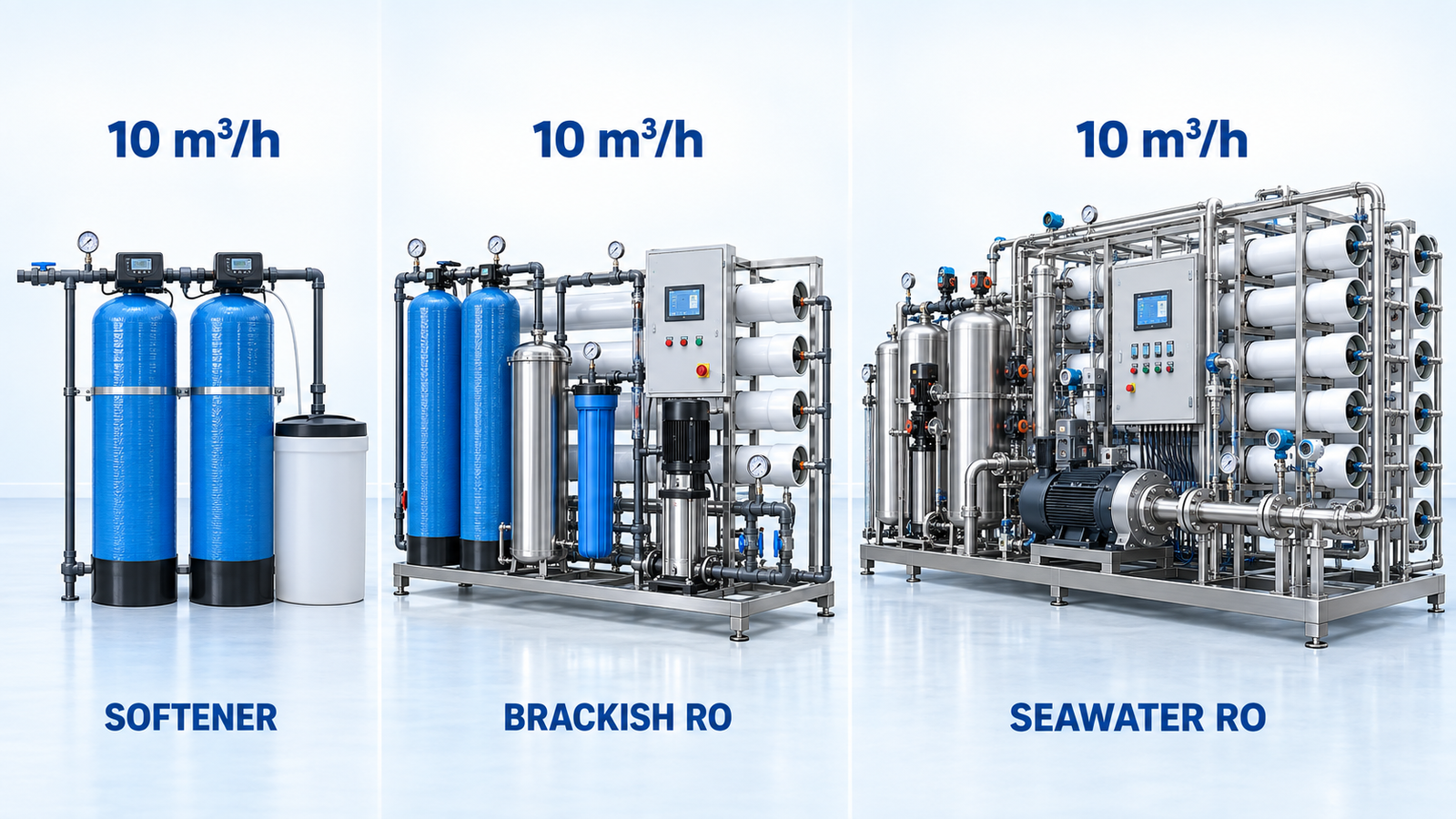
A buyer may compare two quotations for the same 10 m³/h system and feel confused because one price is much higher. That difference is not always supplier profit. Sometimes it reflects better pretreatment, stronger pressure vessels, safer materials, higher automation, or stricter documentation. The buyer needs to identify what is included.
The same flow rate can produce different industrial water treatment system cost because capacity alone does not define treatment difficulty4. A 10 m³/h softener, a 10 m³/h brackish water RO system, and a 10 m³/h seawater desalination system have different pressure levels, membranes, pretreatment stages, materials, controls, and maintenance requirements5.
A 10 m³/h System Is Not One Standard Product
I sometimes see buyers compare systems as if flow rate were the only specification. In real procurement work, flow rate is only the starting point. A basic media filtration system may use FRP filter tanks, distributors, valves, and media. A softening system may add brine tanks, resin, and automatic control valves. An RO system may add cartridge filters, high-pressure pumps, membrane housings, RO membranes, dosing tanks, pressure instruments, and control panels.
Here is a simple comparison:
| Example System Type | Typical Purpose | Main Cost Drivers |
|---|---|---|
| Multimedia filtration | Remove suspended solids and turbidity | FRP tanks, valves, distributors, media, backwash design |
| Water softening | Reduce hardness for boilers or process use | Resin volume, brine tank, control valve, regeneration design |
| Brackish water RO | Reduce TDS for industrial process water | Pretreatment, RO membranes, membrane housings, pumps, dosing |
| Seawater RO | Desalination | High-pressure components, corrosion resistance, energy recovery, pretreatment |
| High-purity process water | Electronics, pharma support, special processes | RO + polishing, monitoring, sanitary materials, documentation |
Component Choices Change the Real Budget
For the products I work with, several component-level choices can move the price significantly:
-
FRP pressure vessels and filter tanks
FRP tanks with food-grade polyethylene liners and fiberglass-reinforced outer layers are widely used because they offer corrosion resistance and reliable mechanical performance6. However, tank size, opening type, pressure rating, color, liner quality, and production consistency all affect cost. -
FRP membrane housings
RO membrane housings must match pressure, membrane size, port type, and system configuration. A low-grade housing can become a major risk in a high-pressure RO system. -
Valves and controllers
Manual valves reduce upfront cost, but automatic control valves can improve operational consistency. For bulk procurement, I ask buyers to consider operator skill level and maintenance expectations. -
Dosing tanks and chemical systems
Antiscalant dosing, pH adjustment, chlorine removal, or cleaning chemicals may be essential. Omitting dosing equipment can make a quotation look cheaper but shorten membrane life7. -
Certifications and hygiene documents
CE, NSF-related documentation, ISO9001 quality management, and domestic hygiene approvals are often important in international procurement. I always advise buyers to verify certificate scope, validity, and whether the certificate applies to the exact component or model.
A Practical Way I Compare Quotations
When I review a quotation, I separate the system into layers:
- Process design layer: filtration, softening, RO, UV, polishing
- Pressure and safety layer: vessels, housings, pumps, gauges, relief design
- Material layer: FRP, PE liner, stainless steel, UPVC, EPDM, food-grade contact materials
- Control layer: manual valves, automatic valves, PLC, sensors, alarms
- Compliance layer: certificates, test reports, manuals, traceability
- Service layer: drawings, spares, lead time, packing, after-sales communication
This method helps me avoid a common mistake: choosing the lower price without understanding what disappeared from the scope.
How Should I Compare Upfront Price With Total Cost of Ownership?
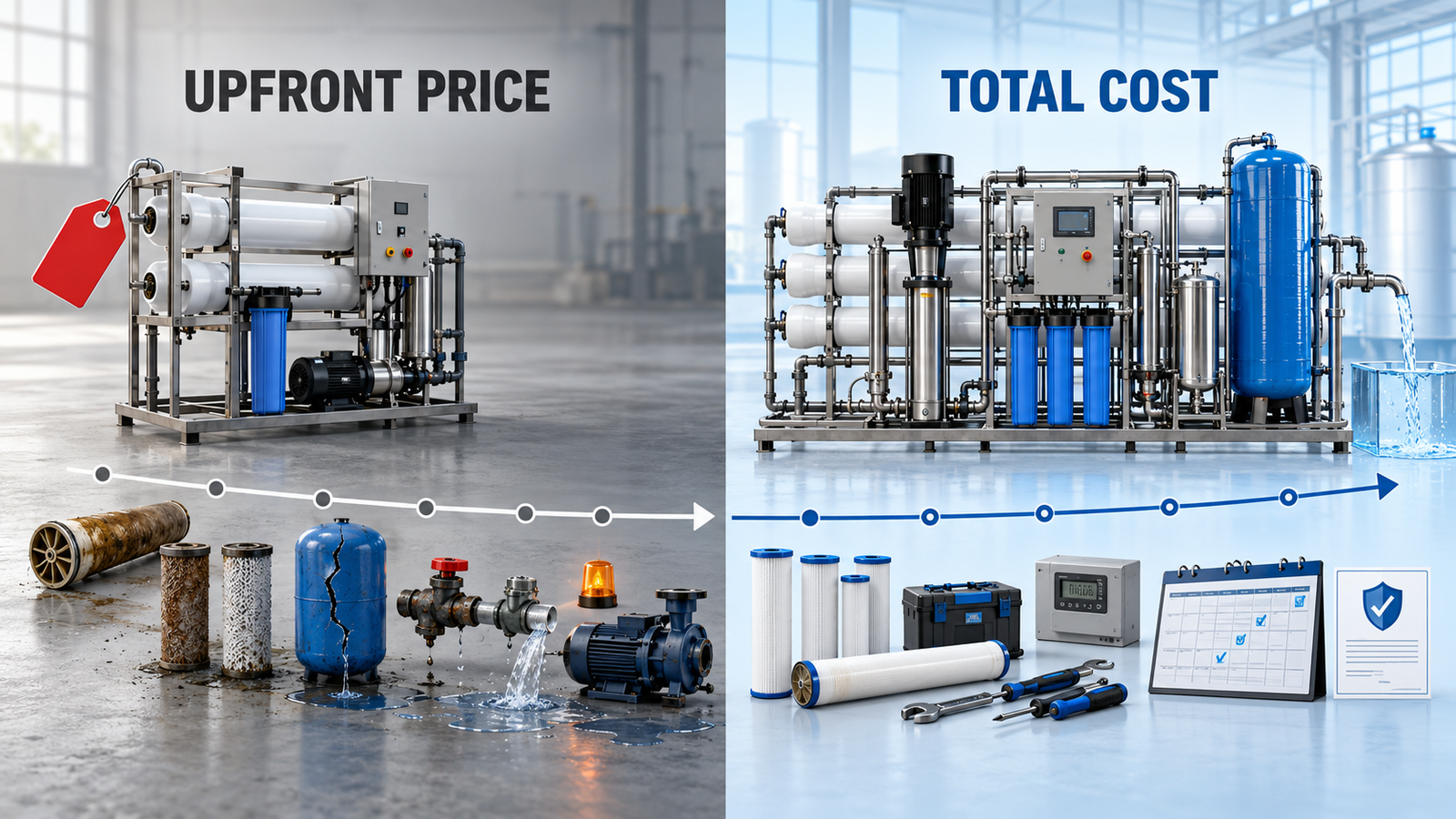
A low upfront price can feel like a procurement win. The problem appears later when membranes foul too quickly, tanks crack, valves fail, or the system cannot meet output quality. In water treatment, the purchase price is only part of the financial decision. I prefer to compare lifecycle cost.
Industrial water treatment system cost should be evaluated as total cost of ownership8, not only equipment price. Buyers should include purchase cost, spare parts, consumables, membrane replacement, resin replacement, chemical use, energy consumption, downtime risk, maintenance labor, warranty response, and compliance risk before choosing a supplier.
The Hidden Costs I Watch Closely
I have seen buyers focus intensely on the first quotation and spend less time checking service life. That is understandable because procurement teams have budget pressure. Still, I believe this is where many project risks start.
Key hidden costs include:
- Frequent replacement of low-quality components
- Higher chemical consumption due to poor pretreatment
- Shorter RO membrane life
- Downtime during production or municipal supply
- Higher labor cost for manual operation
- Import delays caused by missing documents
- Project penalties caused by late delivery
- Compliance issues in drinking water or regulated applications
For example, an FRP tank or membrane housing may appear as a small percentage of a full system quotation. But if it fails, the replacement cost includes shipping, downtime, labor, and possible damage to other components. That is why I treat pressure rating, liner material, fatigue testing, and quality control as more than technical details.
At Hedelong, the products I work around include FRP vessels designed for water treatment applications, with food-grade water-contact base materials such as polyethylene liners and fiberglass-reinforced epoxy outer structures. Our supplied business context references working pressure around 10.5 bar / 150 psi, operating temperature ranges such as 1–48°C, and fatigue cycle testing such as more than 100,000 cycles from 0–150 psi for relevant products. I mention these as buyer-verification points, not as a substitute for project engineering approval.
A Simple Total Cost View
| Cost Category | What I Include | Why It Matters |
|---|---|---|
| Initial equipment | Tanks, housings, pumps, valves, membranes, controls | Defines project capital cost |
| Consumables | Media, resin, cartridges, membranes, chemicals | Determines recurring cost |
| Energy9 | Pumps, blowers, controls | Affects monthly operation cost |
| Maintenance | Labor, tools, service visits, cleaning | Affects reliability and staffing |
| Downtime | Lost production, emergency repairs | Often exceeds component price |
| Compliance | Testing, documents, local approvals | Reduces legal and market risk |
| Logistics | Packing, freight, customs, lead time | Important for international buyers |
Where Buyers Can Save Safely
I do not think every project needs the most expensive components. Good procurement is not about buying the highest specification everywhere. It is about matching specification to risk.
A buyer may save safely by:
- Choosing the correct tank size instead of oversizing blindly
- Using standard colors and standard openings when customization is not needed
- Selecting manual operation for low-risk, low-frequency processes
- Standardizing spare parts across multiple systems
- Buying components in bulk when the project pipeline is clear
- Confirming packaging and shipping plans early to reduce freight problems
However, I would be careful about saving money by reducing pressure ratings, removing pretreatment, ignoring certification needs, or buying undocumented materials for drinking water contact. Those savings may create expensive failures.
What Cost Ranges Can I Use for Early Budgeting?
Buyers often need a rough number before they can approve a project study. I understand that. The problem is that broad ranges can be misleading if they are not tied to assumptions. I can provide reference ranges, but I always treat them as budgeting guidance, not a final quotation.
For early planning, an industrial water treatment system may range from several thousand USD for small filtration or softening equipment to tens or hundreds of thousands of USD for larger RO, desalination, or high-purity systems. A technical quotation must confirm water quality, flow rate, treatment target, materials, automation, certifications, and scope.
Reference Ranges With Caution
The following ranges are only for early budget thinking. They are not fixed prices, and they should not replace an engineering quotation.
| System Category | Very Broad Budget Reference | Main Assumptions |
|---|---|---|
| Small filtration or softening system | USD 2,000–15,000+ | Lower flow, standard FRP tanks, basic controls |
| Medium industrial filtration or softening skid | USD 10,000–50,000+ | Higher flow, multiple tanks, automatic valves |
| Brackish water RO system | USD 15,000–150,000+ | Depends heavily on TDS, recovery, pretreatment, automation |
| Seawater RO system | USD 80,000–500,000+ | High pressure, corrosion control, complex pretreatment |
| High-purity process water line | USD 50,000–500,000+ | RO plus polishing, monitoring, stricter documentation |
I use “+” because project scope can expand quickly. A system price may include only the skid, or it may include feed pumps, raw water tank, treated water tank, dosing units, CIP cleaning system, instruments, electrical cabinet, spare parts, export packing, and commissioning support10. These differences matter.
Why I Avoid Precise Price Promises
A fixed online price may look helpful, but it can create false confidence. I would need more information before I could judge whether a system is underspecified or overspecified.
For example:
- A low-TDS municipal water RO system may need modest pretreatment.
- A high-hardness groundwater RO system may need softening or antiscalant dosing.
- A high-iron well water system may need oxidation and filtration before RO.
- A seawater desalination system needs very different pressure and corrosion control.
- A drinking water system may need stronger material documentation and local hygiene review.
Also, international buyers must consider freight, Incoterms, import duties, local installation, and local inspection. A supplier quotation may be FOB, CIF, EXW, or DDP11. These terms can change the landed cost significantly.
A Better Budgeting Method
When I help buyers prepare early estimates, I prefer this process:
- Define the water source and collect a test report
- Confirm treated water use and quality target
- Set average flow and peak flow
- Choose the treatment route with a qualified engineer or system designer
- List major components and material requirements
- Decide the automation level
- Clarify certification and documentation requirements
- Separate component cost, skid cost, freight, installation, and operation
- Request quotations using the same technical sheet
- Compare lifecycle cost, not only first price
This process helps buyers get quotations that are easier to compare. It also reduces misunderstandings with suppliers.
How Can I Prepare an Inquiry That Leads to an Accurate Industrial Water Treatment System Cost?
An unclear inquiry leads to a vague quotation. A vague quotation leads to difficult comparison. That creates procurement risk. I believe the buyer can control much of this risk by preparing a clear technical request before asking for price.
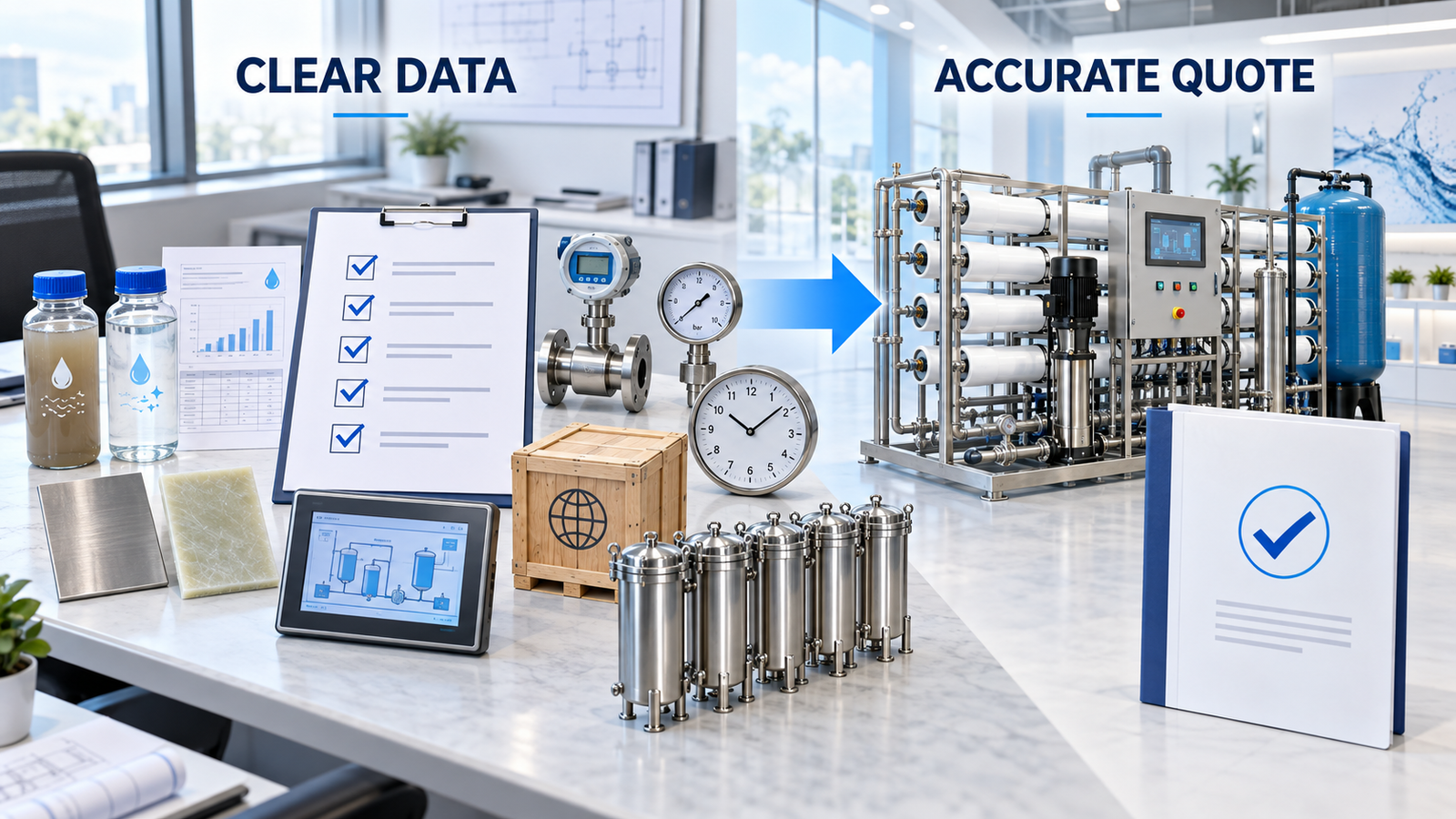
To get an accurate industrial water treatment system cost, I should provide raw water analysis, treated water standard, flow rate, operating hours, application, preferred materials, pressure requirements, automation level, certification needs, destination country, delivery terms, and expected purchase quantity. A complete inquiry helps suppliers quote comparable and reliable solutions.
My Practical Inquiry Checklist
When I receive a detailed inquiry, I can respond faster and more usefully. When I receive only “send price,” I need to ask many follow-up questions. For procurement managers and project engineers, I recommend using a checklist like this:
Project information
- Country and project location
- Application industry
- New project or replacement project
- Required delivery time
- Estimated annual purchase volume if it is a bulk program
Water information
- Raw water source
- Full water analysis
- Seasonal variation if known
- Pretreatment already available or not
Performance requirement
- Required flow rate
- Daily operating hours
- Treated water quality target
- Recovery rate expectation if RO is involved
- Discharge or concentrate handling requirements
Component preferences
- FRP tank size and opening type
- Membrane housing size and pressure rating
- RO membrane brand or equivalent requirement
- Brine tank, dosing tank, storage tank size
- Valve type: manual, automatic, diaphragm, control valve
- Controller and automation preference
Compliance and documents
- CE requirement
- NSF-related requirement
- ISO9001 supplier system requirement
- Drinking water hygiene requirement
- Test reports, manuals, drawings, labels
- Local inspection or registration needs
Commercial details
- Quantity
- Incoterms
- Destination port
- Packaging requirements
- Spare parts request
- Warranty expectations
How I Compare Suppliers Beyond Price
For overseas buyers, supplier selection is as important as the quotation itself. I suggest checking:
-
Manufacturing capability
I would ask whether the supplier has stable production processes. In Hedelong’s case, the supplied context includes CNC blow molding, CNC injection molding, CNC winding, and multi-arm rotational molding for relevant product lines. -
Quality management
I would verify ISO9001 documentation and ask how incoming materials, production processes, pressure testing, and final inspection are controlled. -
Material suitability
I would check whether water-contact materials are appropriate for the application, especially for drinking water or food-related use. -
Certification scope
I would not assume a certificate covers every product or every country. I would ask for certificate copies, model coverage, validity dates, and applicable standards. -
Customization ability
If I need special color, interface, tank size, flange type, or pressure requirement, I would confirm feasibility before placing the order. -
Bulk supply stability
For distributors and system integrators, stable batch quality matters. A small sample order may pass, but a container-level order requires consistent production and packing control. -
Technical communication
A reliable supplier should explain trade-offs clearly. I do not expect every supplier to design the entire plant, but I do expect accurate component parameters and honest scope boundaries.
A Short Template Buyers Can Use
I need a quotation for an industrial water treatment project. Raw water is [source], with attached analysis. Required treated water is [standard/application]. Flow rate is [m³/h], operation is [hours/day]. Please quote [system/components] with [materials], [pressure rating], [automation level], [certifications], [quantity], and delivery to [country/port] under [Incoterm]. Please include technical datasheets, certificates if applicable, lead time, packing, and spare parts recommendations.
This template saves time. It also makes the final industrial water treatment system cost easier to defend inside a procurement review.
Frequently Asked Questions
What is the biggest factor in industrial water treatment system cost?
Raw water quality is often the biggest factor because it determines the treatment process. High hardness, high TDS, iron, organic matter, bacteria, oil, or seawater salinity can add pretreatment, stronger materials, higher pressure components, and more controls. Flow rate matters too, but capacity alone is not enough.
Is a cheaper industrial water treatment system always a bad choice?
A cheaper system is not always bad if the specification matches the application. However, a low price becomes risky when it removes essential pretreatment, uses weak pressure vessels, lacks material documentation, or ignores compliance needs. I always compare lifecycle cost, not only the first purchase price.
Do CE, NSF, or ISO9001 certificates guarantee full system compliance?
No. Certificates are important documents, but buyers should verify their scope, validity, and model coverage. A certified component does not automatically guarantee that the full system meets every local regulation12. Final compliance should be checked against the project, market, installation, and application requirements.
How can I reduce my water treatment system budget without increasing risk?
I would standardize component sizes, avoid unnecessary customization, confirm accurate flow demand, choose the right automation level, and plan bulk purchasing when possible. I would not reduce risk-critical items such as pressure rating, sanitary materials, pretreatment, or required documentation.
What information should I send before requesting a quotation?
I should send raw water analysis, treated water quality target, flow rate, operating hours, application, destination country, certification needs, material preferences, automation requirements, quantity, and delivery terms. A complete inquiry helps suppliers provide a more accurate and comparable quotation.
Conclusion
Industrial water treatment system cost is not a single fixed number. It is a project-specific budget shaped by water quality, flow rate, treatment goals, component quality, documentation, automation, and lifecycle risk. I recommend that buyers compare suppliers with the same technical assumptions and verify certifications carefully. If you are sourcing FRP tanks, membrane housings, RO membranes, brine tanks, dosing tanks, valves, controllers, or related water treatment components, I can help you review the component requirements and prepare a clearer quotation request for your next project.
"Drinking Water Treatment Technology Unit Cost Models", https://www.epa.gov/sdwa/drinking-water-treatment-technology-unit-cost-models. U.S. EPA water-treatment cost models document that capital cost estimates differ substantially by process type, capacity, and design assumptions, providing contextual support for broad early-stage cost ranges across filtration, softening, and reverse-osmosis systems. Evidence role: general_support; source type: government. Supports: Government water-treatment cost models show that capital costs vary widely by treatment technology, design capacity, and configuration, including filtration, ion exchange, and reverse osmosis.. Scope note: Such models support the variability and order-of-magnitude approach but do not verify the article's exact dollar ranges for every market or supplier. ↩
"The Effects of Source Water Quality on Drinking Water Treatment Costs", https://pmc.ncbi.nlm.nih.gov/articles/PMC6040680/. U.S. EPA cost-estimation guidance for drinking-water treatment identifies design flow, source-water quality, target contaminants, and selected treatment processes as central inputs to treatment cost estimates. Evidence role: general_support; source type: government. Supports: Cost-estimation guidance for water-treatment systems commonly treats design flow, influent water quality, treatment objectives, and selected processes as core determinants of capital and operating cost.. Scope note: The source supports the principal cost drivers but may not address every commercial factor listed, such as supplier documentation scope or export delivery terms. ↩
"The Effects of Source Water Quality on Drinking ... - PMC - NIH", https://pmc.ncbi.nlm.nih.gov/articles/PMC6040680/. WHO guidance on drinking-water quality emphasizes that treatment selection should be based on source-water characteristics and target hazards, which supports requesting current raw-water analysis before system sizing or quotation. Evidence role: mechanism; source type: institution. Supports: Water-treatment design depends on source-water characteristics such as turbidity, dissolved solids, hardness, metals, microorganisms, and pH.. Scope note: WHO guidance is primarily framed around drinking-water safety, so its support is contextual for broader industrial process-water applications. ↩
"The Effects of Source Water Quality on Drinking ... - PMC - NIH", https://pmc.ncbi.nlm.nih.gov/articles/PMC6040680/. U.S. EPA treatment-technology guidance indicates that appropriate treatment depends on contaminant characteristics, water-quality goals, and system design conditions, supporting the point that capacity alone is not a sufficient design or cost basis. Evidence role: general_support; source type: government. Supports: Treatment-process selection and design depend on influent quality and required effluent quality as well as hydraulic capacity.. Scope note: The source supports the engineering principle rather than a direct comparison of two commercial quotations with the same flow rate. ↩
"Reliable Sea Water Ro Operation with High Water Recovery ...", https://pmc.ncbi.nlm.nih.gov/articles/PMC7923200/. Peer-reviewed desalination reviews describe brackish-water and seawater reverse osmosis as pressure-driven membrane processes with feed-water-dependent pretreatment and pressure requirements, while ion-exchange softening relies on resin exchange rather than membrane desalination. Evidence role: mechanism; source type: paper. Supports: Ion-exchange softening, brackish-water RO, and seawater RO use different separation mechanisms, pressure regimes, pretreatment needs, and component requirements.. Scope note: The source should support the process differences, not the article's illustrative 10 m³/h example as a priced commercial package. ↩
"FRP vs. Other Tank Lining Materials: A Comparison Guide", https://americanfiberglasstank.com/feeds/blog/frp-vs-rubber-lined-tank. Materials-engineering literature reports that fiber-reinforced polymer composites are commonly selected for corrosive fluid-service applications because they provide corrosion resistance and useful mechanical strength compared with many conventional materials. Evidence role: mechanism; source type: paper. Supports: Fiber-reinforced polymer composites are used in corrosive environments because they combine corrosion resistance with favorable strength-to-weight mechanical properties.. Scope note: This supports the material rationale generally; it does not validate the performance of any specific tank model, liner formulation, or manufacturer. ↩
"Fouling in reverse osmosis membranes: monitoring ... - PMC", https://pmc.ncbi.nlm.nih.gov/articles/PMC10102236/. Peer-reviewed membrane-treatment literature identifies scaling, fouling, and chlorine oxidation as major causes of reverse-osmosis membrane performance decline and describes antiscalant addition and dechlorination as common control measures. Evidence role: mechanism; source type: paper. Supports: RO membranes are vulnerable to scaling, fouling, and oxidant damage, and pretreatment or chemical conditioning is used to control those mechanisms.. Scope note: The source supports the technical mechanism; actual membrane life depends on feed water, operating conditions, cleaning practice, and membrane type. ↩
"Life-Cycle Cost Analysis Framework for Water Efficiency ...", https://www.energy.gov/cmei/femp/articles/life-cycle-cost-analysis-framework-water-efficiency-measures. Life-cycle cost studies of membrane and desalination systems evaluate total cost using both capital and operating components, including energy use, chemical consumption, membrane replacement, and maintenance. Evidence role: expert_consensus; source type: paper. Supports: Lifecycle-cost analyses of water treatment account for capital expenditure as well as energy, chemicals, membrane replacement, maintenance, and other operating costs.. Scope note: The evidence supports the economic framework generally, not the financial outcome of a particular buyer's procurement decision. ↩
"Economics and Energy Consumption of Brackish Water ... - PMC", https://pmc.ncbi.nlm.nih.gov/articles/PMC8399043/. International and institutional analyses of desalination identify energy consumption, especially for high-pressure reverse-osmosis pumping, as a major contributor to operating cost. Evidence role: statistic; source type: institution. Supports: Energy is a major operating input in desalination and other pressure-driven water-treatment processes.. Scope note: The support is strongest for RO and desalination; energy may be a smaller share for simple gravity filtration or low-pressure treatment systems. ↩
"Work Breakdown Structure-Based Cost Models for Drinking ...", https://nepis.epa.gov/Exe/ZyPURL.cgi?Dockey=P100MYKY.TXT. U.S. EPA water-treatment cost models separate process equipment from ancillary capital and operating cost elements, supporting the need to compare quotations by scope rather than headline price alone. Evidence role: general_support; source type: government. Supports: Water-treatment cost estimates include multiple cost elements beyond the primary treatment unit, such as pumps, tanks, instrumentation, installation, and ancillary systems.. Scope note: The source supports the principle of scope-dependent cost estimation but does not describe every commercial item listed in the article. ↩
"Know Your Incoterms - International Trade Administration", https://www.trade.gov/know-your-incoterms. The International Chamber of Commerce defines Incoterms rules as standardized trade terms that allocate delivery obligations, costs, and risk between buyer and seller, which explains why FOB, CIF, EXW, and DDP can produce different landed-cost outcomes. Evidence role: definition; source type: institution. Supports: Incoterms define buyer and seller responsibilities for delivery, cost allocation, and risk transfer in international trade.. Scope note: Incoterms define contractual responsibilities but do not determine actual freight rates, duties, taxes, or local installation costs. ↩
"Compliance FAQs: CE Marking", https://www.nist.gov/standardsgov/compliance-faqs-ce-marking. Certification bodies and standards organizations describe certifications as scope-limited attestations tied to specified standards, products, models, or management systems, supporting the need to verify whether a component certificate applies to a complete water-treatment installation. Evidence role: definition; source type: institution. Supports: Certifications are limited by their stated scope, applicable standard, covered models, and issuing program, and do not automatically extend to other components or full installations.. Scope note: The exact legal effect varies by jurisdiction, certification scheme, and project application. ↩