

When I help customers filter tank water for safe drinking projects, I see one common problem: buyers often treat filtration as a single product choice. That creates risk, because stored water can contain sediment, organic matter, hardness, microorganisms, or dissolved salts. I prefer a system approach that starts with testing and ends with maintenance.
To filter tank water for safe drinking, I would first test the water source, then design staged treatment: sediment filtration, activated carbon, softening if needed, reverse osmosis for dissolved contaminants, and UV or chlorine disinfection. I would also use food-grade storage materials, verify certifications, and maintain every filter, membrane, lamp, and tank on schedule.
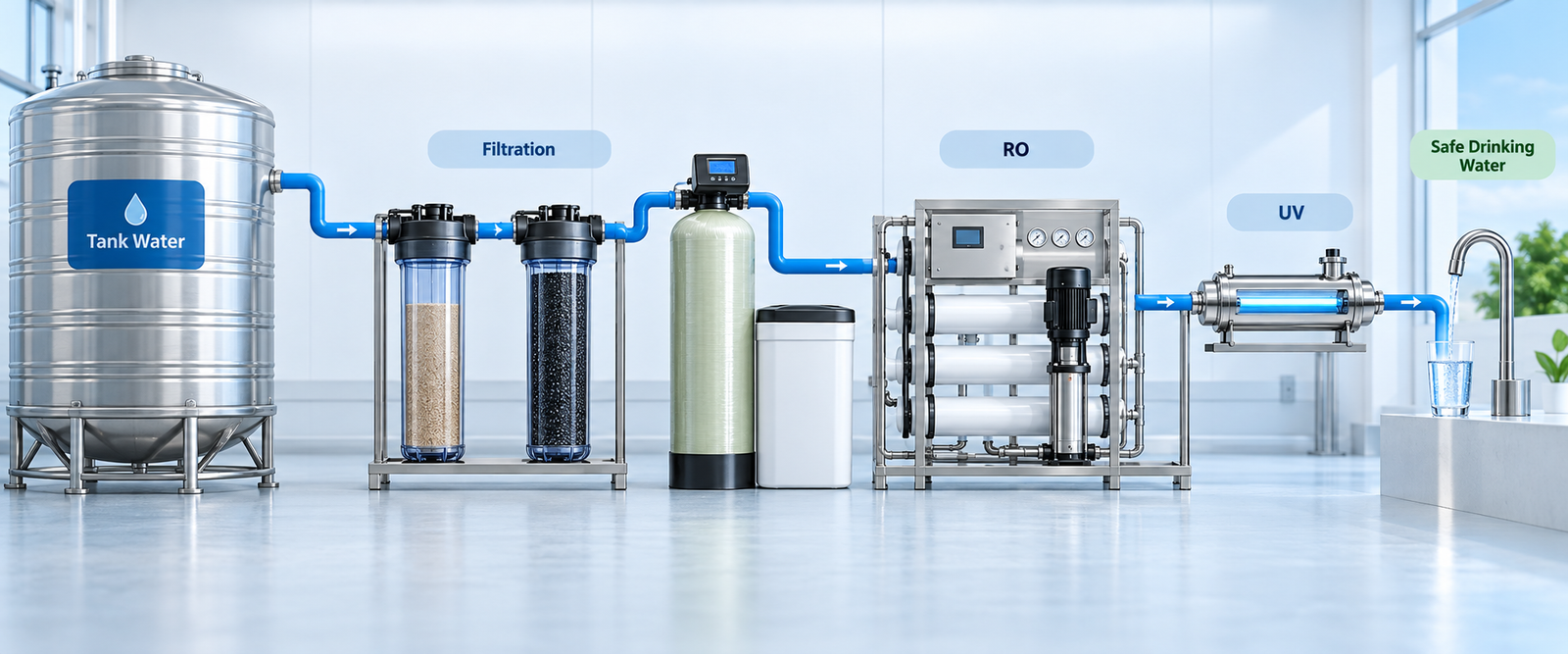
I do not see this as a simple DIY question only. For project engineers, system integrators, and procurement managers, the real question is how to reduce drinking-water safety risk through correct equipment selection, verified documents, and stable long-term operation.
How Should I Filter Tank Water After Testing the Source?
When I plan how to filter tank water, I start with the source because the wrong starting point can make the whole system unreliable. A rainwater tank, borehole tank, municipal storage tank, and process water tank can have very different risks. If I skip testing, I may select equipment that looks correct but fails in practice.
I would filter tank water only after checking source quality, target use, local drinking-water requirements, flow rate, pressure, and contaminant type. Water testing guides the treatment chain. Without testing, I cannot responsibly decide whether sediment filtration, carbon, softening, RO, disinfection, or a combination is required.
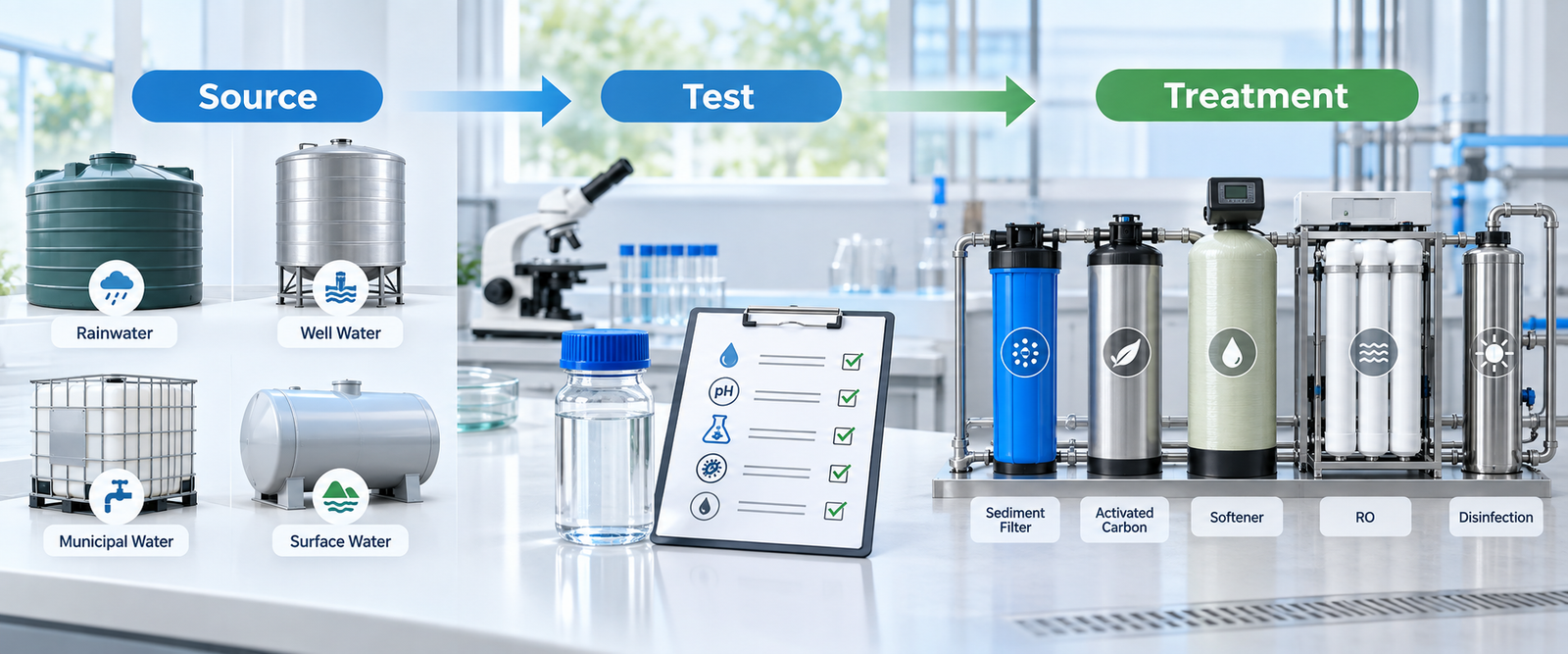
Why source testing comes first
In my daily B2B communication, overseas customers often ask for tank size, pressure rating, interface type, and certification documents. These details matter. However, I usually remind buyers that equipment specifications should follow water-quality data, not the other way around.
A filter tank alone cannot guarantee potable water. It can hold media such as sand, activated carbon, resin, or other treatment materials. But the tank does not know what contaminants are present. The system designer must know that first.
I would normally ask project teams to clarify:
- Water source: rainwater, groundwater, municipal water, seawater pretreatment, or stored process water
- Storage condition: closed tank, open tank, sunlight exposure, ventilation, and cleaning access
- Target use: drinking, process rinsing, boiler feed, irrigation, or general utility water
- Flow requirement: peak flow, average daily volume, and backwash flow
- Pressure condition: inlet pressure, working pressure, and pressure loss allowance
- Main risks: turbidity, odor, chlorine, hardness, iron, manganese, bacteria, TDS, or organic matter
- Local rules: drinking-water standards and certification expectations in the destination market
A practical testing checklist
I do not present myself as a laboratory or regulator. I rely on test reports from qualified parties. For drinking-water projects, I would expect the buyer or system integrator to verify parameters such as:
| Test Item | Why I Check It | Common Treatment Link |
|---|---|---|
| Turbidity / suspended solids | I need to protect downstream equipment | Sediment filter, multimedia filter |
| Odor / color / chlorine | I need to improve taste and protect RO membranes | Activated carbon |
| Hardness | I need to reduce scaling risk | Softener or antiscalant design |
| TDS / salinity | I need to know if dissolved ions are high | Reverse osmosis |
| Iron / manganese | I need to avoid staining and fouling | Oxidation plus filtration |
| Bacteria indicators | I need to manage microbiological risk | UV, chlorine, or other disinfection |
| pH | I need to check corrosion and treatment compatibility | pH correction if required |
How I connect testing to procurement
Once test data is available, I can help buyers confirm whether the selected pressure vessel, filter tank, membrane housing, or storage tank fits the design. I focus on facts that procurement teams can verify:
- Food-grade wetted materials for drinking-water contact surfaces
- Rated working pressure, such as 10.5 bar / 150 psi where applicable
- Temperature range, such as 1–48°C for many FRP tank applications
- Interface type, such as 2.5" NPSM, 4"-8UN, or flange options
- Tank volume and media loading space for correct filtration performance
- Certification documents, such as CE, NSF-related documents, ISO9001, or local hygiene permits, which buyers should verify against the project requirement
- Maintenance access for backwash, media replacement, and spare parts
I treat water testing as the first purchasing document. It protects the buyer from choosing a beautiful tank that solves the wrong problem.
Which Treatment Stages Help Me Filter Tank Water Safely?
When I explain how to filter tank water, I see confusion between filtration, softening, RO, and disinfection. That confusion can become expensive. If a buyer expects carbon to remove dissolved salts or expects a softener to kill bacteria, the system may fail the drinking-water objective.
I would use each treatment stage for a specific purpose. Sediment filtration removes particles. Activated carbon improves taste and removes some chemicals. Softening reduces hardness. RO reduces many dissolved contaminants. UV or chlorine handles microbial risk. These stages are not interchangeable, and safe design often combines several of them.
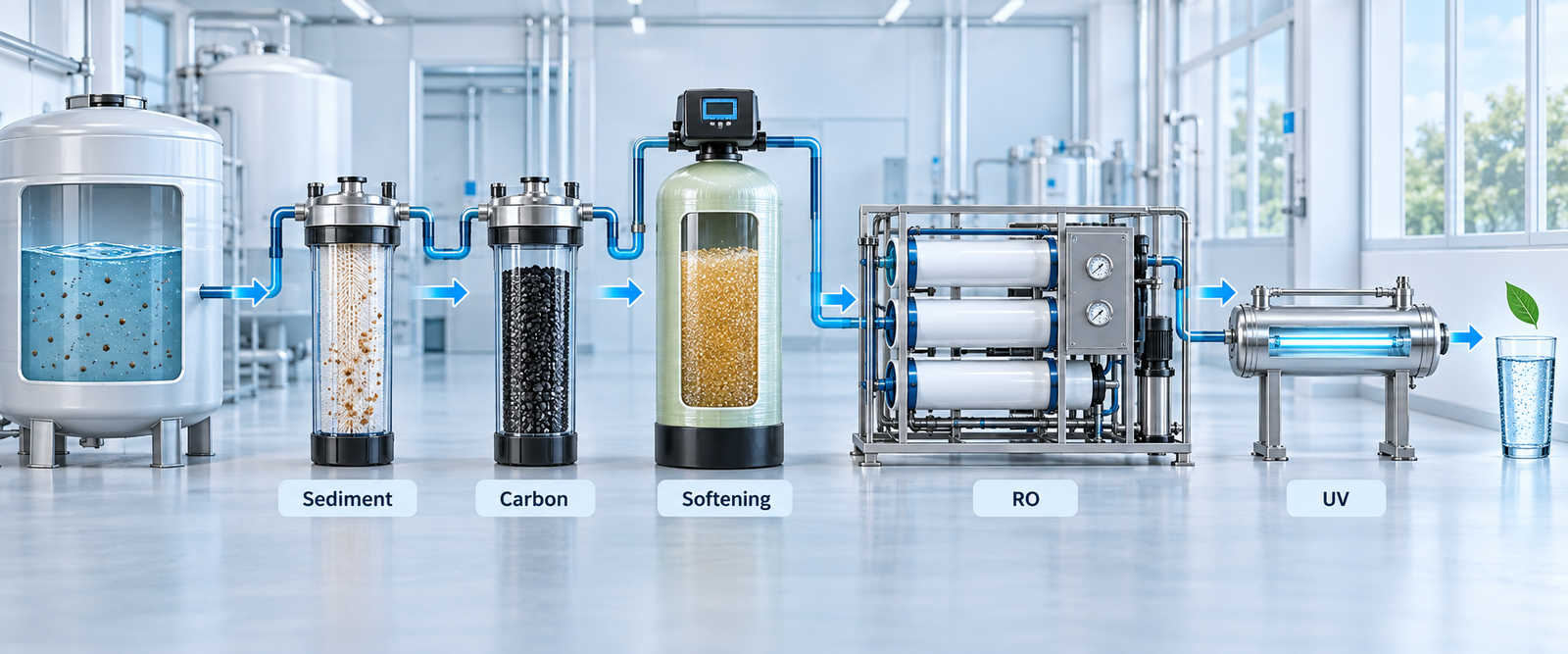
The treatment chain in plain language
I like to compare a drinking-water system to a production line. Each stage has a job. If one stage is missing or undersized, the next stage may carry too much burden.
| Stage | Main Job | What It Does Not Do Well |
|---|---|---|
| Sediment / multimedia filtration | Removes sand, rust, silt, suspended solids | It does not remove dissolved salts or disinfect water |
| Activated carbon | Reduces odor, taste, chlorine, some organics | It does not reliably remove bacteria by itself |
| Softening | Removes calcium and magnesium hardness | It does not reduce TDS in the same way as RO |
| Reverse osmosis | Reduces dissolved salts and many ions | It needs pretreatment and does not replace all sanitation practices |
| UV disinfection | Inactivates microorganisms if water is clear enough | It leaves no residual disinfectant |
| Chlorination | Provides microbial control and residual protection | It requires dosing control and may affect taste |
Why sediment filtration usually comes early
I often see buyers focus on RO membranes first because RO sounds advanced. I understand that reaction. However, RO membranes are sensitive components. If the feed water contains heavy suspended solids, iron, organic matter, or hardness scale risk, membranes can foul quickly.
A filter tank loaded with appropriate media can reduce particles before carbon, softening, or RO. In many systems, this step improves equipment life and reduces maintenance frequency. The correct media depends on the water test and design target.
Common filter media applications include:
- Quartz sand or multimedia layers for suspended solids
- Activated carbon for odor, taste, chlorine, and some organic matter
- Manganese sand or special media for iron and manganese under suitable conditions
- Ion exchange resin for softening when hardness is the main concern
Why disinfection is separate from filtration
I always separate the idea of “clear water” from “safe drinking water.” Clear water may still contain microorganisms. A tank can also become a contamination point if it is not sealed, cleaned, or maintained.
For drinking-water applications, many system designers consider UV, chlorine, ozone, or other disinfection methods. The right method depends on:
- Water clarity: UV works best when turbidity is low.
- Contact time: chemical disinfectants need correct dosing and retention.
- Distribution length: longer piping may require residual protection.
- Local regulation: different markets accept different methods and limits.
- Maintenance ability: UV lamps, dosing pumps, and sensors need service.
Where RO fits
RO is powerful, but I do not treat it as a magic box. RO helps reduce TDS, salinity, nitrates, and many dissolved contaminants. However, it needs correct pretreatment, membrane selection, pressure, recovery design, and periodic replacement.
For project buyers, I would check:
- Feed water analysis
- Required permeate quality
- Membrane model and flow rate
- Pretreatment tank size
- Pressure vessel compatibility
- Cleaning and replacement plan
- Wastewater handling
In short, I would filter tank water through a chain, not through a single assumption. Each stage should have a clear reason based on test results.
What Tank Materials and Specifications Should I Verify?
When I help buyers select components to filter tank water, I pay close attention to materials and pressure ratings. The hidden risk is that a system may look correct on a drawing but use unsuitable wetted materials, weak interfaces, or poorly documented vessels. Those details affect drinking-water safety and project reliability.
I would verify food-grade wetted materials, pressure rating, working temperature, connection type, tank size, liner quality, certification documents, and supplier quality control records. For drinking-water projects, I would also confirm that all documents match the exact model, application, and destination market requirements.
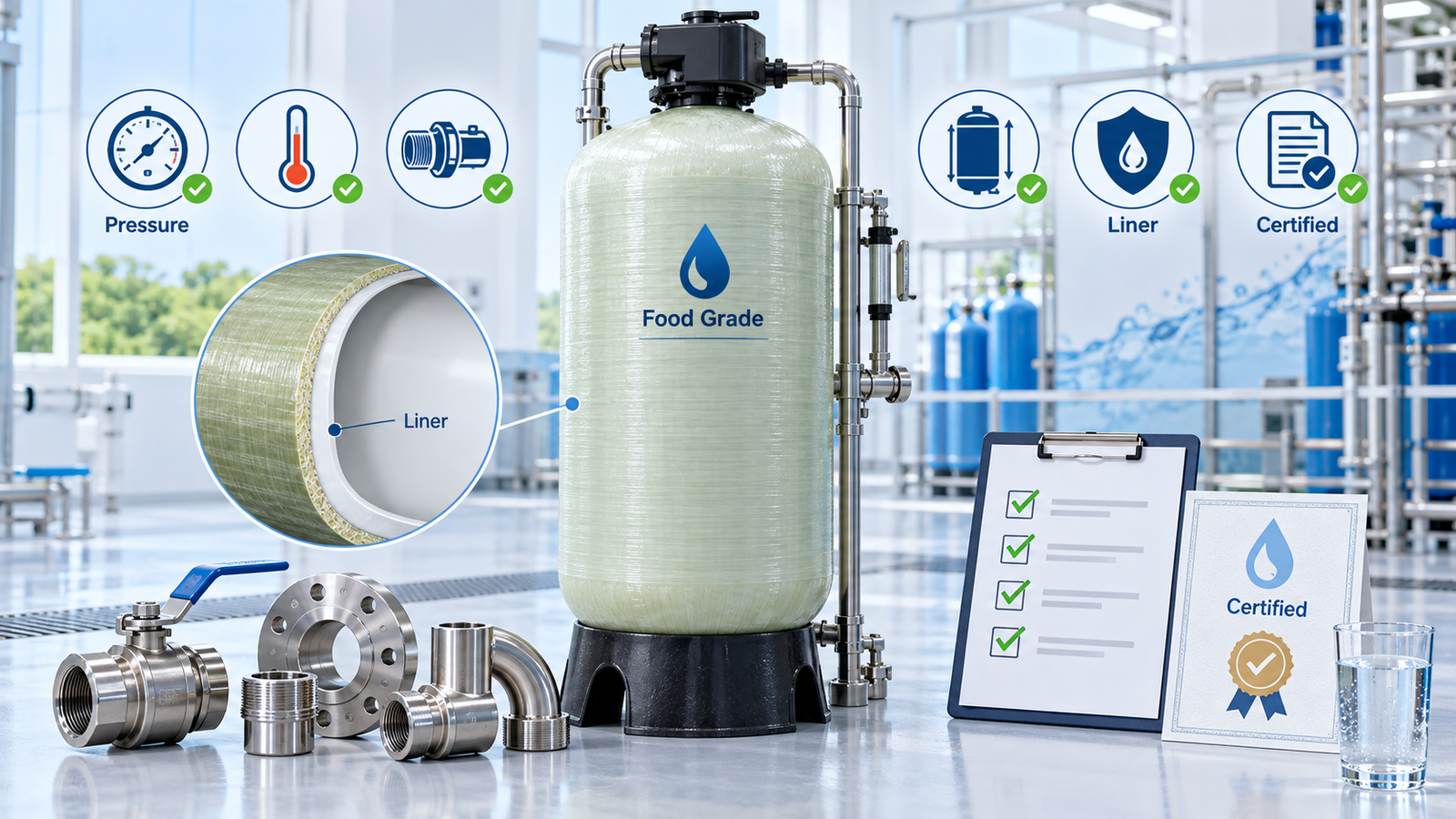
Why food-grade contact materials matter
In our manufacturing context, water-contact base materials are selected for drinking-water applications. For example, FRP pressure vessels commonly use a polyethylene inner liner with an outer layer of glass fiber and epoxy resin. This structure supports corrosion resistance, strength, and sanitary contact when specified correctly.
However, I always encourage buyers to verify material declarations and certification documents. A supplier’s general certificate may not always cover every model, every component, or every market. Procurement teams should request documents early, not at the shipment stage.
I would normally check:
- Material declaration for wetted parts
- Model-specific datasheet
- Pressure rating and test reference
- Interface drawing
- Packing list and label consistency
- Certificate validity and scope
- Spare parts compatibility
Pressure and temperature are not minor details
For many water treatment pressure vessels, buyers commonly evaluate a working pressure around 10.5 bar / 150 psi and an operating temperature range such as 1–48°C, depending on the product design. Some products may also be tested through repeated pressure cycling, such as fatigue cycle testing. Buyers should confirm the exact test conditions from the supplier’s technical documents.
I do not recommend selecting a tank only by diameter and height. Pressure, temperature, and interface design must match the whole system.
| Specification | Why I Verify It | Procurement Risk If Ignored |
|---|---|---|
| Working pressure | I need the vessel to match pump pressure and system design | Leakage, failure, safety risk |
| Burst or fatigue test data | I need confidence in long-term durability | Higher lifecycle cost |
| Temperature range | I need material compatibility | Deformation or performance loss |
| Interface type | I need correct connection with valves and piping | Installation delay |
| Tank volume | I need correct media bed depth and flow | Poor filtration performance |
| Liner material | I need sanitary water contact | Taste, odor, or compliance issues |
| Certification scope | I need documents for the buyer’s market | Customs, tender, or approval problems |
Interface selection affects installation
I often discuss interface types with overseas customers because this detail can stop a project on site. Common options may include threaded connections such as 2.5" NPSM, 4"-8UN, or larger flange connections such as 6" flange, depending on tank size and system design.
The correct interface depends on:
- Valve model
- Distributor design
- Flow rate
- Backwash requirement
- Installation space
- Local piping standard
- Maintenance access
A large filter tank with the wrong connection can create unexpected adapters, pressure loss, or sealing issues. I prefer to confirm drawings before production, especially for customized colors, sizes, or special interfaces.
Supplier quality control matters
From a manufacturing perspective, I value consistent processes such as CNC blow molding, CNC injection molding, CNC winding, and rotomolding for related tanks. These processes help improve dimensional consistency and repeatability. Still, buyers should evaluate suppliers through documents, samples, audits, and communication quality.
I would ask a supplier to provide:
- Technical datasheets
- Product drawings
- Certificate copies for review
- Quality management documents, such as ISO9001-related records
- Pressure test or performance test references
- Photos or videos of production and packing when needed
- Clear warranty and spare-part terms
This procurement work may feel slow at the beginning. But it usually saves time later because drinking-water projects leave little room for vague specifications.
How Do I Maintain a System That Filters Tank Water?
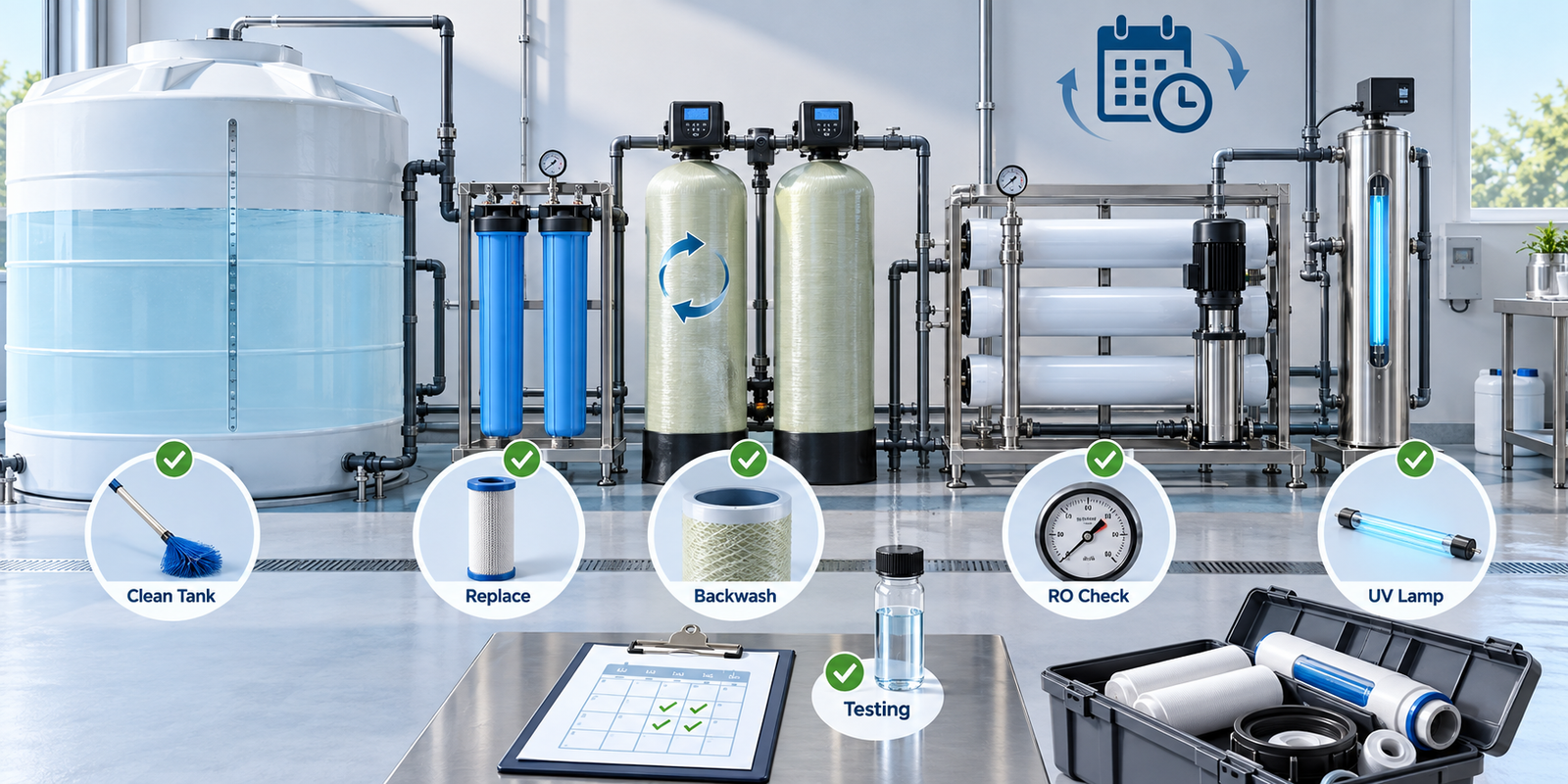
When I design or supply parts for systems that filter tank water, I always think about maintenance. A new system may perform well at startup, but media, membranes, UV lamps, seals, valves, and storage tanks all age. If the owner ignores service intervals, the system can become a risk instead of a safeguard.
I would maintain a tank-water filtration system with scheduled water testing, media backwashing, cartridge replacement, RO membrane monitoring, UV lamp replacement, disinfectant control, tank cleaning, and spare-part planning. Maintenance should be written into the procurement plan before the first shipment.
Why maintenance belongs in procurement
I have seen procurement discussions focus heavily on unit price. I understand that pressure. However, the lowest equipment price does not always mean the lowest lifecycle cost. If a buyer cannot replace media easily, cannot find spare parts, or cannot access the distributor, the system becomes expensive later.
Maintenance planning should include:
- Filter media replacement intervals
- Backwash control valve settings
- Pressure gauge locations
- Differential pressure monitoring
- RO membrane cleaning and replacement
- UV lamp replacement schedule
- Chlorine dosing checks if used
- Storage tank inspection and cleaning
- Spare O-rings, distributors, valves, and fittings
- Operator training and documentation
A practical maintenance table
Exact service intervals depend on water quality, flow, operating hours, and local requirements. I do not claim one universal schedule. Still, I would use a planning table like this during early project evaluation:
| Component | What I Monitor | Typical Maintenance Concern |
|---|---|---|
| Sediment filter / multimedia tank | Pressure loss, turbidity, backwash result | Media fouling or channeling |
| Activated carbon tank | Taste, odor, chlorine breakthrough | Carbon exhaustion or bacterial growth |
| Softener | Hardness leakage, salt use, regeneration | Resin fouling or poor regeneration |
| RO system | Permeate TDS, flow, pressure | Scaling, fouling, membrane aging |
| UV unit | Lamp hours, sleeve clarity, alarm status | Low UV intensity |
| Chlorine dosing | Residual level, pump function | Under-dosing or over-dosing |
| Storage tank | Cleanliness, cover, vent, biofilm | Recontamination |
| Valves and seals | Leakage, cycle operation | Wear and installation failure |
Why storage tanks can become failure points
Many people focus only on treatment equipment and forget the storage tank. I think this is a mistake. Treated water can become contaminated again if the storage tank is not food-grade, sealed, cleaned, or protected from insects, dust, sunlight, and backflow.
For drinking-water applications, I would review:
- Tank material: food-grade polyethylene or other approved wetted material
- Tank cover: sealed design with suitable inspection access
- Vent protection: screened or filtered venting where required
- Drain design: easy removal of sediment during cleaning
- Overflow control: prevention of external contamination
- Cleaning access: manhole or access port where applicable
- Location: away from chemical storage, heat, and contamination sources
How I reduce spare-part risk
For overseas B2B buyers, spare parts are not a small issue. Shipping time, customs clearance, and local availability can affect system uptime. I encourage buyers to include critical spare parts in the first purchase order, especially for remote sites or municipal projects.
Useful spare items may include:
- Control valve seals
- Distributors
- Brine valve parts for softeners
- Pressure gauges
- O-rings
- UV lamps and quartz sleeves
- Cartridge filters
- Dosing pump wear parts
- RO membrane elements
- Common fittings and adapters
I would also keep model numbers consistent across projects when possible. Standardization helps procurement teams reduce inventory complexity and service mistakes.
Frequently Asked Questions
Can one filter tank make tank water safe to drink?
No, I would not assume one filter tank can make all tank water safe to drink. A filter tank may remove sediment, odor, hardness, or specific contaminants depending on its media. Drinking-water safety requires source testing, correct treatment stages, disinfection, food-grade storage, and ongoing maintenance.
Do I need RO to filter tank water for drinking?
I would use RO only when test results show dissolved contaminants, high TDS, salinity, nitrate, or similar risks that justify membrane treatment. RO is not a replacement for sediment filtration, carbon pretreatment, or disinfection. The system designer should confirm feed water quality and local drinking-water targets first.
Is UV enough for stored tank water?
UV can be effective for microbial control when water is clear and the UV unit is correctly sized and maintained. However, UV does not remove particles, chemicals, hardness, or dissolved salts. It also leaves no residual disinfectant, so storage and distribution conditions still matter.
What certifications should I ask a filter tank supplier to provide?
I would ask for model-specific datasheets, material declarations, CE or NSF-related documents where applicable, ISO9001 quality management documents, hygiene or drinking-water contact documents required by the destination market, and pressure-test information. I would also verify that each document applies to the exact product being purchased.
How often should tank water systems be maintained?
I would set maintenance intervals based on water tests, flow rate, operating hours, and equipment type. Sediment filters may need frequent checks, carbon media can exhaust, RO membranes need monitoring, UV lamps usually require scheduled replacement, and storage tanks need cleaning. A qualified local professional should confirm the final schedule.
Conclusion
I would filter tank water for safe drinking only as part of a complete risk-control system. Testing identifies the problem. Sediment filtration, carbon, softening, RO, and disinfection each perform different jobs. Food-grade tanks, verified certifications, correct pressure ratings, suitable interfaces, and maintenance access protect long-term reliability. If you are evaluating filter tanks, membrane housings, storage tanks, or related components for an overseas water treatment project, I can help you confirm specifications, documents, and customization options before procurement.