
A water tank manufacturing company can look strong on paper, but buyers often discover problems only after shipment, installation, or field operation. Poor material control, weak testing, and mismatched interfaces1 can turn a low quote into a project risk. The better approach is to evaluate manufacturers by how well they reduce risk.
The best water tank manufacturing company is the supplier that can consistently control raw materials, production accuracy, pressure or functional testing, documentation, customization, and delivery around your real project conditions. It is not simply the largest factory or the cheapest quote. For serious buyers, “best” means lowest long-term quality, compliance, and installation risk.
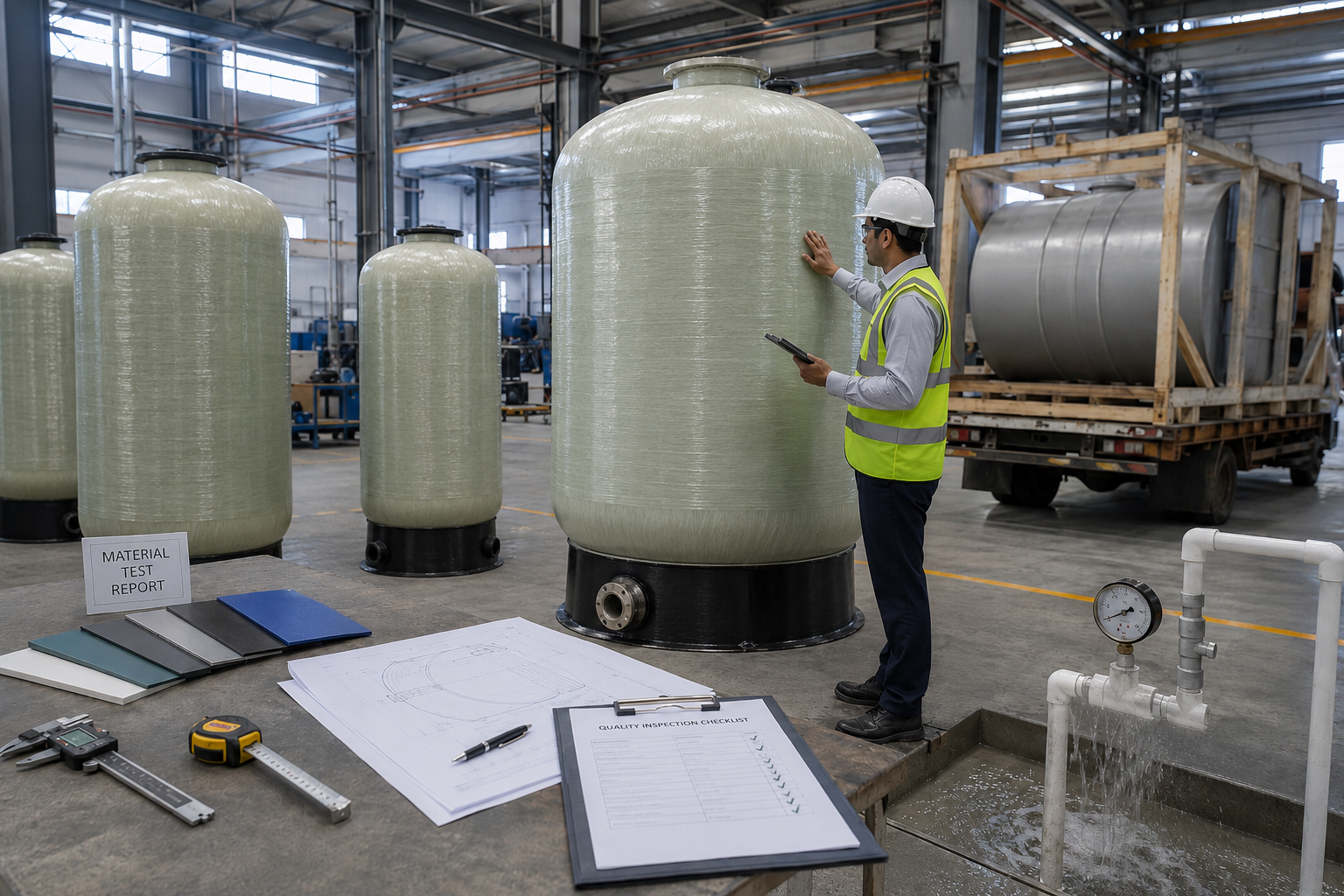
I have worked with overseas water treatment buyers for many years, and I rarely hear a buyer ask only for “a tank.” Most serious inquiries include hidden concerns about pressure, hygiene, certificates, branding, system matching, and after-sales cost. That is where the real selection work begins.
How should you define the best water tank manufacturing company?
Choosing a water tank manufacturing company becomes difficult when every supplier claims stable quality, fast delivery, and competitive pricing. The problem is that those claims sound similar. If buyers do not define “best” clearly, they may compare quotations instead of comparing risk control.
The best water tank manufacturer should be defined by project fit and risk reduction, not by a generic ranking. A strong supplier proves material consistency, process control, testing discipline, compliance support, customization ability, and communication quality before you place repeat orders or commit to a project.
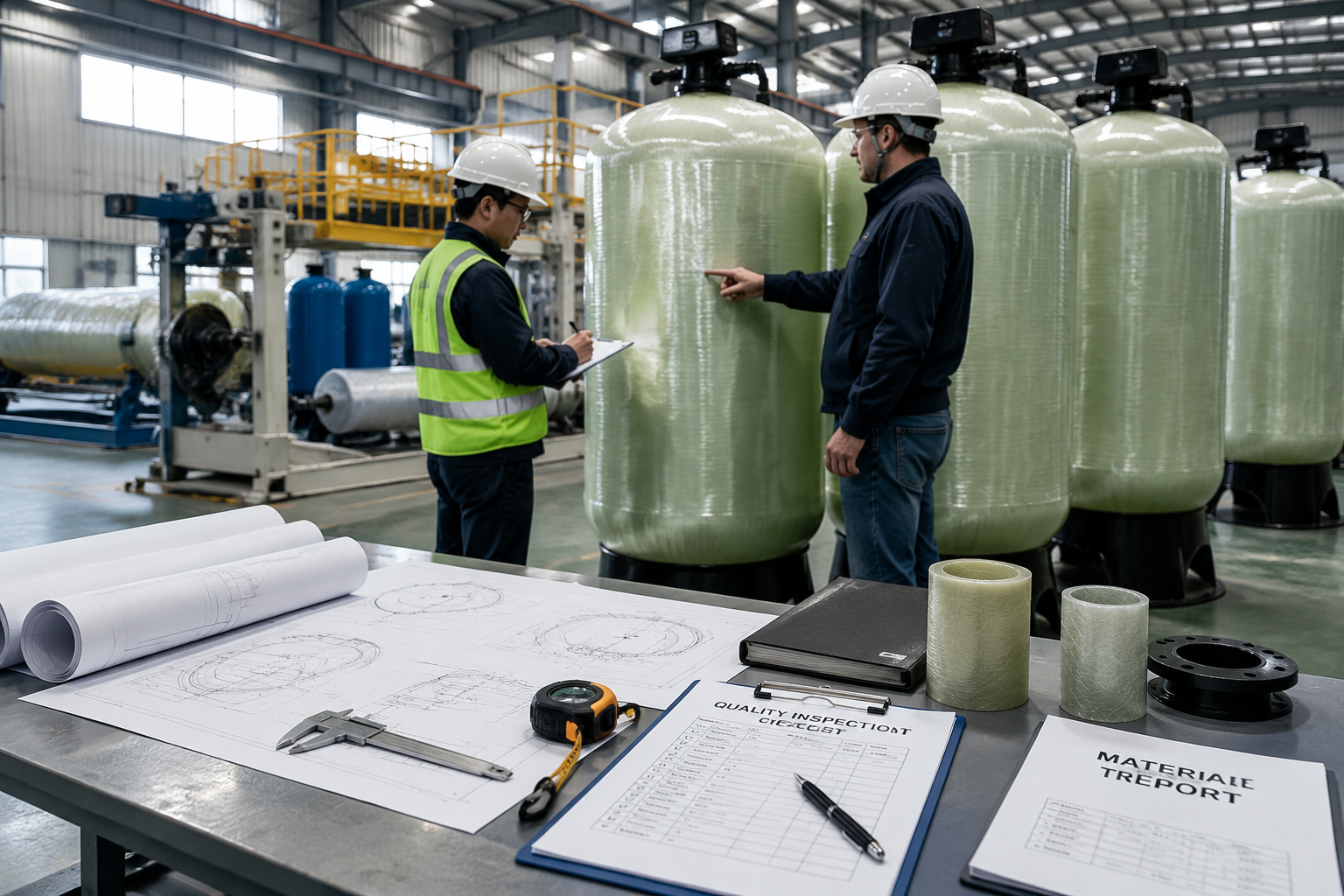
“Best” depends on the project risk
I do not believe there is one universal “best water tank manufacturing company” for every buyer, every country, and every application. A residential storage tank, an FRP pressure tank, a RO system buffer tank, and a chemical dosing tank have different risks. The correct question is:
“Which manufacturer can control the risks in my exact project better than others?”
For brand owners, large distributors, and EPC contractors, the risks are usually not limited to the tank price. They often include:
- Unstable service life in high-pressure or corrosive environments
- Incomplete compliance documents for import, tender, or local approval
- Poor batch consistency across repeat orders
- Wrong ports, interfaces, or dimensions for the system skid
- Weak packaging that causes damage during long-distance shipping
- No real OEM/ODM support when a local brand needs customization
A practical evaluation framework
When I speak with procurement managers, I usually recommend a simple framework. It helps buyers move away from emotional claims and toward verifiable evidence.
| Evaluation Area | What Buyers Should Check | Why It Matters |
|---|---|---|
| Materials | Resin, liner, stainless steel grade, UPVC quality, food-grade compliance | Material failure can shorten tank life |
| Manufacturing process | Winding, molding, welding, curing, assembly control | Process stability affects strength and consistency |
| Testing | Hydrostatic test, pressure cycling, burst pressure, leakage test | Testing reveals hidden defects before shipment2 |
| Documentation | Certificates, inspection records, drawings, manuals, packing lists | Documents reduce import and project approval risk |
| Customization | Size, port position, color, logo, packaging, fittings | OEM/ODM support improves market fit |
| System understanding | RO, UF, NF, softener, filter, boiler feed, reuse application | System mismatch causes installation and performance issues |
Why price alone is dangerous
Low price is not always bad. Every buyer needs cost control. However, a very low price without evidence often means one of several things:
- Lower-grade raw materials are being used.
- Testing steps are reduced or skipped.
- Wall thickness or process time is minimized.
- Documentation support is weak.
- After-sales responsibility is unclear.
I have seen buyers spend weeks negotiating a small discount, then lose much more money because of delayed installation, missing documents, or replacement costs. In water treatment projects, the tank often looks simple, but it connects to pumps, valves, membranes, pipelines, controllers, and site conditions. One mismatch can affect the whole system.
So, the best supplier is not the one that gives the most attractive first quotation. The best supplier is the one that makes your procurement decision safer.
What quality controls should a water tank manufacturing company prove?
A water tank manufacturing company may claim strong quality, but serious buyers need proof. Without raw material inspection, controlled production, pressure testing, and final inspection records, quality becomes a promise instead of a system. That creates uncertainty for importers, distributors, and EPC project teams.
A reliable water tank supplier should prove quality through incoming material checks, controlled manufacturing, dimensional inspection, pressure or functional testing, and final shipment inspection. Buyers should request test records, production standards, certificate copies, and batch traceability before approving large-volume or project-based procurement.
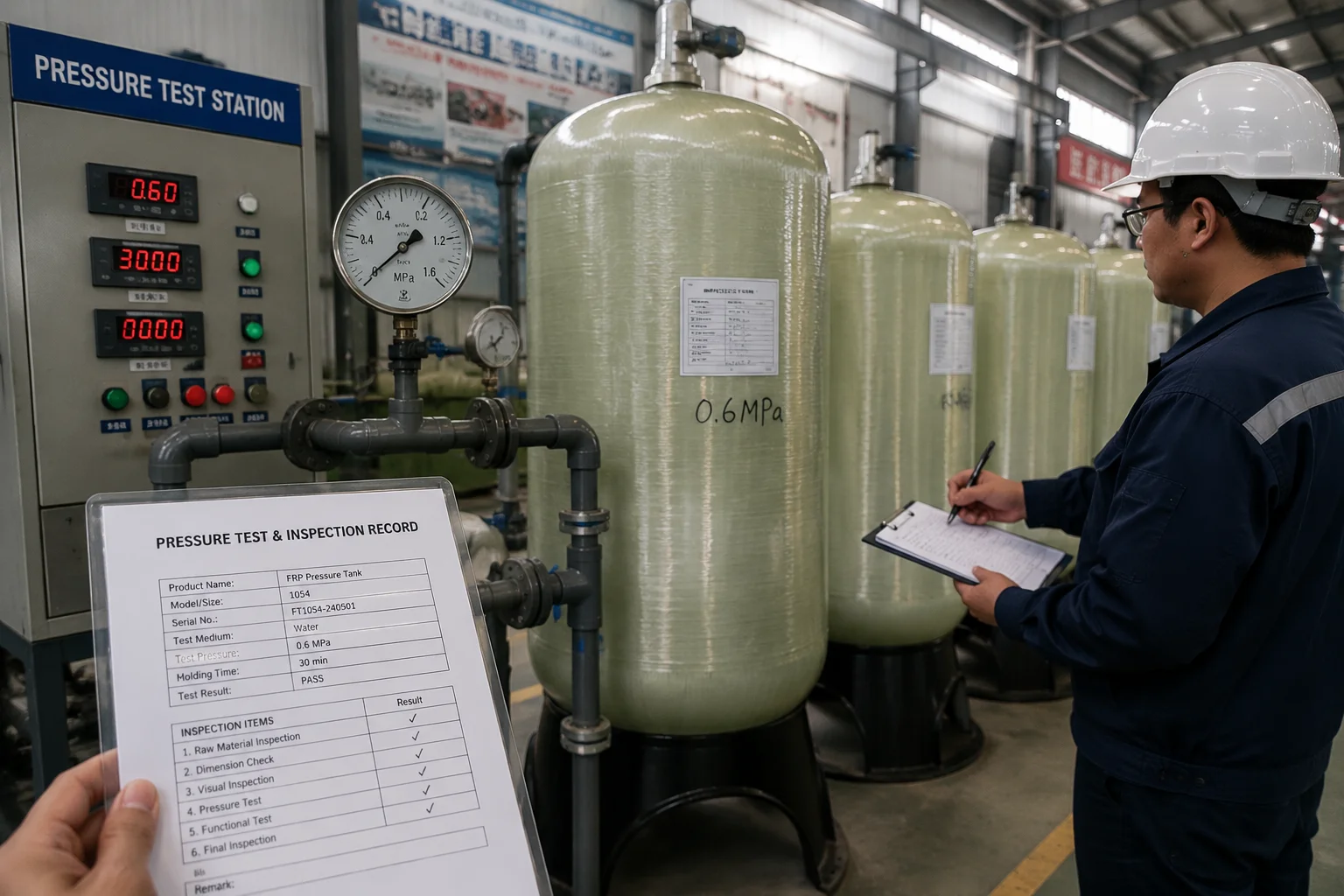
Raw material control comes first
Every strong tank starts before production begins. In our own factory work, I place a lot of attention on raw material verification because later testing cannot fully correct poor material choices. For water treatment applications, common material concerns include:
- Food-grade safety for drinking water contact
- Chemical resistance for special treatment processes
- Pressure resistance for FRP tanks and membrane housings
- Dimensional stability for automated assembly
- RoHS/REACH-related requirements3 for certain export markets
For example, FRP tanks depend heavily on resin quality, glass fiber control, winding parameters, liner quality, and curing conditions.4 Stainless steel tanks require attention to steel grade, welding quality, surface treatment, and corrosion resistance.5 UPVC components need stable formulation and molding accuracy.
Production process must be repeatable
A factory can make one good sample and still fail at batch production.6 That is why repeatability matters more than a beautiful first sample. A serious water tank manufacturing company should have process control points, trained operators, equipment maintenance routines, and inspection procedures.
For FRP pressure vessels and tanks, buyers should ask about:
- CNC filament winding consistency
- Resin-to-fiber ratio control
- Curing process control
- Liner inspection
- Thread and opening accuracy
- Hydrostatic testing procedures
For molded or assembled tanks, buyers should ask about:
- Mold accuracy
- Wall thickness control
- Joint strength
- Port consistency
- Gasket or fitting compatibility
- Packaging protection
Testing should match the application
Testing is not only a formality. It should reflect the actual working conditions of the tank. At Hedelong, our broader water treatment equipment production includes checks such as hydrostatic and functional testing before shipment, pressure cycling tests for relevant pressure products, burst pressure verification based on design requirements, and flow or desalination checks for complete systems.
Buyers can use the table below when reviewing a supplier.
| Test Type | Typical Purpose | Buyer Question |
|---|---|---|
| Hydrostatic test | Checks leakage and pressure holding | Is every unit tested or only samples? |
| Pressure cycling test7 | Simulates repeated operating stress | How many cycles are used for this product type? |
| Burst pressure test | Verifies safety margin | What is the relationship to design pressure? |
| Dimensional inspection | Confirms installation fit | What tolerance is controlled? |
| Functional test | Checks system operation when integrated | Is the tank tested alone or with equipment? |
Inspection records reduce disputes
When a project issue happens, everyone wants evidence. The buyer checks the purchase order. The contractor checks the installation. The supplier checks production records. If no records exist, the dispute becomes emotional.
That is why I advise buyers to request:
- Production batch number
- Material inspection record
- Pressure or leakage test report
- Final inspection checklist
- Packing photos before shipment
- Nameplate or marking details
- Drawings approved before production
These documents do not guarantee that no problem will ever occur. However, they reduce uncertainty and help both sides solve issues faster.
Why should a water tank manufacturing company understand your water treatment system?
A water tank manufacturing company that only asks for size and quantity may miss the most important details. Tanks are rarely isolated products in real projects. They connect with RO systems, UF systems, NF systems, softeners, media filters, pumps, valves, controls, and site pipelines.
A qualified tank manufacturer should understand the tank’s role in the full water treatment system.8 The supplier should ask about application, working pressure, water quality, temperature, installation space, connected equipment, port layout, flow rate, cleaning method, and compliance requirements before finalizing the design.
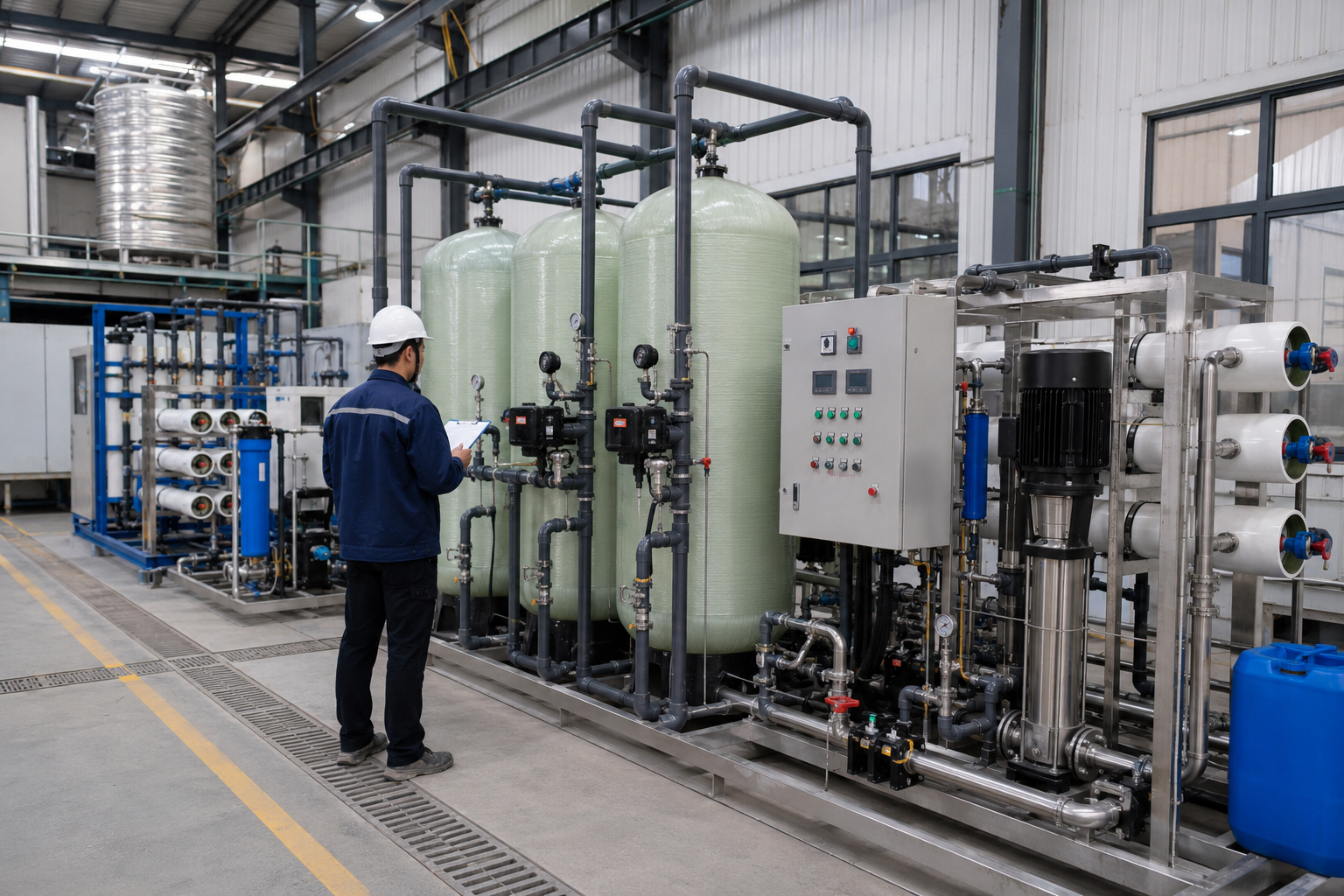
A tank is part of a process
In water treatment, a tank may serve many functions. It may store raw water, balance flow, support filtration, hold treated water, collect backwash water, feed a RO system, or buffer ultrapure water. Each role creates different design concerns.
For example:
- A raw water tank may need sediment handling and easy cleaning.
- A softener tank needs correct resin loading, distributor matching, and valve compatibility.
- A RO product water tank9 may need hygienic materials and low contamination risk.
- A boiler feed water tank may need temperature and corrosion considerations.
- A chemical dosing tank must match the chemical concentration and material resistance.
If the manufacturer does not ask about the application, the tank may physically fit the order but fail the project.
Key questions a good supplier should ask
When my team reviews a tank or system inquiry, we usually ask practical questions before recommending a design. These questions help prevent misunderstandings.
- What is the water source? Tap water, groundwater, seawater, wastewater, or process water?
- What is the tank function? Storage, filtration, softening, pressure holding, or dosing?
- What is the working pressure and expected pressure fluctuation?
- What is the flow rate through the system?
- What equipment connects to the tank? RO, UF, NF, EDI, softener, media filter, pump, or valve?
- What are the installation limits? Height, footprint, pipe direction, access space?
- What market standards or certificates are required?
- Does the buyer need OEM branding, labels, manuals, or packaging?
These questions may seem basic, but they often reveal hidden risks.
System mismatch can be expensive
A tank with the wrong connection height may force the contractor to change pipelines on site. A wrong port size can delay installation. A material mismatch can cause corrosion, odor, contamination, or failure. A tank that cannot handle real pressure variation may create safety and maintenance issues.
This is why I always prefer to review the tank together with the process diagram when possible. Even a simple P&ID or layout sketch helps. It lets the manufacturer check whether the tank dimensions, inlet and outlet positions, valves, drain, manhole, pressure rating, and installation direction make sense.
Common system-based tank considerations
| Application | Important Tank Consideration | Common Buyer Mistake |
|---|---|---|
| RO pretreatment | Flow balance and pressure stability | Only checking tank volume |
| Water softening | Distributor, resin volume, valve matching | Ignoring valve interface |
| UF/NF system | Backwash and cleaning compatibility | Underestimating drain flow |
| EDI ultrapure water | Hygiene and contamination control | Using unsuitable storage material |
| Municipal package plant | Site installation and maintenance access | Choosing dimensions without layout review |
A serious water tank manufacturing company should not simply sell a container. It should help you avoid design mismatch, especially when the tank is part of a larger water treatment solution.
Do certifications prove a water tank manufacturing company is reliable?
Certifications are important, but they can create a false sense of security if buyers treat them as a complete guarantee. A water tank manufacturing company may hold useful certificates, yet the certificate scope, product model, test conditions, and target market requirements still need careful verification.
Certifications help prove that a manufacturer follows recognized standards, but they do not replace supplier evaluation. Buyers should verify certificate validity, scope, model coverage, test reports, hygiene documents, export files, and local regulatory requirements before assuming a tank is suitable for a specific market or project.
Certificates are evidence, not magic
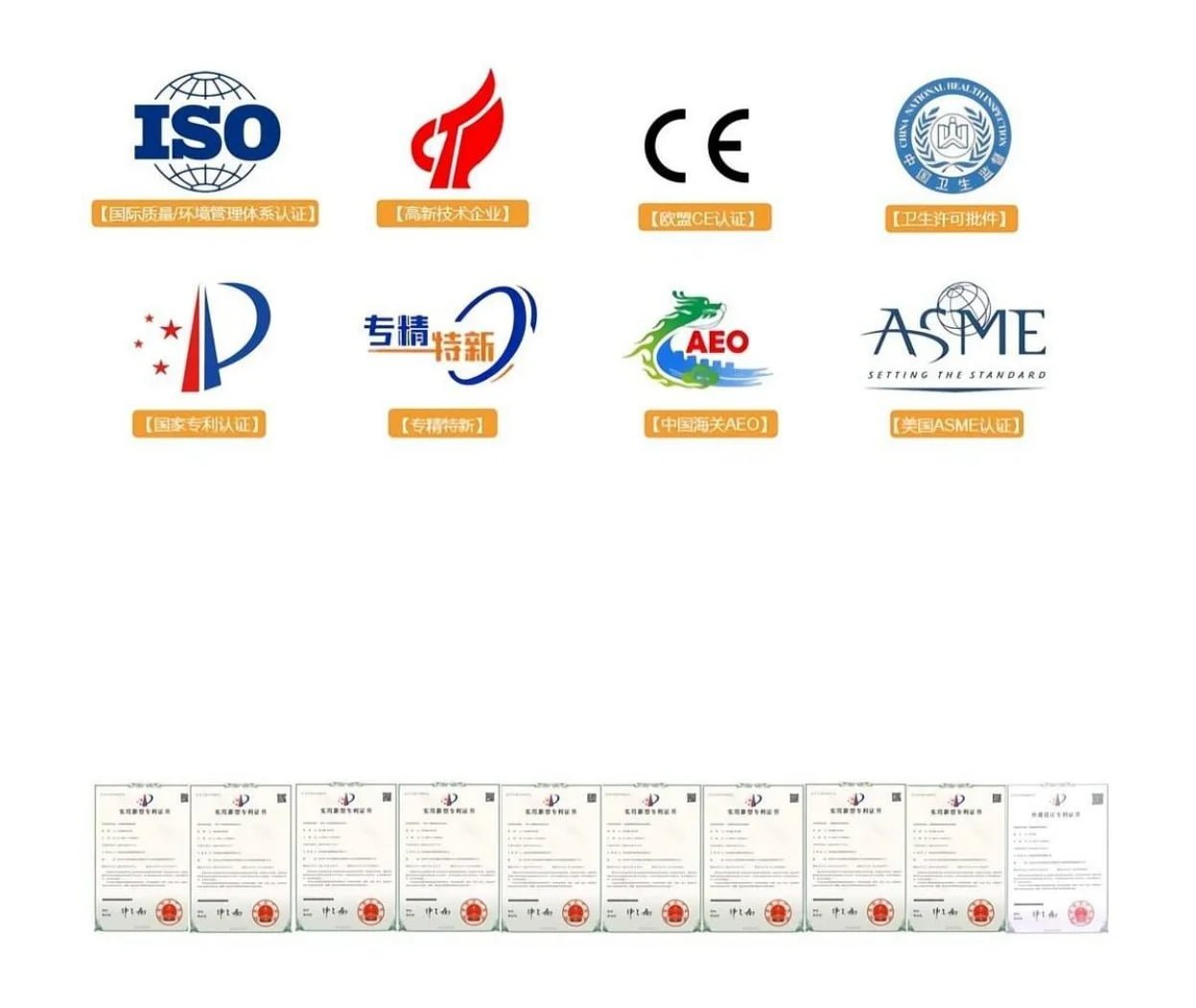
I respect certifications because they create a common language between suppliers, buyers, contractors, and regulators. Standards such as ISO900110, ISO14001, CE, NSF-related requirements, and domestic drinking water hygiene approvals can be very important, depending on the product and market.
However, certificates are not all the same. A certificate may apply to a factory management system, a product category, a specific model, or a test sample. Buyers should not assume that one document covers everything.
What buyers should verify
Before relying on a certificate, I suggest checking these points:
-
Is the certificate still valid?
Expired certificates create import and tender risks. -
Does the certificate match the supplier name?
Trading companies and factories may provide different documents. -
Does it cover the exact product type?
A certificate for one tank series may not cover another. -
Does it match the destination market?
Requirements differ across the EU, Middle East, Southeast Asia, Africa, and Latin America. -
Are supporting test reports available?
Some projects require test reports, material declarations, or hygiene documents. -
Does the buyer need legalized or notarized documents?
Some tenders and government projects require special document handling.
Certificate review table
| Document Type | What It Helps Prove | What It Does Not Always Prove |
|---|---|---|
| ISO9001 | Quality management system exists | Every batch is defect-free |
| ISO14001 | Environmental management system exists | Product meets all local water rules |
| CE | Product meets relevant EU directives | All models or markets are covered |
| NSF-related documents | Hygiene or material suitability | Complete local approval in every country |
| Test report | Product passed specific tests | All future production will match unless controlled |
Why project documents matter
Large buyers often need more than certificates. They may need technical drawings, user manuals, spare parts lists, installation instructions, warranty terms, inspection records, and packing details. EPC contractors may also need documents for tender submission or consultant approval.
This is where supplier experience becomes valuable. A manufacturer that regularly supports OEM/ODM and project buyers usually understands document discipline better than a supplier that only sells small standard orders.
At Hedelong, we often support buyers with technical documentation, customized packaging files, branding details, and product data needed for water treatment equipment procurement. I do not present that as a substitute for local legal review. Buyers still need to confirm final compliance in their target market. But good supplier documentation can make that local approval process much smoother.
How does OEM/ODM capability separate a serious water tank manufacturing company?
A water tank manufacturing company with real OEM/ODM capability gives buyers more than a standard tank. It helps brand owners, distributors, and EPC contractors control dimensions, interfaces, packaging, labels, documents, and project-specific requirements. Without this support, buyers may struggle to build repeatable product lines.
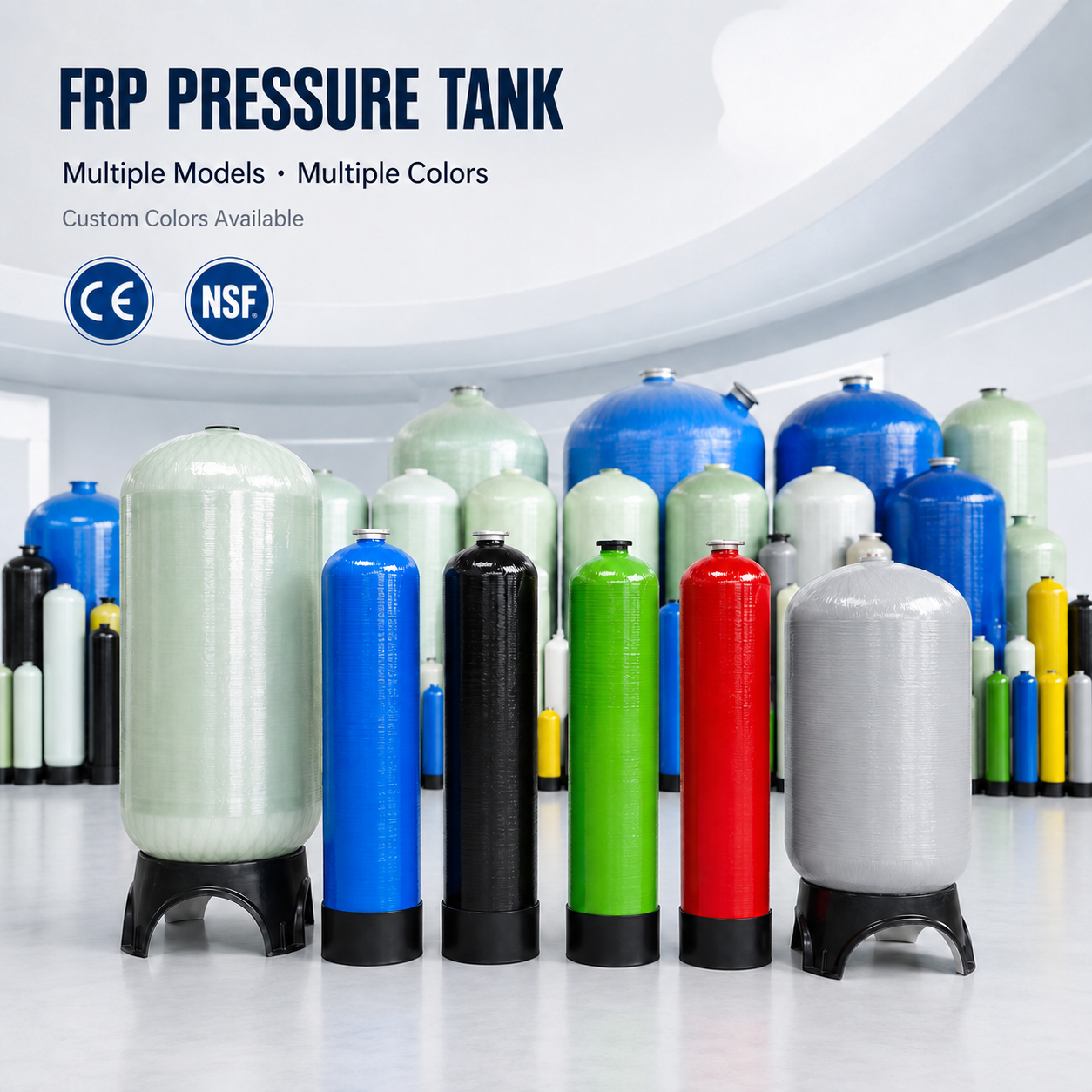
OEM/ODM capability matters because many water treatment buyers need tanks adapted to local markets, brand positioning, installation conditions, and connected systems. A serious manufacturer can customize design, materials, openings, colors, packaging, manuals, documentation, and production batches while keeping quality consistent.
OEM/ODM is not only about a logo
Some buyers think OEM means printing a logo. In reality, logo printing is only a small part of OEM/ODM cooperation. For large distributors and brand owners, the deeper value is repeatable customization.
A strong OEM/ODM supplier can help with:
- Tank dimensions for local installation habits
- Port size and position for existing systems
- Material selection for water quality and chemical exposure
- Color and surface finish for brand identity
- Labels and nameplates for local languages
- Carton, pallet, or crate packaging for long-distance shipping
- Manuals and technical files for distributors and installers
- Batch consistency across repeat procurement cycles
When buyers operate across several markets, these details can become a competitive advantage.
Customization must still be controlled
Customization can create risk if the factory lacks process discipline. Every custom change should be reviewed against production feasibility, testing requirements, safety margin, and delivery schedule. I prefer a structured customization process because it prevents unclear expectations.
A practical process may include:
-
Application review
The supplier confirms the tank’s use, pressure, water quality, and installation conditions. -
Drawing confirmation
Both sides approve dimensions, ports, accessories, labels, and tolerances. -
Sample or pilot batch
The buyer checks fit, appearance, documentation, and packaging. -
Testing and inspection
The factory performs agreed tests before shipment. -
Mass production control
The supplier follows approved files and maintains batch records. -
Feedback loop
Field feedback helps improve the next order.
Why OEM/ODM matters for EPC contractors
EPC contractors do not buy tanks for shelves. They buy tanks for delivery schedules, site installation, consultant approval, and long-term operation. A small design problem can delay an entire water treatment plant.
For EPC projects, customization often includes:
| EPC Need | Manufacturer Support |
|---|---|
| Site layout restrictions | Adjust height, diameter, or port orientation |
| Consultant approval | Provide drawings, test records, and certificates |
| Local installation practice | Match pipe standards and connection types |
| Transport limits | Optimize packaging and container loading |
| Maintenance access | Add manholes, drains, or inspection points |
| System integration | Coordinate with RO, UF, NF, softener, or filter skids |
How Hedelong fits this evaluation
As a China-based water treatment equipment manufacturer with nearly 20 years of OEM/ODM experience, Hedelong supports more than isolated tank supply. Our production background covers water treatment equipment such as RO systems, UF/NF systems, EDI ultrapure water systems, softeners, media filters, FRP pressure vessels, membrane housings, and integrated package plants.
This system background helps us discuss tanks in context. We can review how a tank connects with filtration, membrane separation, softening, boiler feed water, direct drinking water, or industrial process water. We also support customization around materials, interfaces, packaging, branding, and documentation.
I would not claim that this makes Hedelong the “best in the world.” That would be an empty claim without a universal third-party ranking. What I can say is that a buyer should look for verifiable capabilities, and we are prepared to discuss those checklist items in detail.
Frequently Asked Questions
What is the most important factor when choosing a water tank manufacturer?
The most important factor is risk control. Buyers should check material quality, production process, testing methods, documentation, customization ability, and system understanding. Price matters, but a low price cannot compensate for weak quality control, poor compliance support, or installation mismatch.
Should I choose the largest water tank factory?
The largest factory is not always the best choice. Large capacity can help with delivery, but buyers still need to verify batch consistency, inspection records, material control, testing procedures, and project support. A smaller but disciplined supplier may be better for specialized OEM/ODM needs.
Are certificates enough to confirm tank quality?
Certificates are useful, but they are not enough by themselves. Buyers should verify certificate validity, product scope, model coverage, test reports, hygiene documents, and local market requirements. They should also request inspection records and confirm whether the actual order matches certified specifications.
Why should a tank supplier ask about RO, UF, NF, or softening systems?
A tank supplier should ask about connected systems because tank design affects flow, pressure, installation, cleaning, and maintenance. RO, UF, NF, and softening systems may require different materials, interfaces, drains, valves, and pressure ratings. System understanding helps prevent costly mismatch.
Can Hedelong provide OEM/ODM water tank and water treatment equipment support?
Yes. Hedelong provides OEM/ODM support for water treatment equipment and related tank solutions, including customization of materials, dimensions, interfaces, packaging, branding, and documentation. Buyers can share project requirements, drawings, target market standards, and procurement plans for technical review.
Conclusion
The best water tank manufacturing company is not defined by a slogan, a low quotation, or a simple global ranking. It is defined by how well the supplier reduces your real procurement and project risks through material control, process stability, testing, documentation, certification support, customization, and system understanding. If you are sourcing tanks or complete water treatment equipment for repeat procurement or EPC projects, contact Hedelong with your application details, drawings, and target market requirements. I will help you review the key risks before production starts.
"Quality control of supplier defects in a precision industry: a case study ...", https://www.academia.edu/112677635/Quality_control_of_supplier_defects_in_a_precision_industry_a_case_study_approach. Quality-management guidance treats control of externally provided materials, production verification, and conformity to specified requirements as core measures for reducing nonconforming outputs and downstream quality risk. Evidence role: general_support; source type: institution. Supports: A neutral quality-management or engineering source should support that material verification, inspection/testing, and conformity to specified requirements reduce nonconformities and downstream project risk.. Scope note: Such sources support the general quality-risk mechanism rather than proving this specific outcome for every water tank project. ↩
"46 CFR Part 56 Subpart 56.97 -- Pressure Tests", https://www.ecfr.gov/current/title-46/chapter-I/subchapter-F/part-56/subpart-56.97. Pressure-equipment testing standards describe hydrostatic testing as a method for verifying pressure integrity and identifying leakage or weakness before equipment enters service. Evidence role: mechanism; source type: institution. Supports: A standard or engineering reference should support that hydrostatic or pressure testing is used to verify pressure integrity and detect leakage or structural weakness.. Scope note: The source would support the testing principle; actual defect detection depends on test design, acceptance criteria, and manufacturing controls. ↩
"EU REACH", https://www.trade.gov/eu-reach. European Union RoHS and REACH rules establish substance restrictions and chemical-information obligations for relevant products placed on the EU market. Evidence role: historical_context; source type: government. Supports: Official EU sources should support that RoHS restricts certain hazardous substances in electrical and electronic equipment and that REACH imposes chemical registration, communication, or restriction duties for substances and articles in the EU market.. Scope note: Applicability depends on product classification, materials, and whether the tank or associated equipment falls within the regulated scope. ↩
"Study on Winding Forming Process of Glass Fiber Composite Pressure ...", https://pmc.ncbi.nlm.nih.gov/articles/PMC12156421/. Research on filament-wound glass-fiber-reinforced polymer pressure vessels shows that material selection, fiber architecture, winding conditions, liner design, and curing affect mechanical performance and failure behavior. Evidence role: mechanism; source type: paper. Supports: A peer-reviewed composites paper should support that FRP pressure-vessel or tank properties depend on material composition, fiber orientation or winding parameters, liner behavior, and curing quality.. Scope note: Findings from a given FRP study may concern specific resin systems, geometries, or test conditions rather than all commercial water tanks. ↩
"APPENDIX I WELDING SURFACE PREPARATION REQUIREMENTS", https://web.culpepercounty.gov/media/836. Materials and corrosion references describe stainless steel corrosion resistance as dependent on alloy grade, welding practice, surface condition, and the chemical environment in service. Evidence role: mechanism; source type: research. Supports: A corrosion-engineering or materials reference should support that stainless steel corrosion performance is affected by alloy grade, weld condition, surface finish, and exposure environment.. Scope note: The source would provide general materials support; tank suitability still requires project-specific assessment of water chemistry, temperature, and fabrication quality. ↩
"Statistical process control", https://en.wikipedia.org/wiki/Statistical_process_control. Quality-management standards emphasize controlled production processes, monitoring, and verification because conformity must be maintained during routine production, not merely demonstrated by an initial sample. Evidence role: general_support; source type: institution. Supports: A quality-management source should support that consistent production requires controlled processes, monitoring, and verification beyond initial sample approval.. Scope note: This supports the general quality-control principle rather than quantifying failure rates for water tank manufacturers. ↩
"Pressure Cycling of Type 1 Pressure Vessels with Gaseous Hydrogen", https://www.osti.gov/servlets/purl/1111666. Pressure-vessel test standards use cyclic-pressure loading to assess durability under repeated pressure changes and to identify fatigue-related weaknesses. Evidence role: mechanism; source type: institution. Supports: A testing standard or engineering source should support that cyclic-pressure tests evaluate pressure-containing products under repeated loading to assess fatigue or durability.. Scope note: The specific cycle count and acceptance criteria vary by product type, design code, and intended service. ↩
"Water Treatment Pilot Plant Design Manual: Low Flow Conventional ...", https://nepis.epa.gov/Exe/ZyPURL.cgi?Dockey=P100LXYJ.TXT. Water-treatment design references describe tanks as process components whose sizing, connections, hydraulics, and materials must be coordinated with pumps, valves, treatment units, and water-quality objectives. Evidence role: general_support; source type: education. Supports: A university or public water-treatment design reference should support that tanks interact with pumps, valves, flow control, pressure, treatment stages, and water-quality requirements.. Scope note: Such references support system-level design reasoning; they do not prescribe a single design for every tank application. ↩
"Drinking Water Treatment: Reverse Osmosis", https://extensionpubs.unl.edu/publication/g1490/na/html/view. Public-health guidance on drinking-water storage notes that treated water can be recontaminated during storage, making hygienic materials, protected storage, and sanitary maintenance important. Evidence role: mechanism; source type: government. Supports: A public-health or water-safety source should support that treated water can be recontaminated during storage if materials, tank hygiene, or system design are inadequate.. Scope note: This supports the hygiene rationale for product-water storage generally, not the performance of any particular RO tank design. ↩
"ISO 9001:2015 - Quality management systems — Requirements", https://www.iso.org/standard/62085.html. ISO describes ISO 9001 as a quality-management-system standard for organizational processes and conformity to customer and regulatory requirements, rather than as a certification that every individual product batch is defect-free. Evidence role: definition; source type: institution. Supports: ISO’s official description should support that ISO 9001 is a quality management system standard focused on processes and customer/regulatory requirements, not a guarantee that each individual product is defect-free.. Scope note: The standard’s effect depends on implementation quality, audit scope, and ongoing process control. ↩