
An RO membrane housings supplier can look easy to choose when every quote lists similar sizes, pressure ratings, and certificates. The problem starts when vessels leak, interfaces do not match, or batches arrive inconsistently. I have learned from manufacturing and inspection work that the safer choice is the supplier who can prove control before shipment.
A reliable RO membrane housings supplier should be selected by manufacturing control, test records, dimensional consistency, material traceability, and project support—not by price alone. Buyers should verify FRP material inspection, vessel forming accuracy, pressure testing, certification status, interface compatibility, documentation support, and the supplier’s ability to keep quality stable across repeated batches.
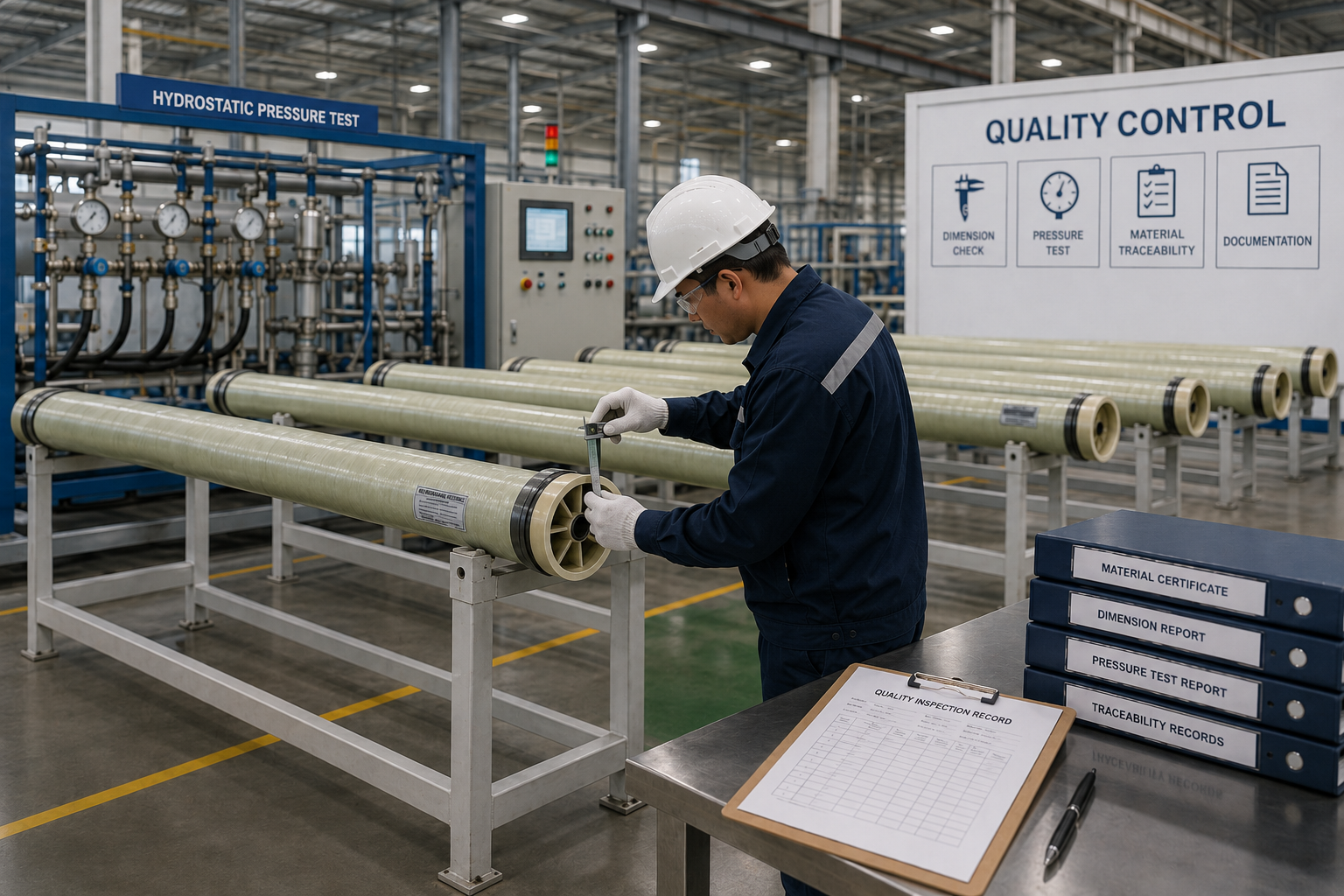
I often tell buyers that a membrane housing is a small part of the full water treatment system cost, but it can create a large project risk. So, before comparing unit prices, I prefer to compare what each supplier actually controls, records, and guarantees.
Why Is an RO Membrane Housings Supplier More Than a Parts Vendor?
A buyer may treat membrane housings as standard accessories because the drawings look simple. That assumption can create hidden risk. When a vessel does not seal properly or match the skid layout, the cost is not only the part. The real cost is rework, delay, and customer pressure.
A serious RO membrane housings supplier does more than ship pressure vessels. The supplier helps control compatibility, sealing reliability, pressure safety, batch consistency, and delivery documentation. In my experience, the best supplier discussions start with application risk, not only with diameter, length, and price.
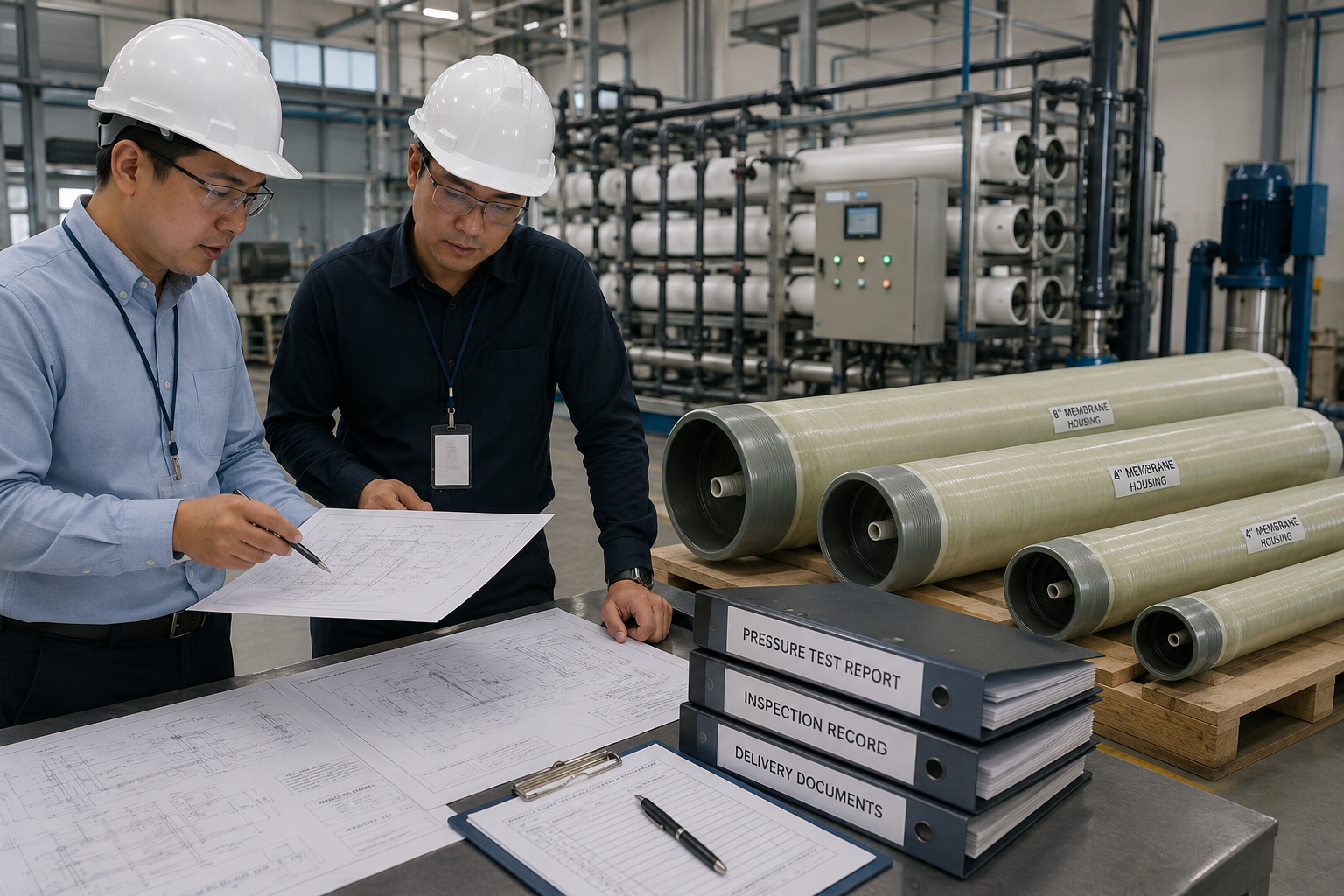
The housing is part of the system, not just the catalog
RO membrane housings hold membrane elements under pressure.1 That sounds straightforward, but the vessel must match several conditions at the same time:
- Membrane element size, such as 2.5", 4", or 8"
- Element quantity, such as 1-core, 2-core, 4-core, or 6-core
- Working pressure and design pressure2
- End-port or side-port configuration
- Permeate port position and connection type
- Skid layout and pipe alignment
- Feedwater quality and operating environment
- Regulatory and documentation requirements
If one item is wrong, the buyer may face a problem that appears during assembly or commissioning. I have seen buyers spend more time solving interface details than they expected because the quotation stage was too shallow.
Low price can hide missing work
I do not believe every low quote is bad. Sometimes a supplier has efficient production, a local material advantage, or a simplified packaging requirement. However, I always ask what is included in the price.
A low price may exclude:
- Material traceability
- Consistent wall thickness control
- Accurate port machining
- Full hydrostatic testing
- Batch inspection records
- Protective export packaging
- OEM labels or technical files
- Pre-shipment documentation
That is why I view the RO membrane housings supplier as a risk-control partner. The unit price matters, but the missing controls behind the price matter more.
Common buyer risks when the supplier is weak
| Buyer Risk | What Usually Causes It | What I Check Before Production |
|---|---|---|
| Leakage at end caps | Poor sealing surface or assembly control | End-cap fit, O-ring condition, pressure test |
| Pipe mismatch | Wrong port type or position | Drawing confirmation and interface review |
| Batch inconsistency | Weak process control | Dimensional sampling and production records |
| Delivery delay | Unclear packaging or order planning | Production schedule and export packing plan |
| Certification confusion | Logo shown without scope clarity | Certificate validity, model coverage, and document match |
I prefer to solve these points before production because after shipment, every small issue becomes expensive. For EPC contractors and distributors, that cost includes site time, customer complaints, and project schedule pressure.
What Should an RO Membrane Housings Supplier Confirm Before Quoting?
A quick quote may feel efficient, but it can also be incomplete. If the supplier only asks for diameter and quantity, important project details may be missing. That creates uncertainty. I believe a careful quotation process is one of the first signs of a mature supplier.
An RO membrane housings supplier should confirm membrane element size, element quantity, vessel arrangement, pressure class, port configuration, feedwater conditions, application scenario, order scale, packaging needs, technical documents, and batch consistency requirements before quoting. These questions reduce mismatch, rework, and procurement risk.
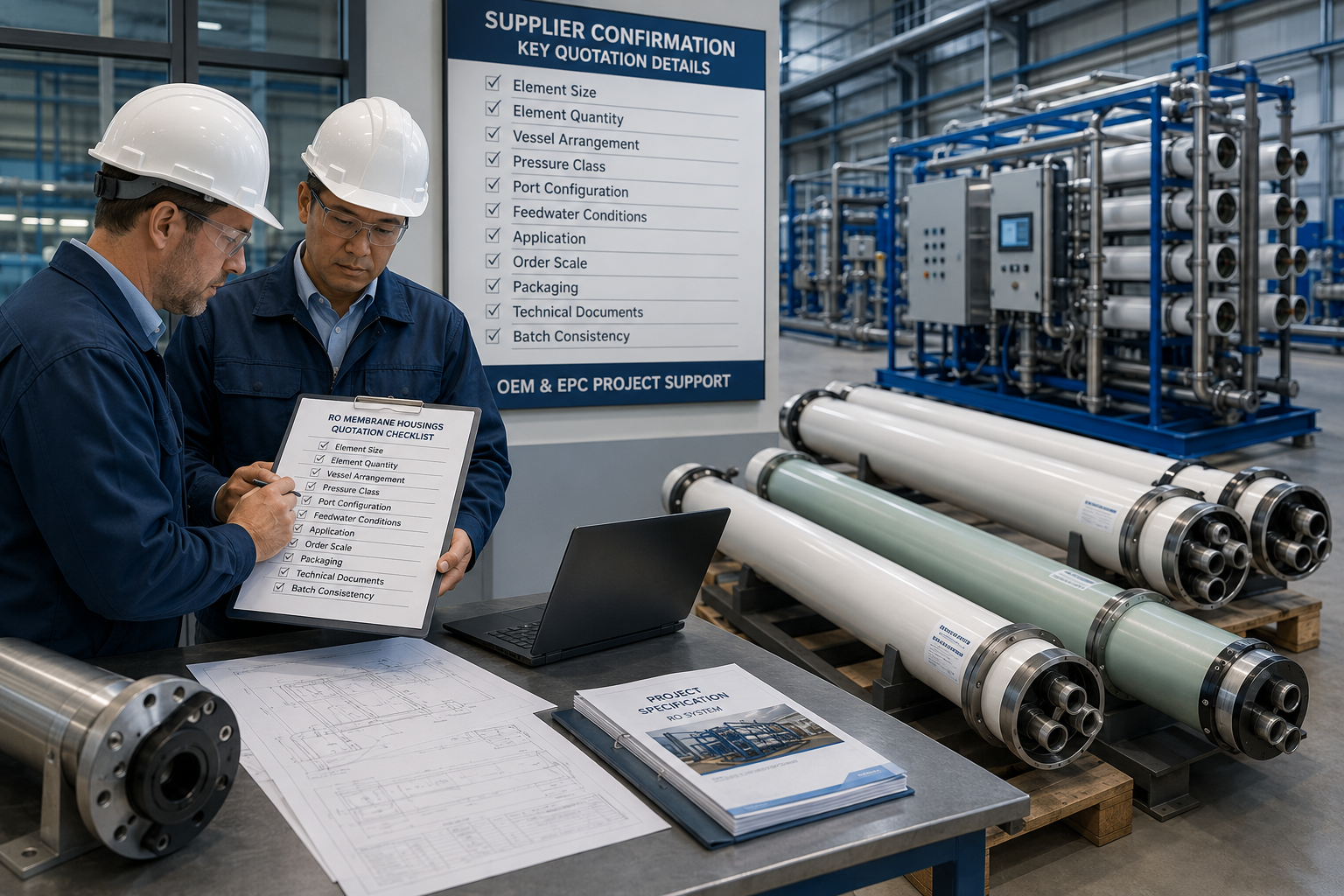
The quotation should start with operating conditions
When I communicate with procurement managers, I usually ask about the project before I talk about price. This is not to make the process complicated. It is to prevent a wrong product from being selected.
The basic quotation checklist should include:
- Membrane element diameter: 2.5", 4", 8", or another specification
- Number of elements per vessel: 1, 2, 3, 4, 6, or custom
- Vessel pressure rating: based on working and design pressure
- Port arrangement: end port, side port, or special connection
- Connection standard: clamp, thread, flange, or custom interface
- Application: drinking water, boiler feed water, industrial pure water, seawater, reuse, or other
- Feedwater condition: salinity, temperature, chemicals, or pre-treatment status
- Installation layout: horizontal, vertical, skid-mounted, or containerized
- Quantity and delivery schedule
- Documentation and inspection requirements
If these points are not clear, the supplier may quote a model that looks correct but does not fit the system. That creates risk for both sides.
Pressure rating should not be guessed
The pressure rating is not just a number on a datasheet. It connects to the application. For example, a low-pressure brackish water RO system and a higher-pressure desalination or special industrial system may require very different vessel designs3.
A responsible RO membrane housings supplier should ask about:
- Normal operating pressure
- Maximum possible pressure
- System pressure fluctuation
- Cleaning process conditions
- Temperature range
- Safety margin required by the project
I avoid making pressure assumptions from only the membrane size. The same membrane dimension can appear in different applications. That is why I want the buyer’s design condition before recommending a housing.
Documentation matters for cross-border procurement
For brand owners, EPC contractors, and large distributors, the part itself is only one part of the procurement file. The buyer may also need documents for customs, project approval, local compliance, or after-sales support.
Here is a simple comparison I use during supplier evaluation:
| Quotation Item | Basic Supplier Response | Strong Supplier Response |
|---|---|---|
| Product model | Sends catalog page | Confirms model against project conditions |
| Pressure data | Lists pressure rating | Explains working/design pressure suitability |
| Ports | Shows standard port | Confirms port position and connection standard |
| Certificates | Sends logo or PDF | Provides valid certificate and scope information |
| Packaging | Says export packing | Confirms carton, pallet, label, and protection |
| OEM support | Says yes | Provides drawing, label, manual, and file options |
I have found that suppliers who ask better questions before quoting often create fewer problems after delivery. The quotation stage tells you how the supplier thinks. If the supplier thinks only in units and prices, the buyer must carry more technical risk.
How Can I Verify RO Membrane Housings Supplier Quality Evidence?
Many suppliers can send attractive catalogs. The pressure vessel may look similar in photos. The real challenge is knowing whether the supplier controls production consistently. I have learned that buyers should ask for evidence that can be checked, not only claims that sound professional.
You can verify an RO membrane housings supplier by reviewing material inspection records, FRP production controls, dimensional inspection data, hydrostatic test procedures, burst-pressure verification where applicable, final inspection records, and batch traceability. Quality evidence should connect to real production, not only to marketing documents.
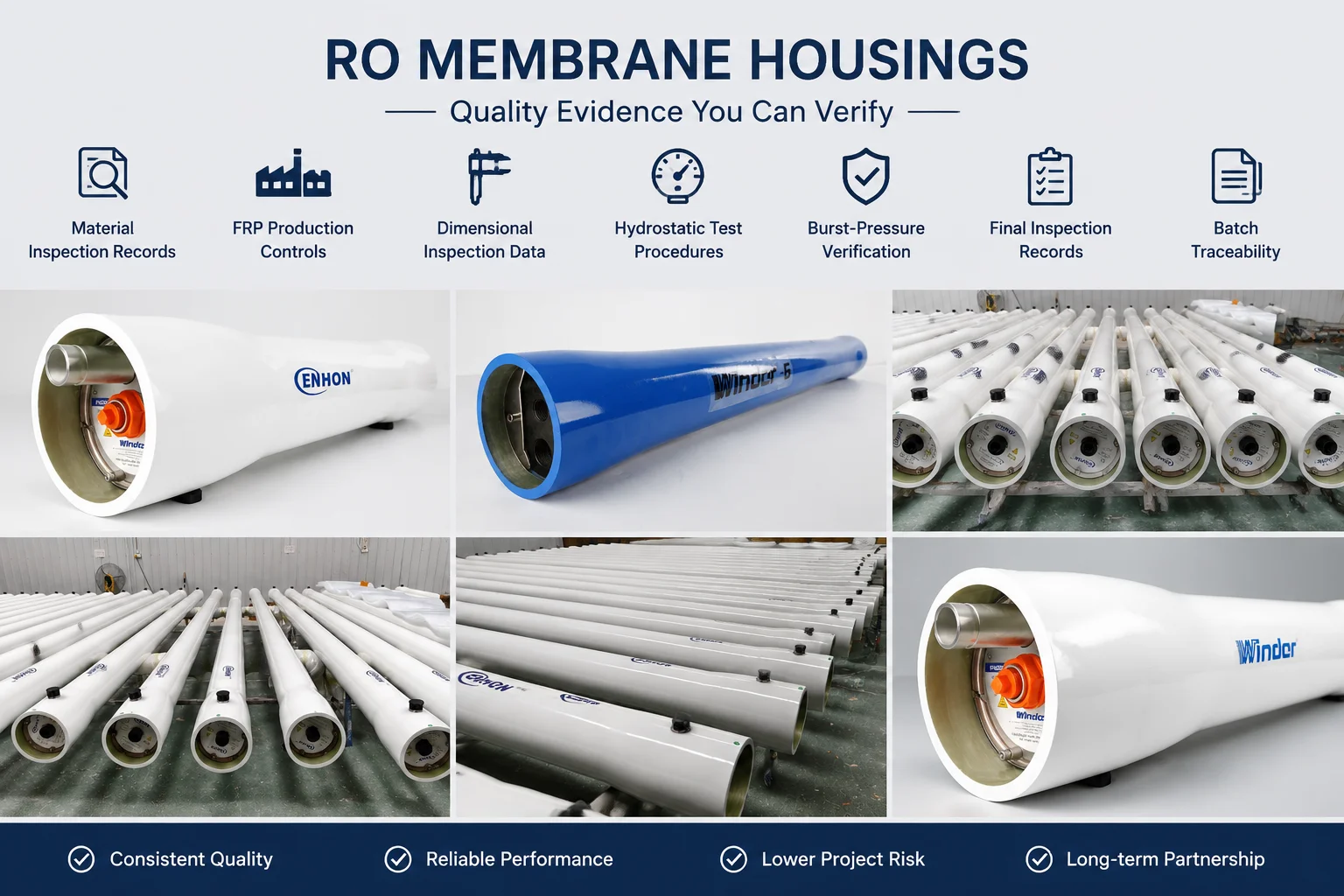
Material control is the starting point
For FRP membrane housings, material quality matters before the vessel is formed4. The supplier should control resin, fiberglass, liners, end caps, seals, and connection components. If the input materials vary too much, stable finished products become harder to achieve.
In my manufacturing experience, I prefer to check:
- Resin batch information
- Fiberglass type and storage condition
- Food-grade or drinking-water contact suitability where required
- O-ring and sealing component quality
- End-cap material consistency
- Port material and machining quality
- RoHS/REACH or other buyer-required material compliance
A buyer does not need to inspect every raw material personally. However, the buyer can ask whether the supplier has an incoming inspection system and whether records are available for project orders.
FRP process control should be visible
FRP pressure vessels depend heavily on process control.5 In our industry, common manufacturing processes include CNC filament winding, rotational molding, injection molding for certain components, precision machining, and controlled assembly6. The exact process depends on the product design.
The key point is simple: the supplier should not rely only on worker experience. The supplier should have controlled equipment, process parameters, and inspection checkpoints.
Important process controls include:
- Winding angle and tension control
- Layer structure consistency
- Curing condition control
- Wall thickness monitoring
- Port opening accuracy
- End sealing surface quality
- Assembly torque or fit control
- Visual inspection for cracks, voids, or surface defects
At Hedelong, our broader water treatment equipment production uses automated lines, CNC filament winding, multi-axis molding, precision injection molding, and automated assembly depending on product category. I mention this because buyers should understand the type of manufacturing discipline behind the product, not only the final photo.
Testing separates claims from evidence
A strong supplier should be able to explain how vessels are tested before shipment. Depending on the model and project requirement, the inspection plan may include hydrostatic testing, pressure cycling validation, burst pressure verification7, flow or fit checks, and 100% final inspection.
I recommend buyers ask for test evidence such as:
| Quality Evidence | Why It Matters | What Buyers Can Request |
|---|---|---|
| Hydrostatic test record | Confirms sealing and pressure integrity | Test pressure, duration, result, batch number |
| Dimensional inspection | Reduces installation mismatch | Port distance, length, diameter, tolerance data |
| Burst test verification | Shows design safety margin where applicable | Test report or type test summary |
| Final inspection checklist | Confirms shipment readiness | Visual, packing, label, accessories list |
| Batch traceability | Helps after-sales management | Serial number, production date, material batch |
I do not suggest that every buyer must demand laboratory-level data for every small order. That can be impractical. However, for annual procurement values above USD 5 million or for large infrastructure projects, inspection records are not optional paperwork. They are risk-control tools.
I trust a supplier more when the supplier can show boring, consistent inspection records than when the supplier only shows a beautiful brochure.
Dimensional control can prevent expensive rework
A vessel that passes pressure testing can still cause trouble if the dimensions do not match the system.8 This is especially important for skid-mounted RO systems, containerized plants, and OEM product lines where repeated assembly speed matters.
Critical dimensions usually include:
- Overall vessel length
- Port center distance
- Port orientation
- Connector thread or flange size
- Mounting saddle position
- End-cap clearance
- Permeate outlet position
Hedelong’s production environment includes dimensional tolerance control for water treatment equipment components, with precision targets such as ±0.2 mm in applicable automated processes. The exact tolerance for a membrane housing depends on design and component type, but the principle remains the same. A buyer should ask how dimensions are controlled across batches.
Are Certifications Enough When Choosing an RO Membrane Housings Supplier?
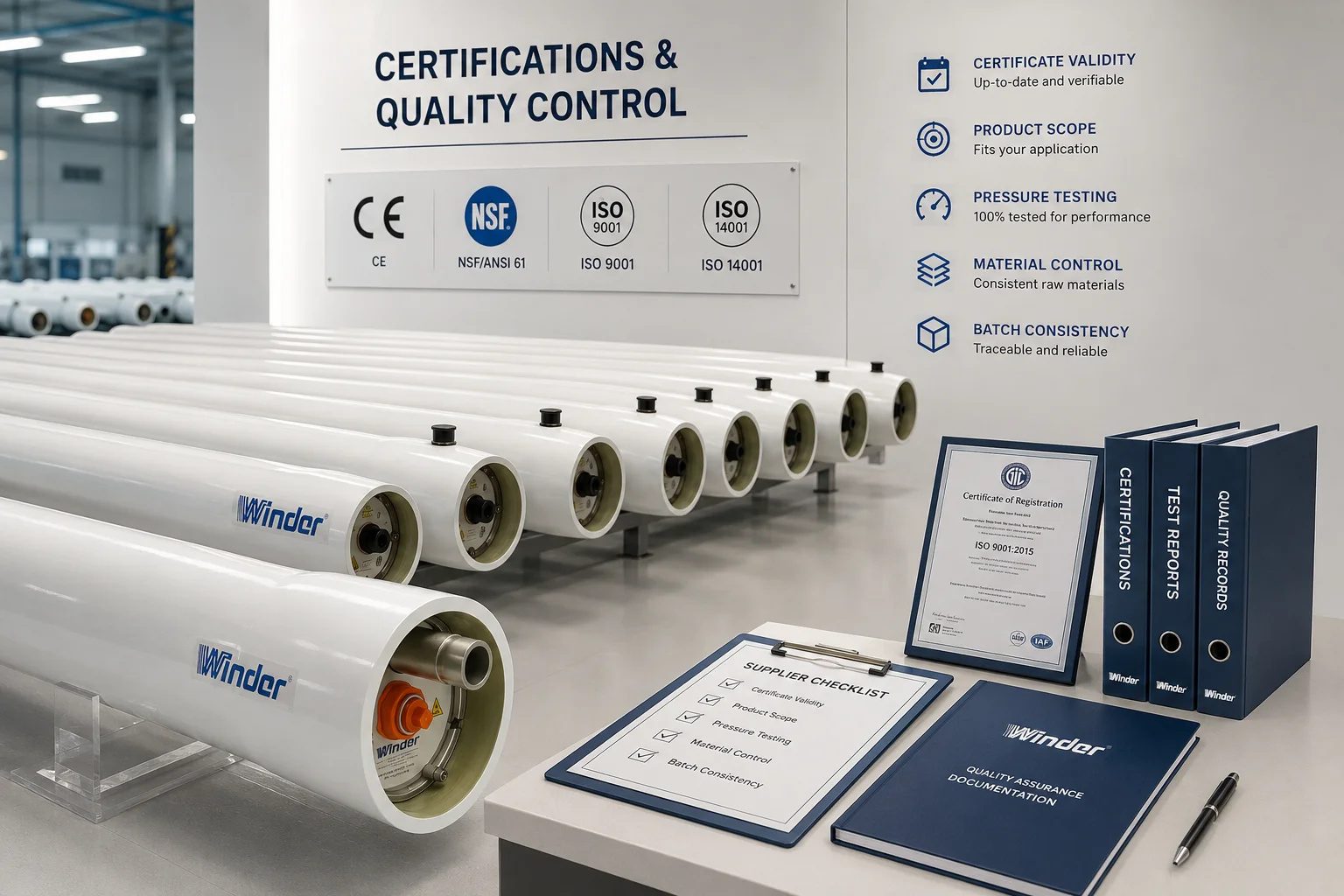
Certificates are important, but they can create false comfort if buyers stop there. A supplier may show CE, NSF, ISO9001, or ISO14001 documents, yet the buyer still needs to confirm model scope, production consistency, and batch inspection. Certification is an entry point, not the whole answer.9
Certifications help screen an RO membrane housings supplier, but they do not guarantee long-term reliability by themselves. Buyers should verify certificate validity, product scope, quality management practice, pressure testing, material control, and repeat-batch consistency before approving a supplier for serious projects.
Certifications answer only part of the question
In international procurement, certificates matter because they support compliance and market access. For water treatment equipment, buyers may ask for:
- ISO9001 for quality management
- ISO14001 for environmental management
- CE for relevant market requirements
- NSF for drinking-water-related applications where applicable
- Domestic drinking water hygiene approvals
- CCC or other local certifications when required
These documents are useful. I never dismiss them. However, a certificate does not replace production control. A buyer should still ask whether the specific product model, material, or production site is covered.
The stronger question is consistency
A procurement manager does not buy only one sample. The manager buys repeat shipments. The real supplier question is:
Can this supplier keep the same quality in batch one, batch five, and batch twenty?
That is why I focus on the supplier’s quality system. A good quality system should include:
- Incoming material inspection
- In-process inspection
- Pressure testing
- Dimensional sampling
- Final product inspection
- Nonconformity handling
- Traceability
- Corrective action records
If a supplier has ISO9001 but cannot explain these steps clearly, I would treat the certificate as incomplete evidence. The certificate may be valid, but the buyer still needs proof that the supplier manages daily production well.
Certification review checklist
I use a simple checklist when reviewing supplier certification:
| Question | Why I Ask It |
|---|---|
| Is the certificate valid now? | Expired certificates create compliance risk |
| Does the certificate cover the product type? | Some certificates cover only selected models |
| Does the certificate match the factory name? | Trading company documents may not show manufacturing control |
| Is the testing standard relevant? | Not every test applies to every application |
| Can the supplier provide batch inspection records? | Certification does not prove shipment-level quality |
This approach is especially important for Belt and Road markets, where procurement teams often manage different local requirements, customs expectations, and project-owner documentation standards. A certificate helps the file. Inspection evidence protects the project.
Do not confuse sample quality with batch quality
Many buyers receive a good sample and assume the supplier is approved. I understand why this happens. A good sample saves time. But a sample does not always represent mass production.
A reliable RO membrane housings supplier should explain how sample quality becomes batch quality. The supplier should show how process parameters, materials, testing, packing, and labeling remain controlled after the sample stage.
This is one reason OEM/ODM buyers should avoid approving a supplier based only on a showroom sample. The supplier must also show repeatability.
How Does OEM/ODM Support Reduce Buyer Risk?
OEM/ODM support may sound like branding, but it is much more than a logo. For distributors, EPC contractors, and brand owners, project success depends on clear documentation, stable packing, correct labels, and after-sales traceability. Weak support can turn a good product into a hard-to-manage supply chain.
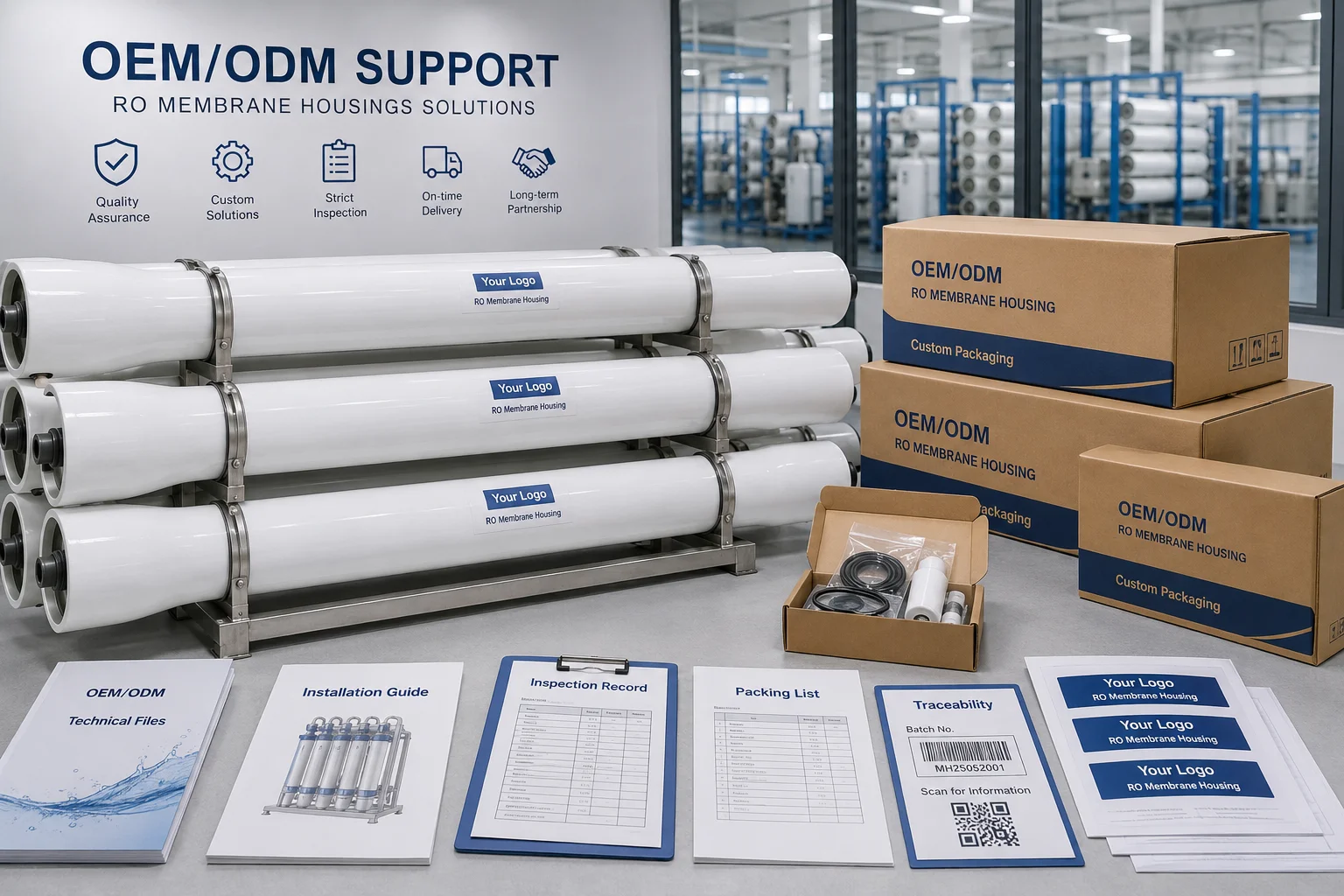
A capable RO membrane housings supplier reduces buyer risk through OEM/ODM packaging, branding, technical files, installation guidance, inspection records, batch traceability, and after-sales documentation. These services help procurement teams manage cross-border projects, distributor channels, and repeated system deliveries more efficiently.
OEM is not only a private label
When I talk with brand owners, I often notice that “OEM” means different things to different buyers. Some buyers only need a logo on the carton. Others need full product files, customized labels, installation manuals, spare parts lists, and serial-number tracking.
A useful OEM/ODM program may include:
- Custom product label
- Brand carton and pallet design
- Installation manual with buyer logo
- Technical datasheet format
- Product drawings
- Inspection report template
- Spare parts kit
- Barcode or serial number system
- Export document support
- After-sales troubleshooting guide
These details can feel small during negotiation. However, they become important when the buyer’s sales team, installation team, or local distributor needs to support the product.
ODM matters when project conditions are different
ODM support becomes important when a standard membrane housing does not match the buyer’s system design. For example, a buyer may need a different port position, special interface, customized length, special color, different packaging protection, or integration with a specific RO skid design.
A supplier with real manufacturing capability can discuss what is practical and what requires tooling, testing, or minimum order quantity. A pure trading supplier may be able to source a product, but the buyer needs to know who controls the design change and quality verification.
OEM/ODM support and risk reduction
| Buyer Type | Common Risk | OEM/ODM Support That Helps |
|---|---|---|
| Brand owner | Inconsistent product image | Custom labels, manuals, cartons, serial tracking |
| EPC contractor | Site installation mismatch | Drawings, port confirmation, inspection records |
| Distributor | After-sales confusion | Spare parts list, batch traceability, support files |
| Industrial buyer | Maintenance uncertainty | Technical datasheets and operating guidance |
| Trading buyer | Supplier communication gap | Clear files, packing photos, pre-shipment reports |
Hedelong works with OEM/ODM buyers across industrial, commercial, and residential water treatment applications. Our wider product range includes RO systems, UF/NF systems, EDI ultra-pure water systems, water softeners, media filters, FRP tanks, and membrane housings. I mention this because a membrane housing supplier with system-level experience may better understand how the vessel fits the complete water treatment project.
Delivery and packaging are part of quality
Some buyers separate product quality from delivery quality. I see them as connected. A vessel can leave the factory in good condition but arrive damaged if packing is weak.10 This is especially true for export shipments with long routes, multiple handling points, and container loading pressure.
Before confirming an order, I suggest buyers ask:
- How will each housing be protected?
- Are end caps and accessories packed separately or assembled?
- Is carton or wooden pallet packaging available?
- Can the supplier provide loading photos?
- Can the supplier mark batches clearly?
- Can the supplier match shipping documents with product labels?
- Can the supplier support split shipments or project schedules?
For procurement managers handling large project rollouts, these questions are not minor. They protect the project timeline.
Frequently Asked Questions
What is the most important factor when choosing an RO membrane housings supplier?
The most important factor is testable manufacturing control. I would check material inspection, pressure testing, dimensional accuracy, batch traceability, and final inspection records before focusing on price. A low price has value only when the supplier can still prove stable quality.
Are FRP RO membrane housings better than stainless steel housings?
FRP housings are widely used because they are corrosion-resistant, lightweight, and suitable for many RO applications.11 Stainless steel housings may fit specific sanitary or industrial requirements. I would choose based on pressure, feedwater chemistry, compliance needs, installation environment, and total project cost.
Should I require CE, NSF, or ISO certificates from my supplier?
Yes, I would request relevant certificates, especially for regulated markets or drinking-water applications. However, I would not treat certificates as complete proof of reliability. I would also verify the certificate scope, product model coverage, inspection process, and shipment-level quality records.
What information should I send before asking for a quotation?
You should send membrane size, number of elements, pressure rating, port type, application, feedwater condition, installation layout, quantity, packaging requirements, certification needs, and delivery schedule. Clear information helps the RO membrane housings supplier quote the right product and avoid mismatch.
Can an RO membrane housing supplier provide OEM branding?
Yes, many manufacturers can provide OEM branding. I would ask about labels, cartons, manuals, technical datasheets, inspection reports, serial numbers, and spare parts documentation. Strong OEM support helps distributors and brand owners reduce after-sales confusion.
Conclusion
Choosing an RO membrane housings supplier should be a quality-risk decision, not only a price comparison. I would verify what the supplier controls before quoting, how the factory manages FRP materials and production, what pressure and dimensional tests are recorded, and whether certifications match real batch consistency. OEM/ODM support also matters because documentation, packaging, and traceability protect cross-border projects. If you need a manufacturing partner for RO membrane housings or complete water treatment equipment, Hedelong can support your team with customized production, technical files, and project-based supplier communication.
"Reverse Osmosis", https://www.fda.gov/inspections-compliance-enforcement-and-criminal-investigations/inspection-technical-guides/reverse-osmosis. A government or technical source on reverse osmosis describes membrane elements as being installed in pressure vessels for pressurized operation, supporting the article’s description of the housing’s basic function. Evidence role: definition; source type: government. Supports: The source should define reverse osmosis systems as using membrane elements contained in pressure vessels or housings during pressurized separation.. Scope note: This supports the general equipment function, not the quality of any specific supplier’s housings. ↩
"Maximum allowable operating pressure", https://en.wikipedia.org/wiki/Maximum_allowable_operating_pressure. Pressure-vessel engineering references distinguish operating pressure from design pressure, supporting the article’s treatment of both values as relevant selection parameters. Evidence role: definition; source type: institution. Supports: The source should explain the distinction between operating pressure and design pressure in pressure-containing equipment.. Scope note: This is contextual support from pressure-vessel practice and may not address RO membrane housings specifically. ↩
"Batch Reverse Osmosis Desalination Modeling under a Time-Dependent ...", https://pmc.ncbi.nlm.nih.gov/articles/PMC7997241/. University or research-based desalination references report that seawater reverse osmosis typically operates at higher pressures than brackish-water reverse osmosis, supporting the article’s distinction between application pressure classes. Evidence role: general_support; source type: education. Supports: The source should document that seawater desalination RO generally requires higher operating pressures than brackish-water RO.. Scope note: The source would support typical application pressure differences, not prescribe the exact vessel design for a specific project. ↩
"Study on Winding Forming Process of Glass Fiber Composite Pressure ...", https://pmc.ncbi.nlm.nih.gov/articles/PMC12156421/. Composite pressure-vessel studies show that fiber and resin properties influence the strength and reliability of filament-wound FRP structures, supporting the article’s emphasis on material control before forming. Evidence role: mechanism; source type: paper. Supports: The source should explain that fiber, resin, and composite material properties influence the mechanical performance of FRP pressure vessels.. Scope note: The evidence is based on composite pressure-vessel behavior generally and may not test the article’s specific RO housing models. ↩
"Influence Of The Filament Winding ProcessVariables On ...", https://www.academia.edu/93783718/Influence_Of_The_Filament_Winding_ProcessVariables_On_The_Mechanical_Behavior_Of_AComposite_Pressure_Vessel. Research on filament-wound composite pressure vessels links manufacturing parameters such as winding pattern, fiber tension, and curing conditions to mechanical performance, supporting the article’s statement that FRP vessels depend on process control. Evidence role: mechanism; source type: paper. Supports: The source should show that filament winding parameters, curing, layer structure, or other process variables influence composite pressure-vessel strength or failure behavior.. Scope note: The cited research would establish the manufacturing mechanism, not verify any individual supplier’s process controls. ↩
"Study on Winding Forming Process of Glass Fiber Composite ...", https://pmc.ncbi.nlm.nih.gov/articles/PMC12156421/. Technical reviews of composite pressure vessels identify filament winding as a principal manufacturing method for pressure-containing composite structures, supporting the article’s description of controlled production processes. Evidence role: general_support; source type: research. Supports: The source should describe filament winding as a common manufacturing method for composite or FRP pressure vessels and discuss related production controls.. Scope note: This supports the general manufacturing context and does not confirm the exact equipment used by the supplier named in the article. ↩
"Design, Analysis, and Testing of a Type V Composite ... - PMC", https://pmc.ncbi.nlm.nih.gov/articles/PMC11679490/. Pressure-vessel standards and test methods use hydrostatic, cyclic-pressure, and burst-type evaluations to assess pressure integrity and design margins, supporting the article’s use of these records as quality evidence. Evidence role: general_support; source type: institution. Supports: The source should identify hydrostatic testing, pressure cycling, or burst testing as accepted evaluation methods for pressure vessels or composite pressure equipment.. Scope note: The relevance of each test depends on the applicable standard, vessel design, and project requirement. ↩
"Geometric dimensioning and tolerancing", https://en.wikipedia.org/wiki/Geometric_dimensioning_and_tolerancing. Manufacturing engineering literature on dimensional variation and tolerance stack-up shows that parts meeting one functional requirement can still create assembly-fit problems, supporting the article’s emphasis on dimensional control. Evidence role: mechanism; source type: paper. Supports: The source should explain that dimensional variation and tolerance stack-up can create assembly fit problems or rework.. Scope note: This is general manufacturing evidence and may not study RO membrane housings directly. ↩
"ISO 9001 explained", https://www.iso.org/home/insights-news/resources/iso-9001-explained.html. ISO guidance describes ISO 9001 as a quality-management-system standard rather than a direct guarantee of each product’s performance, supporting the article’s distinction between certification and shipment-level quality evidence. Evidence role: expert_consensus; source type: institution. Supports: The source should clarify that ISO-style certification concerns management systems or defined scopes and does not by itself guarantee every product or shipment.. Scope note: This supports the general limitation of certification; it does not assess any specific certificate shown by a supplier. ↩
"Sustainable packaging | ITC - International Trade Centre", https://www.intracen.org/our-work/topics/business-performance/sustainable-packaging. International trade and packaging guidance identifies protective packaging as a means of reducing damage during handling and transport, supporting the article’s claim that delivery quality depends partly on packaging. Evidence role: general_support; source type: institution. Supports: The source should explain that packaging protects goods from damage during transport, handling, storage, or export shipment.. Scope note: This provides general logistics support and does not quantify damage rates for RO membrane housings specifically. ↩
"Reverse Osmosis FRP Tank Overview | Uses & Benefits", https://www.brotherfiltration.com/an-overview-to-reverse-osmosis-frp-tank/. Educational and technical materials on fiber-reinforced polymer composites describe them as lightweight and corrosion-resistant, supporting the article’s explanation of why FRP housings are used in many RO systems. Evidence role: general_support; source type: education. Supports: The source should describe FRP composites as corrosion-resistant and lightweight materials used in pressure vessels or water-treatment equipment.. Scope note: The source would support general material advantages and not prove that FRP is preferable for every pressure, chemistry, or regulatory condition. ↩