
Corrosion can eat profit quietly. Heavy vessels can slow projects down. Wrong material choices can turn a normal water treatment order into a long after-sales problem.
The purpose of FRP in water treatment is to give equipment corrosion resistance, pressure strength, lower weight, and controlled cost1 in one material system, when the design matches the real water chemistry, pressure, temperature, and operating duty.
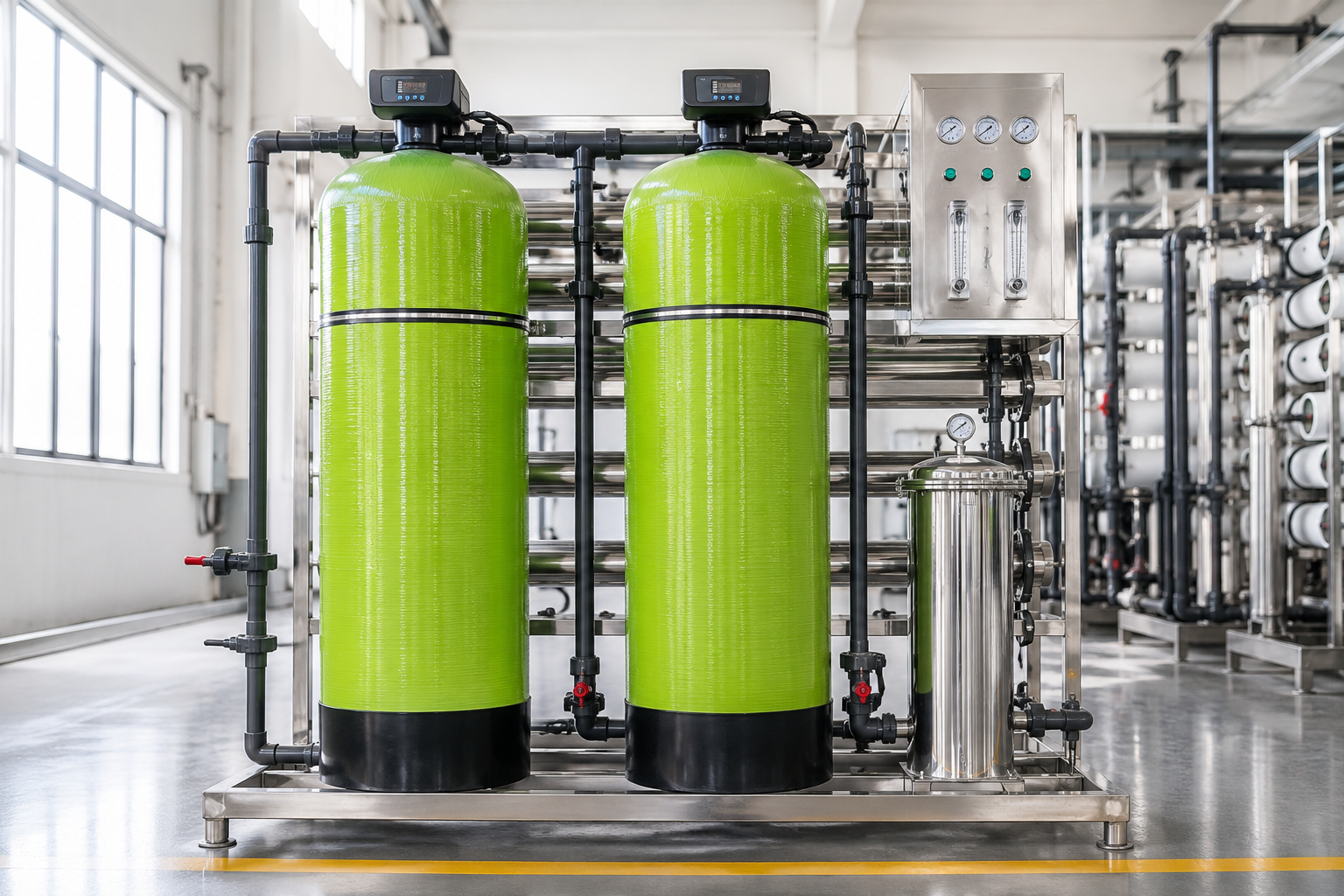
I do not see FRP as a simple low-cost replacement for metal. I see it as a material choice that must earn its place in a system. In my daily manufacturing and quality-control work, I look at FRP pressure tanks, filter vessels, and RO membrane housings from a very practical angle. I ask one basic question first. Will this product keep working safely under the real conditions that the project gives it?
That question matters because water treatment equipment does not work in a clean textbook. It works with pressure, flow, salt, chlorine, acid, alkali, heat, transport stress, and daily operator habits. If I choose FRP only because it is cheaper or lighter, I miss the real purpose of the material. If I choose it because its strengths match the duty, I reduce risk for the buyer, the brand owner, and the end user. That is where the real value of FRP begins.
Why do I use FRP in water treatment equipment?
A tank that rusts too early creates cost. A vessel that is too heavy creates handling trouble. A weak material choice creates doubt before the system starts.
I use FRP in water treatment because it combines corrosion resistance, useful strength, and lower weight.2 This mix makes it suitable for many pressure tanks, media filters, softeners, and RO membrane housings when the design limits are respected.

I start with the job, not the material name
When I review an FRP product, I do not start by saying “FRP is good.” I start with the job. I ask what water passes through the unit. I ask what pressure the product must hold. I ask what chemicals may touch the surface. I ask how often the system starts and stops. I ask whether the product will sit indoors, outdoors, or inside a containerized plant.
FRP makes sense when several needs appear at the same time. A filter vessel may need to resist corrosion from brine or chemical dosing. It may also need enough mechanical strength for pressure use. It may need to be easier to move than a heavy metal tank. In that case, FRP gives a balanced answer.
| Need in the project | How FRP can help | What I still check |
|---|---|---|
| Corrosion control | FRP does not rust like carbon steel3 | Water chemistry and chemical exposure |
| Pressure use | Fibers carry load when wound correctly4 | Pressure rating and test records |
| Lower weight | FRP is easier to handle than many metal vessels | Transport and installation method |
| Cost control | FRP can reduce total equipment cost | Service life and maintenance risk |
I also remind myself that FRP is not a magic answer. Stainless steel may still be better in some high-temperature or special chemical duties. UPVC may be enough for some low-pressure piping and small systems. My goal is not to force FRP into every design. My goal is to use it where its mix of properties fits the job.
Is FRP just plastic, or is it a pressure-ready composite?
Many people hear “plastic” and think “weak.” That shortcut can lead to poor decisions. It can also make a buyer reject a useful product too early.
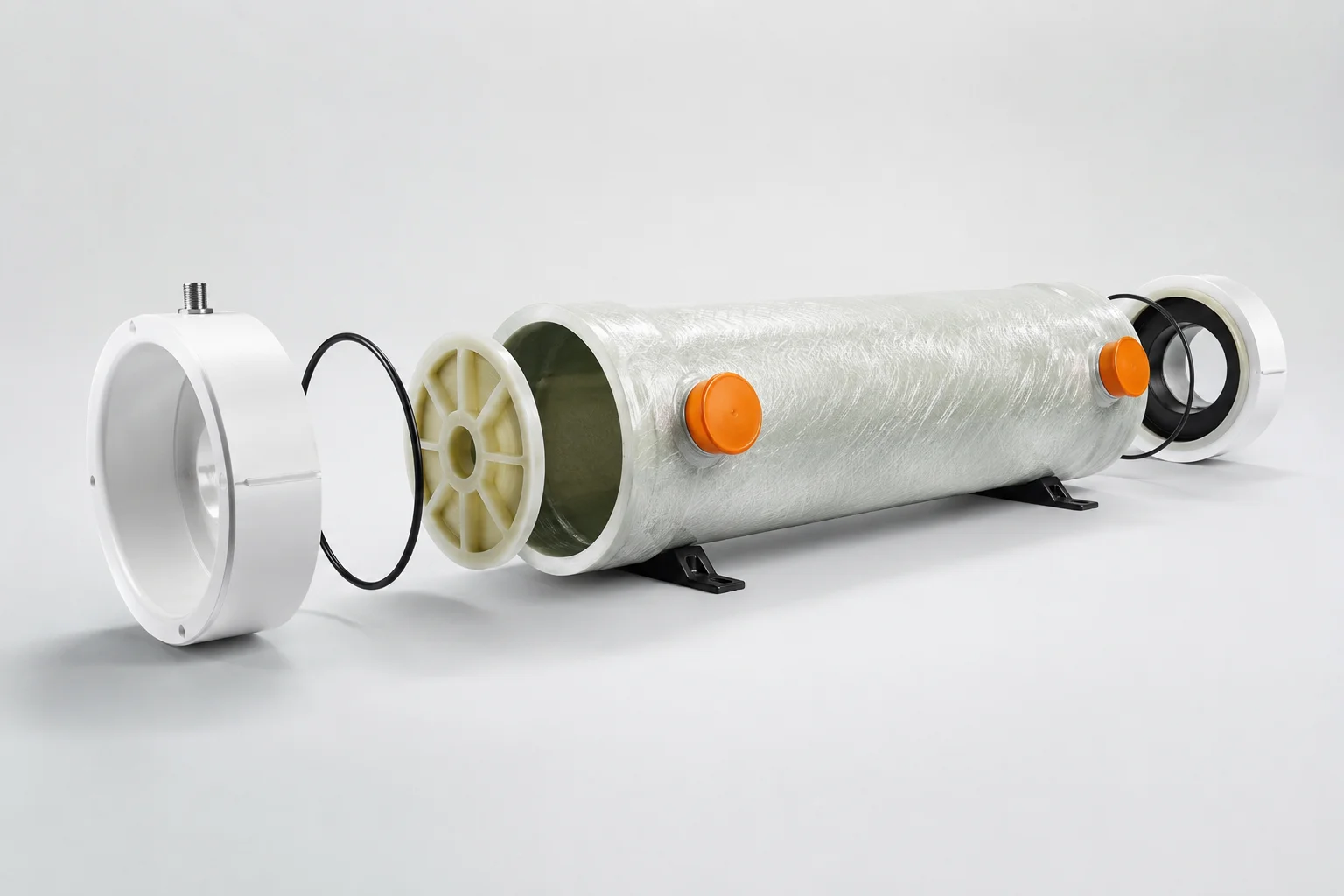
FRP is not ordinary plastic. It is a fiber-reinforced composite.5 The resin helps resist corrosion and hold the structure together. The fiber reinforcement carries much of the mechanical load when the product is designed and produced correctly.6
I look at the structure before I judge the product
In the factory, I treat FRP as a built structure, not as one simple material. The final strength depends on resin, fiber, winding angle, wall thickness, curing, liner quality, and end connection design.7 A good FRP pressure tank or membrane housing is not made by only pouring plastic into a shape. It is made by controlling layers and process details.
This point is very important for procurement teams. Two products may both be called FRP. They may look similar in photos. They may have similar colors. But they can be very different in pressure behavior and long-term stability if the raw materials, winding process, and testing are not controlled.
| Part of FRP product | Main role | What I pay attention to |
|---|---|---|
| Inner liner | Contacts water and helps resist leakage | Material safety and surface quality |
| Resin system | Binds the structure and resists corrosion | Cure quality and chemical fit |
| Glass fiber layer | Gives the product much of its strength | Fiber amount, angle, and consistency |
| Opening and port area | Handles stress concentration | Reinforcement and machining accuracy |
| End sealing area | Keeps pressure contained | Seal design and assembly control |
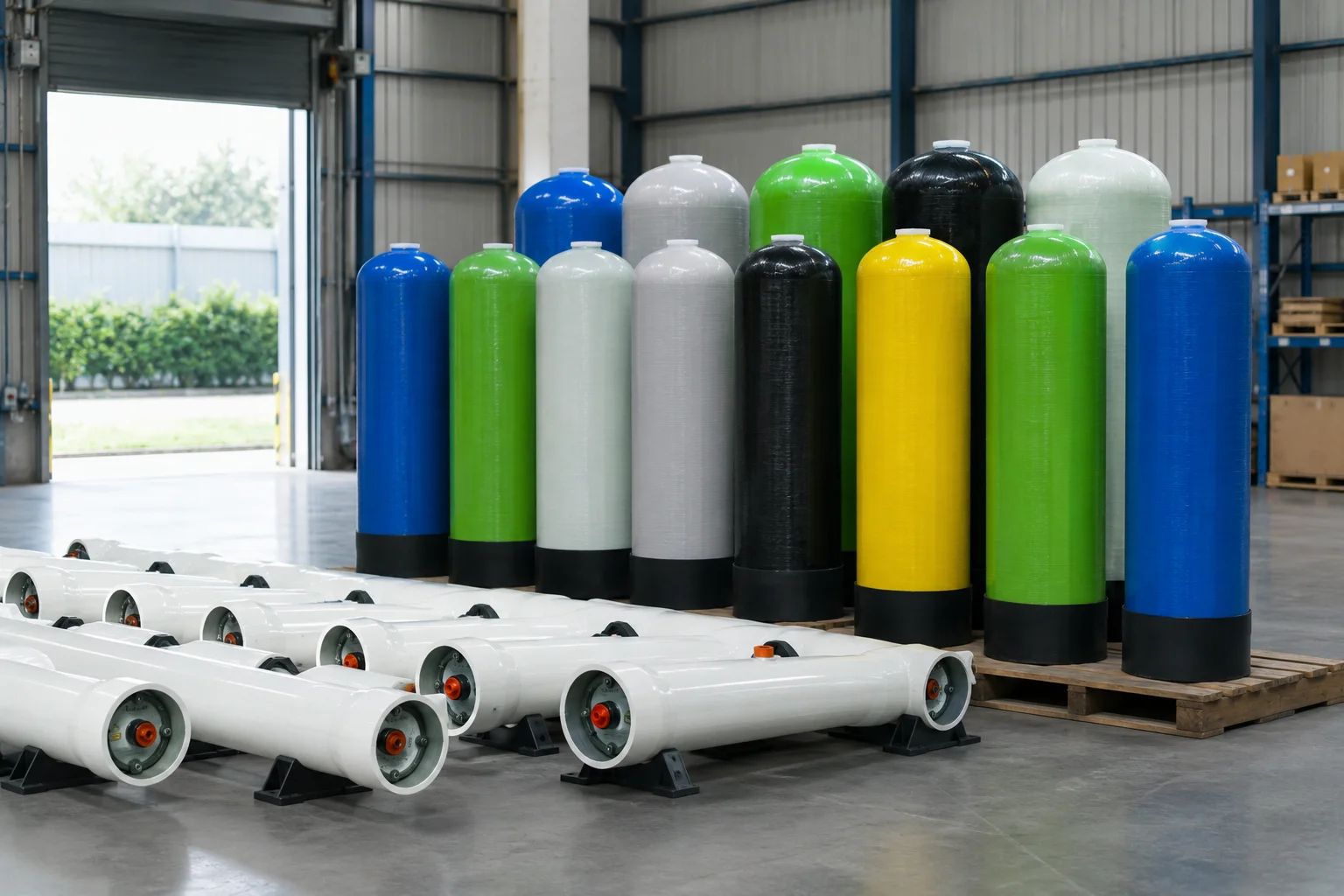
I also look at the product category. A media filter tank has different stress points from an RO membrane housing. A membrane housing may face higher pressure and frequent sealing checks.8 A softener tank may face brine exposure and repeated regeneration cycles. The word FRP does not remove these differences. I must match the structure to the working condition.
Where should I not trust FRP without checking the limits?
A wrong boundary can turn a good material into a bad choice. Pressure, heat, and chemicals can punish a product that was selected too casually.
I do not trust FRP blindly. I check pressure rating, water chemistry, temperature range, chemical exposure, installation environment, and duty cycle before I accept FRP for a tank, filter vessel, or membrane housing.
I define the safe box before I approve the material
Every material has a safe working box. FRP has one too. I need to know whether the system stays inside that box. If the project has normal treated water, moderate temperature, and a pressure range that matches the vessel design, FRP can be a good fit. If the project has strong oxidants, high temperature, unusual solvents, or pressure shocks, I need more review before I accept it.9
I do not like vague technical requirements. A buyer may say “industrial water.” That phrase is not enough. I need actual water quality data, pressure data, chemical dosing details, and site conditions. If I do not have these facts, I cannot judge the true material risk.
| Check item | Why I check it | Risk if I ignore it |
|---|---|---|
| Working pressure | FRP must match the real pressure load | Vessel damage or safety risk |
| Peak pressure | Pumps and valves can create pressure spikes10 | Shortened life or sudden failure |
| Water chemistry | Salt, pH, and chemicals affect material fit | Corrosion or liner damage |
| Temperature | Heat can reduce safe strength11 | Deformation or faster aging |
| Outdoor exposure | Sunlight and weather affect surface aging | Cracks, fading, or surface damage |
| Cleaning chemicals | CIP or regeneration chemicals can be harsh | Seal or liner problems |
I also check the system design around the FRP product. A pressure vessel can be damaged by poor piping support, wrong valve operation, or pump surge. The vessel may be blamed later, but the root cause may start outside the vessel. This is why I prefer to discuss the whole operating condition with the buyer. A correct material choice is never separate from the system around it.
How do I connect FRP selection to lifecycle cost?
A low purchase price looks attractive on a spreadsheet. A failure at site looks expensive in real life. I always compare both pictures.
I connect FRP selection to lifecycle cost by looking beyond unit price. I consider corrosion risk, transport cost, installation ease, maintenance needs, replacement risk, testing records, and supplier process control.
I treat price as one part of cost, not the whole cost
Procurement work often starts with price comparison. I understand that. A brand manager or purchasing manager must control budget. But I also know that water treatment equipment is judged after it runs, not only when it ships. If a product leaks, cracks, or fails pressure tests at the wrong time, the low price becomes a very expensive decision.
FRP can support lifecycle cost control because it can resist corrosion and reduce handling load.12 It can also reduce repainting or anti-rust maintenance that some metal products may need. But these benefits only appear when the product is properly designed and made. Poor FRP can create the same or even higher cost than the wrong metal choice.
| Cost factor | What I compare | Why it matters |
|---|---|---|
| Purchase price | Unit cost and payment terms | It affects project budget |
| Transport cost | Weight and packing size | It affects landed cost |
| Installation cost | Handling and lifting needs | It affects site labor |
| Maintenance cost | Corrosion, sealing, and inspection needs | It affects long-term burden |
| Failure cost | Replacement, delay, and reputation risk | It affects the buyer’s market trust |
| Documentation cost | Certificates, manuals, and test reports | It affects approval and handover |
I also think about brand risk. If a distributor sells FRP tanks under its own brand, one bad batch can damage local trust. If an EPC contractor installs FRP vessels in a public or industrial project, a quality problem can delay acceptance. This is why I tell myself that FRP value must be measured by stable output, not by one cheap offer.
How do I judge a reliable FRP supplier before buying?
A nice sample can hide weak production control. A low quote can hide missing tests. A supplier decision can become a project risk later.
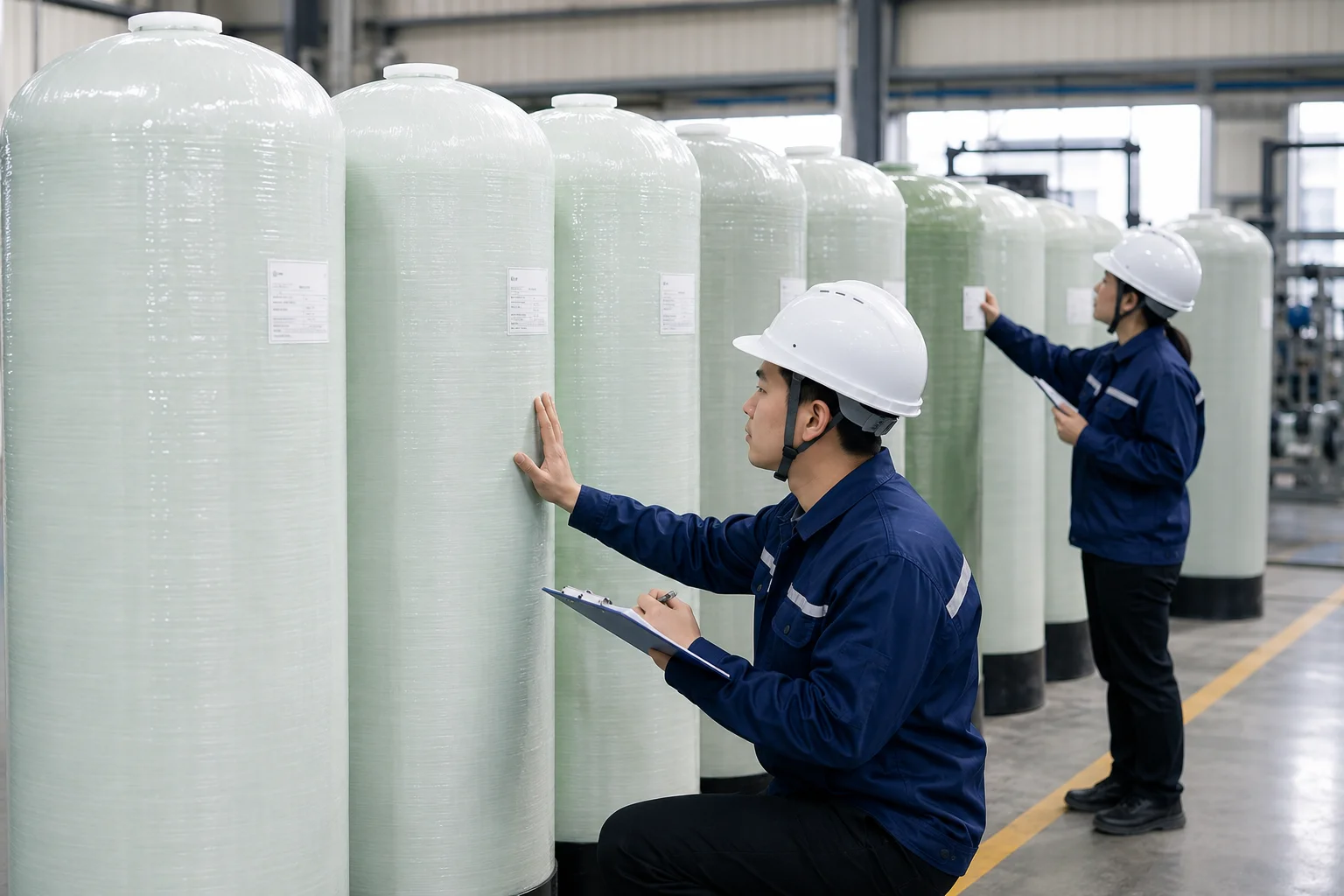
I judge an FRP supplier by manufacturing consistency, raw material control, pressure and safety testing, dimensional accuracy, documentation, and the ability to support OEM or project-specific requirements.
I ask for proof that the factory controls the process
I do not judge an FRP supplier by catalog words alone. I look for process control. I want to know how the factory checks raw materials. I want to know whether the winding process is controlled. I want to know whether pressure testing is done before shipment. I want to know whether the supplier can give clear drawings, labels, manuals, and packing standards.
This is where manufacturing experience becomes practical. A buyer may not see every product during production. So the supplier must build trust through repeatable work and traceable records. For FRP pressure tanks and RO membrane housings, I pay special attention to hydrostatic testing, burst pressure design basis, sealing surface quality, port accuracy, and final inspection records.
| Supplier factor | What I ask for | What it tells me |
|---|---|---|
| Raw material control | Resin, fiber, liner, and seal checks | The supplier controls the starting point |
| Process control | Winding, curing, trimming, and assembly rules | The supplier can repeat quality |
| Pressure testing | Hydrostatic and functional test records | The product was checked before shipment |
| Dimensional control | Port size, length, and tolerance data | The product can fit the system |
| Certification | ISO, CE, NSF, or needed local documents | The product can support market entry |
| OEM/ODM support | Branding, drawings, packaging, and manuals | The supplier can support a product line |
I also check communication quality. A reliable supplier should not say yes to every request without checking conditions. I prefer a supplier that asks about pressure, water quality, temperature, and chemical exposure. Those questions may slow the quotation by one day, but they reduce risk for the whole project. In my view, a supplier who understands limits is safer than a supplier who promises everything.
What should I ask before I approve FRP for my product line?
Unclear questions create unclear answers. If I ask only for a price, I may get a product that fits the budget but not the field.
Before I approve FRP, I ask about application conditions, pressure rating, test method, raw materials, production control, certification, spare parts, packaging, and after-sales support.
I use a checklist to reduce wrong-material risk
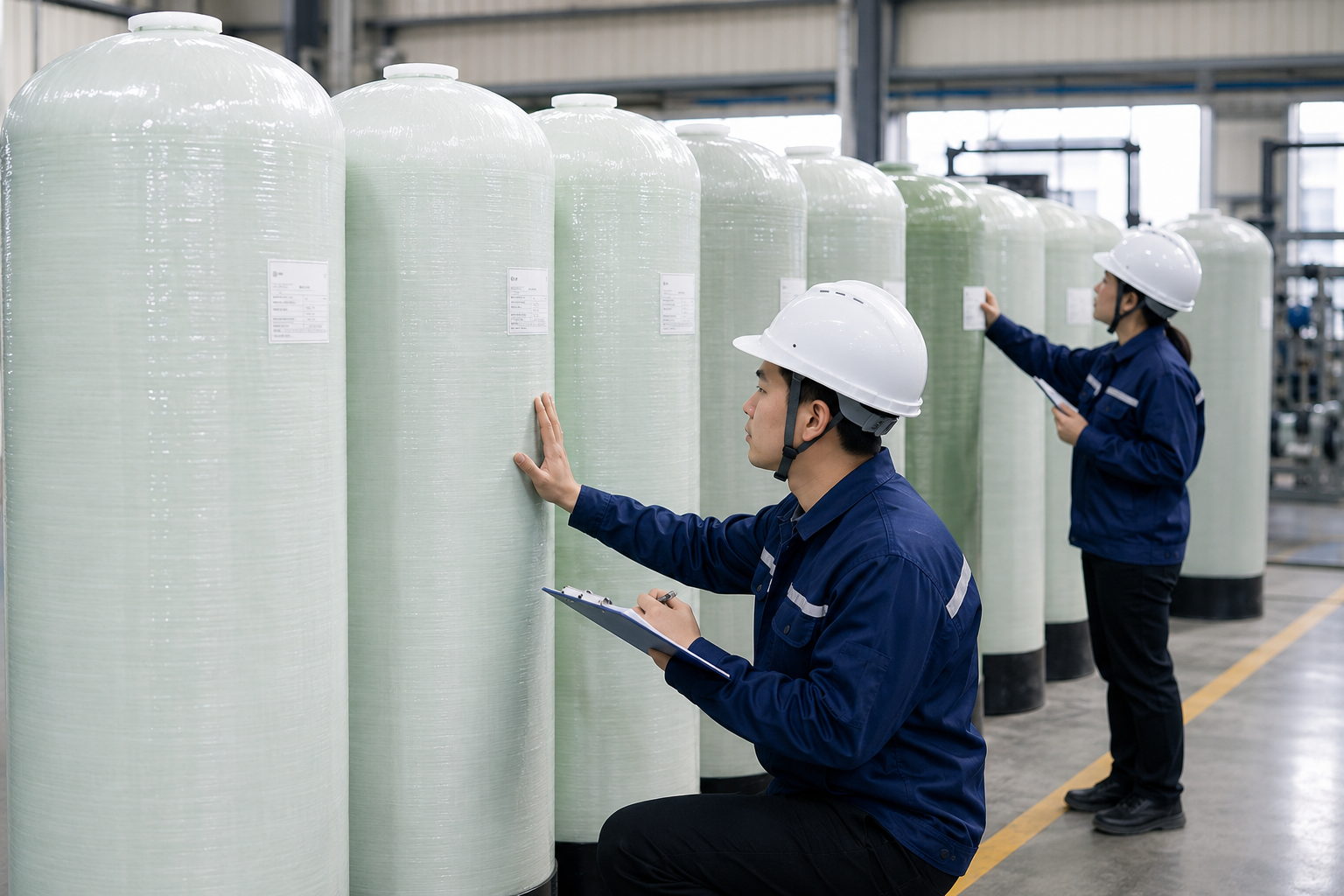
When I support FRP product selection, I like to turn the discussion into a simple checklist. This helps the buyer, the engineer, and the supplier speak about the same facts. It also helps prevent one common problem. People may compare two FRP products by diameter and price only. That comparison is too thin for pressure equipment.
I begin with operating data. I need the normal pressure, peak pressure, flow, temperature, water type, chemical dosing, and cleaning method. Then I move to product data. I check design pressure, test pressure, connection type, liner material, reinforcement method, and seal parts. Then I review supplier data. I check certificates, inspection records, packing method, and lead time.
| Question I ask | Better answer I want | Why I ask it |
|---|---|---|
| What is the real working pressure? | Normal and peak pressure values | I need to match the rating |
| What chemicals touch the vessel? | Dosing and cleaning chemical list | I need to check compatibility |
| What temperature will the unit see? | Normal and maximum temperature | I need to check the safe range |
| What test does the supplier perform? | Clear pressure and functional test method | I need proof before shipment |
| What documents are available? | Drawings, certificates, manuals, reports | I need support for approval |
| What changes are needed for OEM? | Logo, color, packaging, label, manual | I need stable brand delivery |
I also ask who will install and operate the system. Good FRP products still need correct handling. I do not want workers to drop tanks, overtighten fittings, misalign piping, or expose vessels to conditions outside the design range. I see procurement as only one step. I see correct selection, correct manufacturing, correct installation, and correct operation as one chain.
Conclusion
I use FRP when its corrosion resistance, strength, weight, and cost fit the real water treatment duty. I trust it only with clear limits and strong quality control.
"weight reduction of pressure vessel using frp composite material", https://www.academia.edu/20772591/WEIGHT_REDUCTION_OF_PRESSURE_VESSEL_USING_FRP_COMPOSITE_MATERIAL. A technical reference on fiber-reinforced polymer pressure vessels supports that FRP systems are selected for combinations of corrosion resistance, mechanical strength, and low weight, with suitability dependent on design conditions and service environment. Evidence role: general_support; source type: institution. Supports: An independent composites or engineering source should support that FRP pressure vessels are used where corrosion resistance, strength-to-weight performance, and maintenance or cost considerations are relevant.. Scope note: This would support the material rationale generally, but not prove that every FRP product achieves controlled cost in every water-treatment project. ↩
"Carbon-fiber reinforced polymer - Wikipedia", https://en.wikipedia.org/wiki/Carbon-fiber_reinforced_polymer. A general reference on fiber-reinforced plastics describes FRP as a composite material valued for corrosion resistance and favorable strength-to-weight characteristics in engineering applications. Evidence role: definition; source type: encyclopedia. Supports: A neutral reference should define FRP and summarize its commonly cited properties, including strength-to-weight ratio and corrosion resistance.. Scope note: This supports the general property claim, but it does not independently verify performance in a specific tank or membrane-housing design. ↩
"Marine Atmospheric Corrosion of Carbon Steel: A Review - PMC", https://pmc.ncbi.nlm.nih.gov/articles/PMC5506973/. Materials-science sources explain that rust is the corrosion product of iron-containing metals such as carbon steel; polymer-matrix composites such as FRP do not form iron oxide rust, although they may degrade by other mechanisms. Evidence role: mechanism; source type: education. Supports: A materials science source should explain that rusting is oxidation of iron in ferrous metals and that polymer composites do not undergo iron-oxide rusting.. Scope note: This supports the rusting distinction, but not complete immunity of FRP to all forms of chemical or environmental degradation. ↩
"Flexible Composite-Material Pressure Vessel", https://ntrs.nasa.gov/citations/20110024160. Research on filament-wound composite pressure vessels shows that reinforcement fibers provide the principal load-bearing capacity and that winding angle strongly influences pressure performance. Evidence role: mechanism; source type: research. Supports: A composites engineering source should support that fiber orientation and winding pattern determine load-bearing behavior in filament-wound pressure vessels.. Scope note: This supports the mechanism in filament-wound composites generally, but actual strength still depends on resin, processing quality, defects, and design verification. ↩
"Fibre-reinforced plastic - Wikipedia", https://en.wikipedia.org/wiki/Fibre-reinforced_plastic. Reference definitions describe fiber-reinforced plastic as a composite material made from a polymer matrix reinforced with fibers, distinguishing it from unreinforced plastic materials. Evidence role: definition; source type: encyclopedia. Supports: A reference source should define FRP as a composite consisting of a polymer matrix reinforced with fibers.. ↩
"Fiber-Reinforced Polymer Composites: Manufacturing, Properties ...", https://pmc.ncbi.nlm.nih.gov/articles/PMC6835861/. Composite-materials references explain that the polymer matrix binds and protects the reinforcement while transferring stress, and that fibers supply much of the stiffness and strength in the reinforced direction. Evidence role: mechanism; source type: education. Supports: A composite-materials textbook or university source should explain the roles of the matrix and reinforcement in FRP.. Scope note: This supports the general composite mechanism, while corrosion resistance depends on the specific resin, exposure chemistry, temperature, and manufacturing quality. ↩
"Study on Winding Forming Process of Glass Fiber Composite ... - PMC", https://pmc.ncbi.nlm.nih.gov/articles/PMC12156421/. Studies of composite pressure vessels identify fiber architecture, laminate thickness, matrix properties, curing quality, liner behavior, and end-fitting design as factors influencing pressure capacity and failure behavior. Evidence role: mechanism; source type: paper. Supports: A peer-reviewed paper should support that composite pressure-vessel performance is governed by fiber orientation, material properties, laminate thickness, curing quality, liner behavior, and end-fitting design.. Scope note: This supports the relevance of the listed factors but does not validate the quality of any particular manufacturer’s process. ↩
"RO Membrane Housings Supplier | RO Pressure Vessels", https://wateranywhere.com/collections/membrane-housings?srsltid=AfmBOoqxCBKZHs4qPwKgN9d-j9Zli_VI-GWZOpg-idzyMv_dJg9JA7mH. Technical guidance on reverse osmosis systems describes membrane pressure vessels as pressure-containing housings whose end closures and seals are critical to safe operation and require appropriate inspection or maintenance. Evidence role: general_support; source type: institution. Supports: An RO engineering or water-treatment institution source should describe RO membrane pressure vessels as pressure-containing housings with seals or end closures that require inspection and maintenance.. Scope note: This supports the operational context for RO housings generally; actual pressure and inspection frequency vary by system type, membrane configuration, and operating procedure. ↩
"Durability of an Epoxy Resin and Its Carbon Fiber - PMC - NIH", https://pmc.ncbi.nlm.nih.gov/articles/PMC7182928/. Composite-durability literature indicates that polymer-matrix composites can be affected by aggressive chemicals, elevated temperature, solvents, and transient mechanical loading, making service-condition review necessary before selection. Evidence role: expert_consensus; source type: research. Supports: A durability or chemical-compatibility source should support that FRP performance depends on chemical exposure, temperature, and mechanical loading transients.. Scope note: This is contextual support; the degree of risk depends on the specific resin system, fiber architecture, liner material, exposure concentration, and pressure history. ↩
"Hydraulic shock - Wikipedia", https://en.wikipedia.org/wiki/Hydraulic_shock. Hydraulic-transient references explain that rapid changes in flow caused by valve operation or pump events can generate pressure surges, often called water hammer, in piping and vessel systems. Evidence role: mechanism; source type: education. Supports: A hydraulics source should explain that rapid valve closure, pump starts, pump stops, or flow changes can cause transient pressure surges.. Scope note: This supports the mechanism of pressure spikes, but not the magnitude of surge in a specific installation without hydraulic analysis. ↩
"[PDF] Retention of mechanical performance of polymer matrix composites ...", http://whitegroup.beckman.illinois.edu/journal%20articles/Composites.Part.A_Coppola.pdf. Studies of polymer-matrix composites report that mechanical properties are temperature dependent and can decrease at elevated temperatures, particularly as the matrix approaches its thermal transition limits. Evidence role: mechanism; source type: paper. Supports: A peer-reviewed source should support that polymer-matrix composite properties are temperature dependent and may decline near or above relevant thermal limits.. Scope note: This supports the general effect of heat on FRP strength; allowable temperature depends on the resin formulation, cure state, reinforcement, loading mode, and design standard. ↩
"Life-Cycle Cost and Life-Cycle Assessment Analysis at the Design ...", https://scholarship.miami.edu/esploro/outputs/journalArticle/Life-Cycle-Cost-and-Life-Cycle-Assessment-Analysis/991031577212902976. Lifecycle analyses of fiber-reinforced polymer applications commonly identify corrosion resistance and low weight as factors that can reduce maintenance needs and handling or installation burdens compared with some metallic alternatives. Evidence role: general_support; source type: paper. Supports: A lifecycle-cost or infrastructure-materials study should support that corrosion resistance and lower weight are among the factors that can reduce maintenance, transport, or handling burdens for FRP systems.. Scope note: This is contextual support; total lifecycle cost depends on purchase price, design life, service environment, inspection practice, failure consequences, and local labor or transport costs. ↩